 HYGO News
 VP Vance: 'In My Lifetime We Went from Manufacturing Superpower to Dependent on China -- In 100 Days We Reversed It'; Susie Wiles: 'Unparalleled'
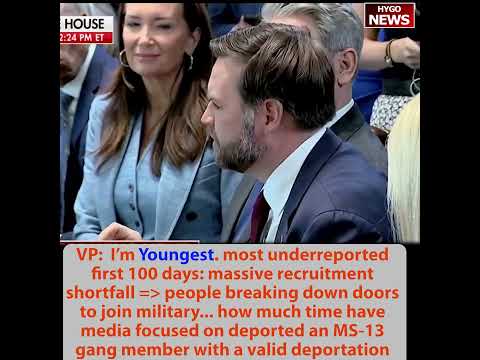
VP Vance: “In My Lifetime We Went from Manufacturing Superpower to Dependent on China — In 100 Days We Reversed It”; Susie Wiles: “Unparalleled”
Vice President JD Vance delivered a generational assessment at the 100-day cabinet meeting in April 2025: “I’m the youngest member at this table. In my lifetime — 40 years — we went from the world’s manufacturing superpower to dependent on China. From the proudest military to one that failed to meet recruiting goals. From bipartisan border consensus to 20 million people running roughshod illegally. In 100 days, we started to reverse every single one of those negative trends.” He challenged the media: “The most underreported fact is that we came in with a massive recruitment shortfall. Now people are breaking down the doors to join. Why does the press focus on a deported MS-13 gang member instead?” White House Chief of Staff Susie Wiles added: “100 days unparalleled in my memory. Promises made have been kept time and time again.”
The 40-Year Decline
Vance framed the administration’s achievements against the arc of his own lifetime.
“At the risk of insulting everybody else at the table, I believe I’m the youngest member sitting at the table,” Vance began.
He traced the decline: “From the time that I was born to the time that Donald J. Trump was inaugurated just a few months ago — 40 years — we went from the world’s manufacturing superpower to one in which we depend on the People’s Republic of China to make the things that we need.”
He continued: “We went from the proudest military in the world to one in which we failed to meet our recruiting goals.”
He completed the triptych: “And we went from one in which bipartisan border policy was the consensus of both Democrats and Republicans to one in which we allowed 20 million people to run roughshod illegally over the countryside, causing crime, causing stress in the welfare system.”
He stated the timeframe: “And again, that happened over the lifetime of the youngest member of the cabinet.”
He delivered the reversal: “And what has happened in 100 days is that we started to reverse every single one of those negative trends.”
Vance’s generational framing was the most powerful argument for the Trump presidency’s significance. Born in 1984, Vance had entered the world during the Reagan-era manufacturing boom. By the time he reached adulthood, those factories had closed. By the time he entered politics, the military couldn’t recruit, the border was open, and the country depended on China for essential goods.
The three pillars of decline Vance identified — manufacturing, military, and border — were not random policy failures. They were interconnected symptoms of a governing class that had prioritized globalism over national interest. Trade agreements sent factories to China. Cultural warfare drove young Americans away from military service. Border laxity was tolerated because it served both cheap-labor business interests and Democratic demographic strategy.
”Most Presidents Have Been Placeholders”
Vance offered a blunt historical assessment.
“You sit in the Oval Office and you see these portraits of presidents past,” Vance said. “And let’s be honest, most of them have been placeholders.”
He elaborated: “They’ve been people who have allowed their staff to sign executive orders with an auto pen instead of men of action.”
He explained the media’s frustration: “And the reason the media attacks this administration as chaotic is because the president is solving the problems the American people set about to solve. He’s actually doing the things that he promised that he would do.”
The “placeholders” characterization was the most provocative line in the speech. Vance was arguing that most modern presidents had not actually governed — they had managed, delegated, and allowed the permanent bureaucracy to run the country while they performed ceremonial functions and gave speeches. Trump was different because he was actually making decisions, directing policy, and holding agencies accountable.
The “auto pen” detail was specific and cutting. Previous presidents had literally delegated their signatures to machines, allowing staff to sign executive orders and official documents without the president’s personal involvement. Trump, by contrast, was personally engaged in every significant decision — a level of executive involvement that the bureaucracy experienced as “chaos” but that voters had elected.
The Recruitment Turnaround
Vance identified the story the media refused to cover.
“The most underreported fact of the first 100 days is that we came in with a massive recruitment shortfall,” Vance said.
He described the reversal: “And in 100 days of Secretary Hegseth and President Trump’s leadership, we now have people breaking down the doors to join our military.”
He challenged reporters directly: “To the media assembled here, it’s a really interesting question. Why does that happen? Why did we go from a military where people didn’t want to serve to now all of a sudden they do want to serve?”
He drew the contrast: “That’s a story you guys should cover. But compared to that, how much time have you instead focused on the fact that we deported an MS-13 gang member with a valid deportation order?”
He delivered the indictment: “Why is it that the press is so focused on the fake BS rather than what’s really going on in the country?”
He concluded: “I think what we’ve shown, sir, is that you can do a lot in 100 days. But you’ve also unfortunately revealed that too much of the American media hasn’t learned the lessons of the past 40 years.”
The recruitment turnaround was indeed underreported. The military recruiting crisis had been one of the most alarming national security trends of the Biden years. Every branch had missed targets. The Army fell tens of thousands short. Analysts warned that the all-volunteer force model might be unsustainable.
Under Trump and Hegseth, the trend had reversed dramatically — with the Navy posting its best numbers since 2002 and other branches showing similar improvements. The turnaround was attributable to the restoration of traditional military culture, the removal of DEI mandates, the vaccine mandate reinstatements, and the presidential support for the armed forces that Trump consistently demonstrated.
Susie Wiles: “Unparalleled”
Chief of Staff Susie Wiles — the quiet force behind the administration’s operational discipline — delivered brief but pointed remarks.
“Congratulations to everyone on 100 days,” Wiles said. “It’s unparalleled in my memory and the best I can tell, ever.”
She clarified: “But it hasn’t been busy for busy’s sake. The president’s promises made to the American people have been kept time and time and time again.”
She addressed the team: “You all have been out there spreading the word with community groups and states and media. It hasn’t gone unnoticed.”
She set the pace: “Let’s work hard to the next 100 and have equally as much success.”
Trump responded: “And you’ve done a great job. I think everybody agrees.”
Wiles’s “not busy for busy’s sake” distinction was important. The administration’s pace — executive orders, tariff announcements, diplomatic meetings, legislative pushes — could appear frantic from the outside. Wiles was saying that every action served a specific purpose connected to a campaign promise. The activity was not performative; it was systematic execution of the agenda voters had endorsed.
Key Takeaways
- Vance: “In my 40-year lifetime, we went from manufacturing superpower to China-dependent, proud military to recruiting failures, bipartisan borders to 20 million illegals. In 100 days, we reversed every trend.”
- He called most past presidents “placeholders who let staff sign with an auto pen.”
- “Most underreported fact: massive recruitment shortfall reversed. People are breaking down the doors to join. Why won’t the media cover that?”
- Susie Wiles: “100 days unparalleled in my memory. Promises made have been kept time and time again.”
- Vance to media: “Why focus on a deported MS-13 gang member with a valid deportation order instead of what’s really happening?”