 HYGO News
 VP: If you enforce your own laws then no National Guard; Nadler Hiding Misbehavior; Mayor Johnson
VP: If you enforce your own laws then no National Guard; Nadler Hiding Misbehavior; Mayor Johnson
Vice President JD Vance’s visit to Los Angeles produced the clearest public articulation yet of the administration’s conditional framework for federal intervention in Democratic-run cities. The formulation was simple: enforce your own laws and protect federal law enforcement, and the National Guard stays home. Allow violent rioters to attack federal agents, and the federal response will arrive. Representative Jerry Nadler’s accusation that ICE agents wear masks to “hide misbehavior” produced a sharp administration response citing a 500% increase in assaults on ICE personnel. Chicago Mayor Brandon Johnson melted down in a public exchange about teen takeover enforcement, saying of the young people involved that “they could be my sons.” And U.S. Ambassador to the United Nations Dorothy Camille Shea delivered the administration’s Security Council message on Iran: the country has all it needs for a weapon; what remains is a decision by the Supreme Leader.
”A Very Simple Proposal”
Vance’s opening was calibrated for maximum clarity. “The president has a very simple proposal to everybody in every city, every community, every town, whether big or small. If you enforce your own laws and if you protect federal law enforcement, we’re not going to send in the National Guard because it’s unnecessary.”
The framing establishes the conditional structure. Federal intervention is not the default. It is the response to a specific failure — local authorities failing to enforce their own laws and failing to protect federal personnel operating within their jurisdictions.
”But If You Let Violent Rioters”
The counterfactual was equally direct. “But if you let violent rioters burn great American cities to the ground, then of course we’re going to send federal law enforcement in to protect the people the president was elected to protect.”
The logical structure is the two-sided conditional. Scenario A: local law is enforced, federal personnel are protected, no federal intervention. Scenario B: local law is not enforced, federal personnel are attacked, federal intervention arrives.
Local officials who want to avoid federal intervention have a clear path. They need to enforce the law and protect the agents operating in their jurisdictions. Local officials who prefer a confrontation with the federal government also have a clear path — the one they have been pursuing.
”The People The President Was Elected To Protect”
The phrasing of “the people the president was elected to protect” is worth pause. Presidents are elected to protect all Americans, not just some subset. Vance’s formulation, in context, refers specifically to the Americans who are being attacked by the rioters — federal agents, local residents of affected neighborhoods, business owners whose property is being destroyed.
The implicit argument is that local officials who tolerate the attacks are failing in their duty to protect their own residents, and that when local officials fail, federal officials fill the gap. Federal action is not a usurpation of local authority. It is the exercise of federal responsibility when local authority has abdicated.
”Disgraceful”
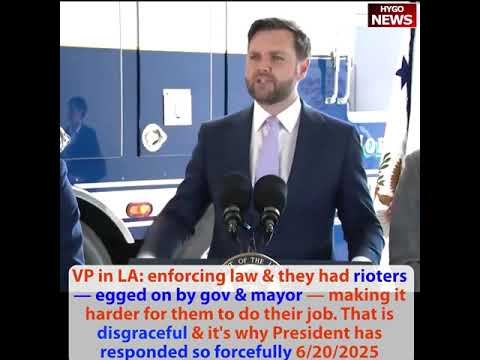
Vance’s judgment of the Los Angeles events was direct. “You had people who were doing the simple job of enforcing the law and they had rioters egged on by the governor and the mayor making it harder for them to do their job. That is disgraceful. And it is why the president has responded so forcefully what happened in Los Angeles.”
“Egged on by the governor and the mayor” is the charge that most directly implicates Newsom and Mayor Bass. The administration is not merely saying that the governor and mayor failed to contain the violence. It is saying that their rhetoric — their statements about the raids, their characterizations of ICE, their framings of the enforcement operation — encouraged the violence.
Whether that charge is fair depends on how one reads the various statements Newsom and Bass made in the relevant period. The administration’s framing is that those statements crossed a line from policy disagreement into incitement. Local officials who call federal enforcement “unconstitutional,” “human rights violations,” or equivalent charges contribute to a climate in which physical interference with federal operations becomes more thinkable.
The Two-Part Justification
Vance laid out the two-part justification for the federal response. “Number one, because we’ve got to enforce our borders and get so many of these criminals out of our country to begin with. And number two, when you have violent agitators who make it impossible for the law enforcement to do their job, it is necessary to protect them and to defend them.”
Part one: the underlying mission is legitimate. Federal immigration law must be enforced. Removing criminal undocumented individuals from the country is the work that ICE is conducting.
Part two: the mechanics of that work must be protected. Law enforcement cannot do its job when violent agitators make it impossible. When that happens, protective federal action is required.
Both parts have to be true for the current federal posture to be justified. Vance is asserting that both parts are true. Democrats dispute part one (arguing the enforcement operation is too aggressive). They cannot credibly dispute part two (given the footage of attacks on agents).
”Captured And Beaten By Violent Mobs”
Vance’s account of the escalation was specific. “We have to remember that the Friday that the riots started before there was ever a single National Guardsman before the president of the United States had sent in additional federal resources. You had law enforcement officers who were being captured and beaten by violent mobs, egged on by Gavin Newsom and other officials.”
The chronology matters. The National Guard deployment came after, not before, the violence against federal officers began. The administration’s framing is that the deployment was a response to escalating violence, not a provocation of violence.
“Captured and beaten” is specific language. It describes a level of violence that extends beyond disorderly conduct or property damage. Agents who are captured and beaten are at risk of serious injury or death. The federal response to that level of violence, Vance is arguing, was not only appropriate but necessary.
”The People’s President To Enforce The People’s Immigration Law”
Vance closed the section with a rhetorical framing. “It was necessary to send the National Guard to stop that process to bring some order back to this great city and to make it possible for the people’s president to enforce the people’s immigration law.”
“The people’s president” and “the people’s immigration law” are the same rhetorical move twice. Trump is characterized as the president chosen by the people. Immigration law is characterized as the law the people’s representatives enacted. The implicit argument is that opposition to Trump’s enforcement is opposition to the democratic will — both in terms of the elected president and in terms of the enacted statute.
Nadler’s Accusation
The video then addressed the controversy around ICE agents wearing masks. Representative Jerry Nadler had accused ICE agents of using masks to “hide misbehavior.” The implication: agents who do not want to be identified must be doing something that should not be identified.
The video captures the Nadler critique: “But these people are wearing masks and are totally unidentified. And the question is why? The question is why? It’s completely improper. And again, one has to assume they’re hiding something or they’re hiding misbehavior because otherwise why would they be wearing masks and denying their identities?”
The Administration’s Counter
The administration’s response was pointed. “Congressman Nadler’s accusation that our ICE officers are ‘hiding misbehavior’ is DESPICABLE. ICE officers are now facing a 500% increase in assaults due to this rhetoric. When the brave men and women of ICE conduct operations, they clearly identify themselves as law enforcement officers while wearing masks to protect themselves from being targeted by violent criminals.”
The counter-argument has two components. First, the “masks hide misbehavior” framing is wrong on the facts. ICE agents identify themselves as law enforcement during operations; the masks cover faces, not badges or identification. Second, the rhetoric is dangerous — the 500% increase in assaults on ICE personnel is not an abstract statistic but the material consequence of officials at Nadler’s level characterizing ICE as a bad actor.
Why The 500% Figure Matters
A 500% increase in assaults on ICE personnel is a staggering number. It is not the ordinary fluctuation in operational risk. It is a phase-shift in the threat environment. If the baseline is any meaningful number at all — say, 100 assaults per year — a 500% increase pushes the annual total to 600. For federal agents doing a difficult job, that increase is a direct material cost of the rhetoric being deployed against them.
The administration is effectively arguing that members of Congress who deploy that rhetoric bear some responsibility for the increase. Whether that charge is fair depends on one’s view of the relationship between political speech and political violence. The statistical reality is that the assault increase is concurrent with the rhetorical escalation.
Mayor Johnson’s Meltdown
The video then pivoted to Chicago Mayor Brandon Johnson’s exchange about teen takeover enforcement. “Every fricking day, I’m raising children in this city. I know what it’s like to feel unsafe and to be targeted. We have to stop as a city falling to some of the most ridiculous remedial forms of governance. It has not worked.”
The framing is emotionally charged. Johnson is presenting himself as a parent whose policy positions are shaped by the experience of raising children in Chicago. That framing is sympathetic in principle, but the policy substance is the question.
”They All Could Be My Son”
Johnson continued. “And now we’re doing stuff that works and then they want to come up with another idea that has not worked. What sense does that make? I’m saying ask deeper, more profound questions about why young people are gathering in spaces in the first place. That’s why I was up to fricking midnight on Saturday night out, you know, hanging out with some of the young people at the late night basketball showing up for these young brothers. They all could be my son. They can all be my nephews.”
The “they could be my son” framing is the part that traveled. Johnson is urging that teen takeover participants — who, in Chicago, have been associated with property destruction, theft, and public safety disruption — be viewed primarily through the lens of his potential paternal relationship to them rather than through the lens of their conduct.
The framing is not wrong in every respect. Young people engaged in antisocial conduct are still young people. They could benefit from intervention. But the framing elides the victims — residents whose cars were stolen, businesses whose windows were smashed, pedestrians who felt unsafe. If “they could be my son” is extended to the perpetrators, why not to the victims?
Ambassador Shea At The UN
The video closed with U.S. Ambassador to the United Nations Dorothy Camille Shea delivering the administration’s message to the Security Council. “Iran’s leaders could have avoided this conflict had they agreed to a deal that would have prevented them from ever obtaining a nuclear weapon. But they refuse to do so, choosing instead to delay and deny. We can no longer ignore that Iran has all that it needs to achieve a nuclear weapon. All it needs is a decision from their supreme leader. That is unacceptable and this council must urge them to change course.”
The statement repeats the administration’s core message — Iran has the capability and needs only a decision from the Supreme Leader. Delivered at the UN, the message is also aimed at the international community. The Security Council includes Russia and China, both of whom have supported Iran at various points. Shea’s message is addressed to them as much as to Iran.
”This Council Must Urge Them To Change Course”
The call for the Security Council to act is the diplomatic formal request. It is also the political move that positions the United States as the actor calling for collective action while Iran is positioned as the actor refusing to engage. If the Security Council acts, good. If it does not, the United States has made the case that it attempted multilateral solutions before considering unilateral ones.
Key Takeaways
- Vance’s conditional: “If you enforce your own laws and if you protect federal law enforcement, we’re not going to send in the National Guard because it’s unnecessary.”
- Vance on California: rioters were “egged on by the governor and the mayor” while officers “were being captured and beaten by violent mobs.”
- Nadler accuses ICE of “hiding misbehavior” via masks; administration: “ICE officers are now facing a 500% increase in assaults due to this rhetoric.”
- Mayor Johnson on Chicago teen enforcement: “They all could be my son. They can all be my nephews” — the framing that prioritizes perpetrators over victims.
- Ambassador Shea at UN: “Iran has all that it needs to achieve a nuclear weapon. All it needs is a decision from their supreme leader. That is unacceptable and this council must urge them to change course.”