 HYGO News
 VP Harris' great Biden partner 'successes' include 'lowering costs' &'fighting inflation'
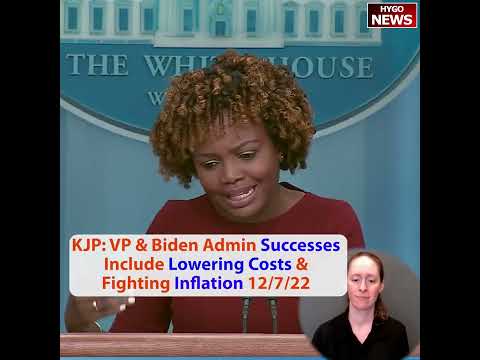
KJP on Harris’s Schedule After 51-49 Senate: “I Don’t Believe” Portfolio Will Change — Calls VP “Great Partner” Citing Economic “Successes”
On 12/8/2022, following the December 6 Georgia runoff that gave Democrats an outright 51-49 Senate majority, a reporter asked White House Press Secretary Karine Jean-Pierre whether Vice President Kamala Harris’s schedule and portfolio would change now that she wouldn’t have to break Senate tie votes as often. “New margin in the Senate now that the vice president won’t have to break the tie as often in theory and she has more flexibility in her schedule and time will that impact her portfolio travel schedule at all?” the reporter asked. KJP said she didn’t believe so but referred the reporter to Harris’s team for specifics. She then pivoted to a broad defense of Harris as “a great partner of the president this past two years” and referenced unspecified “successes” the Biden-Harris administration had achieved “for the American people when it comes to the economy.”
The New Senate Math
The reporter’s question reflected an immediate political reality. The December 6 Georgia runoff had produced a Warnock victory, giving Democrats a 51-49 Senate majority in the upcoming 118th Congress — an outright majority rather than the 50-50 tie they had held in the 117th.
The difference mattered for Kamala Harris specifically. As Vice President, Harris served as Senate President with the constitutional power to break tie votes. In the 117th Congress, this power had been frequently exercised — Harris had cast record numbers of tie-breaking votes, often on party-line legislation that required every Democratic vote.
The 51-49 majority would change this dynamic:
Fewer tie-breaking votes needed — Democrats could afford some defections.
Less Senate presence required — Harris wouldn’t need to be available for every party-line vote.
More scheduling flexibility — She could travel and work on portfolio issues without concern for tie votes.
Reduced procedural burden — The Senate could function without Harris’s constant availability.
The reporter was exploring what this new flexibility might mean for Harris’s role. Would she travel more? Take on different priorities? Expand her portfolio? Change her public presence?
The Harris Portfolio
Vice President Harris’s portfolio during 2021-2022 had included several high-profile but challenging assignments:
Root causes of migration — Addressing conditions in Central America that drove migration to the U.S. border.
Voting rights — Leading the administration’s push for federal voting rights legislation.
Maternal health — Focusing on specific women’s health priorities.
Broadband expansion — Leading efforts to expand internet access.
Relationship with key Democratic constituencies — Including Black voters and women.
These assignments had produced mixed results. The root causes work had not significantly reduced border flows. The voting rights legislation had failed in the Senate. The maternal health initiatives had been incremental rather than transformative. The broadband work had produced modest progress.
Harris’s political positioning had been difficult throughout this period. Her approval ratings had generally been lower than Biden’s own struggling numbers. Media coverage had often been critical. Staff turnover had been high. She had struggled to establish herself as a clear successor if Biden chose not to run in 2024.
”I Don’t Believe So”
KJP’s answer was minimal. “I mean I don’t believe so no I would reach out to her team specifically but I don’t believe so,” KJP said.
The response was notable for several features:
“I don’t believe so” — Suggested personal opinion rather than definite information.
“Reach out to her team specifically” — Deferred specifics to Harris’s separate press operation.
Uncertainty — KJP didn’t know what Harris’s upcoming schedule would look like.
No substantive portfolio information — KJP didn’t describe any specific Harris priorities.
The deferral to Harris’s team was particularly notable. Within the Biden-Harris administration, the VP’s operation was supposed to coordinate with the White House press operation. The need to refer questions to Harris’s team separately suggested that KJP didn’t have ready information about Harris’s schedule or priorities.
This pattern had been observed previously. The Biden-Harris relationship had often appeared less coordinated than previous Presidential-VP teams. KJP’s inability to speak confidently about Harris’s upcoming work was consistent with this pattern.
The Pivot to Partnership Praise
KJP shifted to defending Harris’s role. “I mean the president let me just say the vice president has been a great partner of the president this past two years,” KJP said.
The pivot was defensive in nature. The reporter hadn’t suggested Harris was a poor partner — the question had been about schedule flexibility. But KJP’s response implicitly treated the question as potentially critical of Harris’s role and offered preemptive defense.
The “great partner” framing was the standard administration description of the Biden-Harris relationship. Despite various media reports about tension within the administration, staff turnover in the VP’s office, and Harris’s struggles to find a clear role, the public line was always that the two worked well together.
The repetition of “great partner” across many briefings served a political purpose. It countered narratives of dysfunction within the administration. It reaffirmed Harris’s standing as a potential 2024 successor if Biden didn’t run. It kept visible unity even when private dynamics might have been more complicated.
”Successes” Framing
KJP referenced unspecified accomplishments. “You know the successes that they both have had in the clearly Biden Harris administration on getting things done for the American people when it comes to the economy,” KJP said.
The “successes” framing was deliberately vague. KJP didn’t specify which economic accomplishments she meant. This vagueness had political purposes:
Avoided contentious specifics — Specific claims could be challenged.
Allowed listeners to fill in — Different audiences could assume different achievements.
Maintained flexibility — Claims could be narrowed or broadened later.
Avoided factual disputes — General claims were harder to fact-check than specific ones.
The reference to economic successes in December 2022 was politically delicate. Inflation had been a major problem throughout 2022, with annual rates peaking above 9% in June. By December, inflation had moderated somewhat but remained elevated. Consumer sentiment was weak. The economic picture was mixed at best, with genuine successes balanced against persistent problems.
The administration’s “successes” language paralleled their broader political communications strategy:
Emphasize passed legislation — Infrastructure, CHIPS, Inflation Reduction Act Highlight employment gains — Low unemployment rates and job creation Downplay inflation concerns — Characterizing as temporary or moderating Reference longer-term investments — Without short-term visible results
Whether these framings were “successes” depended on perspective. Legislation had been passed. Jobs had been created. But inflation remained high. Americans were experiencing financial stress. The administration’s story about economic success was not one most Americans would have told about their own economic experience.
The Harris 2024 Question
The broader context of the exchange involved Harris’s 2024 positioning. If Biden chose not to run for re-election, Harris would be the presumptive Democratic nominee. If Biden ran and won, Harris would be the most likely 2028 successor. In either scenario, Harris’s political positioning in 2022-2024 would shape her future prospects.
Harris’s position was challenging. Her polling was weak. Media coverage was often negative. Staff issues had raised questions about her management. But she remained the sitting Vice President, which gave her institutional advantages that competitors couldn’t match.
The administration’s public support for Harris — as expressed in KJP’s “great partner” language — was partly strategic. Undermining Harris publicly would damage the administration’s image. Supporting her publicly maintained political viability that preserved Biden’s own 2024 options.
The “great partner” framing was therefore both substantive (reflecting an actual working relationship) and strategic (maintaining political positioning that served the administration’s broader interests).
The Incomplete Answer
The exchange ended with KJP’s sentence trailing off after “when it comes to the economy.” The transcript cuts off at this point, suggesting either the clip ended or the complete briefing included more content that wasn’t captured.
The incompleteness was characteristic of KJP’s briefing style. She often trailed off into vague phrasing rather than completing crisp conclusions. The “when it comes to the economy” opening promised economic specifics that weren’t delivered. Instead, the generic reference to success served as placeholder content.
This pattern frustrated reporters seeking substantive administration positions. Briefings became exercises in extracting specifics from generalities, clarifying vagueness, and pressing for concrete answers. The efficiency of information transfer was low.
Key Takeaways
- Following the December 6 Georgia runoff giving Democrats 51-49 Senate control, a reporter asked whether VP Harris’s schedule or portfolio would change now that she wouldn’t need to break as many ties.
- KJP said “I don’t believe so” and referred detailed questions to Harris’s team.
- She pivoted to calling Harris “a great partner of the president this past two years” — standard administration framing that countered reports of internal tensions.
- KJP referenced vague “successes” of the “Biden Harris administration” in the economy, without specifying particular accomplishments.
- The new Senate math gave Harris more scheduling flexibility but the administration provided no specifics about how she would use it.
Transcript Highlights
The following is transcribed from the video audio (unverified — AI-generated from audio).
- New margin in the Senate now that the vice president won’t have to break the tie as often in theory.
- She has more flexibility in her schedule and time will that impact her portfolio travel schedule at all?
- I don’t believe so no I would reach out to her team specifically but I don’t believe so.
- The vice president has been a great partner of the president this past two years.
- You know the successes that they both have had in the clearly Biden Harris administration.
- On getting things done for the American people when it comes to the economy.
Full transcript: 109 words transcribed via Whisper AI.