 HYGO News
 Vance: Green Card 'Not About Free Speech'; Leavitt: 15 Injunctions in One Month 'Absurd'; Bessent: 'Fake News Isn't Strong Enough'
Vance: Green Card “Not About Free Speech”; Leavitt: 15 Injunctions in One Month “Absurd”; Bessent: “Fake News Isn’t Strong Enough”
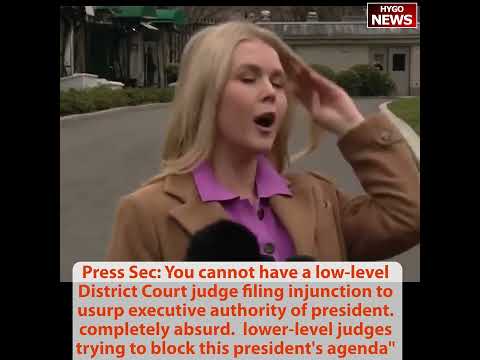
A March 2025 compilation featured three senior officials addressing distinct challenges. VP Vance argued that deporting green card holders was “not fundamentally about free speech” but about “who we, as an American public, decide gets to join our national community.” Press Secretary Leavitt revealed that the administration had faced 15 judicial injunctions in one month compared to 14 total injunctions against Biden in three years, calling it “completely absurd” for “low-level district court judges” to “usurp the executive authority of the president.” Treasury Secretary Bessent offered a convert’s confession: “When I was on the other side of the wall, I never really liked the term ‘Fake News.’ Now that I am on the inside, I think the term probably isn’t strong enough.”
Vance: Immigration Is About National Community
Vance addressed the legal and philosophical framework for deporting non-citizens who engaged in activities the government deemed contrary to American interests.
“A green card holder, even if I might like that green card holder, doesn’t have an indefinite right to be in the United States of America, right?” Vance said. “American citizens have different rights from people who have green cards, from people who have student visas.”
He rejected the free speech framing: “My attitude on this is, this is not fundamentally about free speech.”
Vance then articulated the principle he viewed as paramount. “To me, yes, it’s about national security, but it’s also more importantly about who do we, as an American public, decide gets to join our national community,” he said.
He stated the legal reality: “If the Secretary of State and the President decide this person shouldn’t be in America and they have no legal right to stay here, it’s as simple as that.”
When asked about future deportations, Vance confirmed: “I think we’ll certainly see some people who get deported on student visas if we determine that it’s not in the best interest of the United States to have them in our country. I don’t know how high that number is going to be, but you’re going to see more people.”
The “national community” framing was the most philosophically substantive argument the administration had offered on immigration enforcement. Rather than treating immigration purely as a legal or economic question, Vance was arguing that a nation had the right to curate its membership — to decide who was welcome and who was not based on whether their presence served the national interest and was compatible with the national community’s values.
Leavitt: “15 Injunctions in One Month”
Leavitt provided the statistic that quantified the judicial resistance the administration was facing.
“In one month — in February — there have been 15 injunctions of this administration and our agenda,” Leavitt said. “In three years under the Biden administration, there were 14 injunctions.”
The comparison was staggering: more injunctions in a single month of Trump than in three full years of Biden. The disparity suggested not that Trump was breaking more laws than Biden but that the judicial system was being deployed asymmetrically against the Republican administration.
Leavitt described the administration’s response: “Fighting back by appealing, fighting back by using the full weight of the White House Counsel’s Office and our lawyers at the federal government who believe that this injunction is entirely unconstitutional.”
She stated the constitutional argument: “You cannot have a low-level district court judge filing an injunction to usurp the executive authority of the President of the United States. That is completely absurd.”
Leavitt connected the pattern to the broader lawfare narrative. “It’s very clear that there are judicial activists throughout our judicial branch who are trying to block this president’s executive authority,” she said. “We are going to fight back.”
She cited Trump’s personal experience as evidence of resilience: “Anyone who saw President Trump and his legal team fighting back — they know how to do it. He was indicted nearly 200 times, and he’s in the Oval Office now because all of the indictments, all of these injunctions have always been unconstitutional and unfair.”
The 15-to-14 comparison became one of the most effective arguments for judicial reform. If one month of a Republican president generated more judicial resistance than three years of a Democratic one, the system was not functioning as a neutral arbiter — it was functioning as a partisan weapon.
Bessent: “Fake News Probably Isn’t Strong Enough”
Treasury Secretary Scott Bessent provided what may have been the most candid assessment of media accuracy from any senior financial official.
“When I was on the other side of the wall, I never really liked the term ‘Fake News,’” Bessent said. “Now that I am on the inside, and I can see what they’re reporting, I think the term Fake News probably isn’t strong enough.”
He described the methodology he had observed: “They start with an a priori — they’ve written the story, and then they just kind of shape, shift facts to back into it. Because many of the stories that I’ve been involved with are just so far off. So far off.”
Bessent cited a specific example: “There was a story in the New York Times the other day that talked about 50% headcount decreases at the IRS. Nobody’s talking about that. These were on background, these were not named sources, and they’re just trying to stir up — to cause trouble during taxpayer filing season. I mean, it’s crazy.”
The observation carried particular weight coming from Bessent. As a former hedge fund manager who had spent decades on Wall Street analyzing information and assessing credibility, his professional judgment about media accuracy was informed by a career in which being wrong about facts had financial consequences. His assessment that “Fake News probably isn’t strong enough” was not a political talking point but a professional evaluation from someone whose livelihood had depended on distinguishing reliable information from unreliable.
Key Takeaways
- Vance said green card deportations were “not about free speech” but about “who we, as an American public, decide gets to join our national community.”
- Leavitt revealed 15 judicial injunctions against the Trump administration in one month, compared to 14 against Biden in three years, calling it “completely absurd.”
- She said the administration would fight back through appeals and the White House Counsel’s Office, calling the injunctions “entirely unconstitutional.”
- Treasury Secretary Bessent said “when I was on the other side, I never liked the term Fake News. Now on the inside, I think it probably isn’t strong enough.”
- Bessent cited a New York Times story about IRS headcount cuts as fabricated: “Not named sources, just trying to cause trouble during filing season.”