 HYGO News
 VP Vance: 'We Were Actually Governed by Complete Morons'; On Jan 21 Asked Where Biggest Supply Chain Deficiencies Were: 'Answer Was We Don't Know'; Bessent on Rand Paul: 'Could Cause a Sudden Stop in the Economy -- I'm a Deficit Hawk But Also a Realist'; Schumer's 'Laughable Lie-Filled Rant' on Energy
VP Vance: “We Were Actually Governed by Complete Morons”; On Jan 21 Asked Where Biggest Supply Chain Deficiencies Were: “Answer Was We Don’t Know”; Bessent on Rand Paul: “Could Cause a Sudden Stop in the Economy — I’m a Deficit Hawk But Also a Realist”; Schumer’s “Laughable Lie-Filled Rant” on Energy
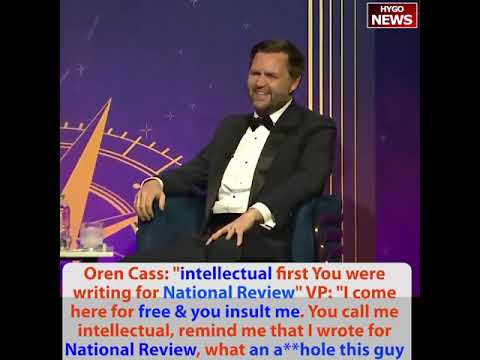
In a Compact Magazine interview, Vice President JD Vance and Oren Cass exchanged memorable commentary in early June 2025. Cass described Vance as “someone who was an intellectual first… You were writing for National Review.” Vance’s response was classic: “I come here for free and you insult me. You call me an intellectual, remind me that I wrote for National Review — what an a**hole this guy is!” (Cass: “That’s fair. I will admit that I too wrote for National Review.”) More substantively, Vance described Biden administration failures: “If I on January 21st in fact asked this question: where are the biggest deficiencies in our supply chains? What are the 100 products completely reliant on some other entity? I asked that explicit question and the answer was, ‘we don’t know.’ Nobody in the prior government had actually asked these very fundamental questions.” His conclusion: “We were actually governed by complete morons and we didn’t even realize it until the Trump administration started to get underneath the hood of our government.” Treasury Secretary Scott Bessent pushed back against Rand Paul’s fiscal demands: “What Senator Paul is advocating for could cause a sudden stop in the economy. I’m a deficit hawk, but I’m also a realist.” He explained: “Every $300 billion is 1% of GDP… we want to cut and constrain spending AND we want to grow the economy.”
The Cass-Vance Exchange
Oren Cass began with intellectual praise.
“There are politicians out there who are, they’ve just been politicians, but you are someone who was an intellectual first,” Cass said.
He qualified the characterization: “Some people don’t like the word intellectual, but I mean it in the good sense of the term.”
He specified the background: “You were writing for National Review. You were at the bar late at night arguing about and helping shape these ideas that you are now…”
Vance’s Signature Response
Vance interrupted with humor that became instantly viral.
“I come here for free and you insult me,” Vance said.
He specified the offensive framings: “And you call me an intellectual. Remind me that I wrote for National Review.”
He delivered the punchline: “What an asshole this guy is.”
Cass’s response acknowledged the barb: “That’s fair. I will admit that I too wrote for National Review.”
The Intellectual Label
Vance’s “insult” framing was politically sophisticated:
Why “intellectual” could be an insult in MAGA world:
-
“Intellectual” had become associated with:
- Elite academic credentials
- Disconnection from working-class concerns
- Pretense of superior knowledge
- Policy failures justified by expertise
- Paternalistic approach to voters
-
MAGA had developed skepticism of intellectuals because:
- Establishment experts had consistently failed
- “Experts” had pushed disastrous policies
- Intellectual credentials no longer guaranteed competence
- Working-class Americans had been hurt by expert guidance
- Credentialism had become distinct from capability
National Review context:
- National Review was conservative intellectual flagship
- But had become associated with “establishment” conservatism
- Had been critical of Trump during 2016 primaries
- Had gradually become more Trump-friendly
- Still represented intellectual rather than populist right
Vance’s specific positioning:
- Had written for National Review earlier in his career
- Had evolved toward more populist positions
- Had become Trump’s VP after initial Trump skepticism
- Represented conservative evolution from elite to populist
- Could acknowledge intellectual background while emphasizing populist approach
The joke worked because:
- It acknowledged Vance’s actual intellectual history
- It celebrated his evolution beyond that background
- It demonstrated self-awareness about conservative movements
- It created insider humor about conservative debates
- It humanized Vance while making a political point
”We Don’t Know”
Vance then made substantive policy criticism.
“One thing that is shocking about the prior government, about the government we inherited the White House from, is if I, on January the 21st, in fact I did ask this question,” Vance said.
He specified the question: “Where are the biggest deficiencies in our supply chains? What are the 100 products that are, were completely reliant on some other entity to make for us? Where are they made and how hard would it be to onshore that manufacturing?”
He described the response: “I asked that explicit question and the answer was, we don’t know. Nobody in the prior government had actually asked these very fundamental questions.”
The Supply Chain Ignorance
Vance’s example was devastating in its specificity.
January 21, 2025 was one day after inauguration. The Trump administration was just taking office. Vance asked a fundamental question about American industrial vulnerabilities.
What the administration wanted to know:
- Which products were critical for American economic security
- Which of these had supply chains vulnerable to disruption
- How concentrated were those supply chains in adversary nations
- What would it take to restore American manufacturing capability
- Which disruptions could cause immediate economic crisis
The Biden administration should have known:
- COVID had revealed supply chain vulnerabilities
- China tension had increased concerns
- Various government studies had been commissioned
- National security concerns had been documented
- Policy responses had been debated
What Biden officials actually provided:
- “We don’t know.”
This was not a minor knowledge gap. It was:
- A fundamental failure of governance
- Evidence of complete strategic neglect
- Indicator of deep bureaucratic dysfunction
- Warning of American vulnerability
- Confirmation of administration incompetence
Four years of the Biden administration had produced no systematic understanding of American supply chain vulnerabilities. The information that Trump’s administration could then begin to gather was information that should have been continuously maintained by professional government throughout Biden’s term.
”Complete Morons”
Vance delivered his judgment.
“And so what is so crazy about the hyper-globalized era is that you had these basic questions about the brittleness of our supply chains that were completely uninvestigated by the very people who supported globalizing those supply chains,” Vance said.
He delivered the conclusion: “We were actually governed by complete morons and we didn’t even realize it until the Trump administration started to get underneath the hood of our government.”
The Moron Framework
Vance’s “complete morons” was pointed but analytically defensible.
What “morons” meant in context:
- Not intellectual disability
- Not stupidity in the pejorative sense
- Rather: fundamental failure to understand reality
- Advocating policies without understanding consequences
- Promoting globalization while ignoring its risks
- Responsible for decisions without analytical foundation
The specific moron framework:
- Officials who globalized supply chains without understanding dependencies
- Experts who promoted free trade without analyzing strategic consequences
- Policymakers who assumed markets would solve problems they created
- Bureaucrats who maintained systems they didn’t understand
- Leaders who exercised authority without substantive knowledge
Why this characterization was fair:
- The specific failures were documented
- The consequences were severe (COVID supply crises, drug shortages, etc.)
- The officials responsible had not been held accountable
- The same officials continued to influence Democratic policy
- The failures reflected systematic rather than individual problems
Vance’s “didn’t even realize it” framing captured the institutional reality. Americans had been governed by people who didn’t understand their responsibilities, and who had not recognized their own incompetence. The Trump administration’s discovery was itself the first step toward accountability.
Schumer on Energy
The broadcast included Senator Chuck Schumer’s attack on OBBB’s energy provisions.
“Look at the facts. The Republican plan will increase average national electricity prices by about 10%,” Schumer said.
He cited specific costs: “The Republican plan will increase total household energy costs by $32 billion.”
He framed the impact: “That means American families will pay $32 billion more all to please the ideological blindness of the fossil fuel industry.”
He raised employment concerns: “And that’s not to mention that the Republican plan would cost America about 800,000 jobs by 2030, all across America in red states and blue states.”
He delivered the moral framing: “What a terrible price to pay just to lower taxes for the ultra-rich, just to line the pockets of the fossil fuel industry to satisfy the ideological hatred that fossil fuel industry has for clean energy and to lose out on American energy dominance.”
The Schumer Problems
Schumer’s framing had multiple issues:
“Increase electricity prices 10%”:
- This was projection based on assumptions contrary to actual experience
- The Trump administration’s energy policies were designed to decrease prices
- Eliminating subsidies for expensive renewable energy could initially create adjustments
- But expanding fossil fuel production would reduce overall energy costs
- The 10% increase projection assumed no supply response
“$32 billion additional costs”:
- Calculated on the 10% increase assumption
- Ignored the $32 billion in increased production
- Ignored the jobs created in fossil fuel sector
- Ignored the reduced international energy dependence
- Ignored the reduced electricity bills from cheaper natural gas
“800,000 jobs lost by 2030”:
- Projection assumed clean energy industry collapse
- Ignored jobs created in fossil fuel sector
- Ignored overall economic growth effects
- Used scoring methodology favoring renewable subsidies
- Ignored the reality that American jobs had been created, not destroyed
“Fossil fuel industry hates clean energy”:
- Many oil and gas companies actively invested in clean energy
- Natural gas replaced coal (cleaner)
- Energy mix had been diversifying even without mandates
- The “hate” framing was politically convenient but factually unsupported
“Energy dominance” framing:
- Actually OBBB was about energy abundance AND dominance
- Clean energy subsidies had been creating energy dependence
- American energy security had been undermined by unreliable renewables
- Reducing reliance on Chinese solar panels supported American dominance
- Natural gas expansion created American dominance
Bessent on Rand Paul
Treasury Secretary Bessent addressed the Rand Paul fiscal hawk position.
“I’m a fiscal hawk, but I am also a realist,” Bessent said.
He explained the framework: “The way to think about this is every $300 billion is 1% of GDP.”
He referenced his earlier point: “As the clip that you just showed where I said we didn’t get here in a year, we’re not going to get out of it in a year.”
He stated the dual objective: “That we have to bring this down gradually because we want to do two things. We want to cut and constrain spending and we want to grow the economy.”
He identified the Paul problem: “What Senator Paul is asking for or advocating for, I think could cause a sudden stop in the economy.”
The “Sudden Stop” Concern
Bessent’s “sudden stop” framing captured a genuine economic concern.
What Paul was advocating:
- Larger immediate spending cuts
- Smaller debt ceiling increase
- More aggressive fiscal contraction
- Short-term fiscal pain for long-term sustainability
What “sudden stop” meant economically:
- Rapid fiscal contraction
- Abrupt reduction in government spending
- Immediate effects on specific sectors
- Potential recession triggers
- Market disruption
Why it was concerning:
- Federal government is approximately 25% of economy
- Large fiscal contraction could spiral
- Multiplier effects amplify fiscal changes
- Private sector adjustments take time
- Market expectations matter
The alternative gradual approach:
- Cut spending while growing economy
- Reduce fiscal drag through growth
- Allow adjustments without crisis
- Use pro-growth policy to offset contraction effects
- Produce sustainable long-term trajectory
Bessent’s “I’m a deficit hawk, but I’m also a realist” captured this balance. Strong fiscal principles combined with practical economic sense. Pure principle without practical implementation could produce worse outcomes than pragmatic compromise.
The GDP Context
Bessent explained Paul’s proposals in GDP terms.
“Every $300 billion is 1% of GDP,” Bessent said.
He extended: “A trillion would be 3% of GDP.”
This was important context:
- $300 billion = 1% of $30 trillion GDP
- $1 trillion cuts = 3% of GDP
- $2 trillion cuts = 6% of GDP (what Paul implicitly wanted)
- Historical GDP contractions of 3-6% in short timeframes typically caused recessions
- Rapid fiscal contraction could trigger economic crisis
Historical comparison:
- Great Recession saw 4.3% GDP contraction (2008-2009)
- COVID saw 9.1% GDP contraction (briefly in 2020)
- Typical recession: 1-3% GDP contraction
- Sudden fiscal contraction of 3-6% could replicate recession
Policy implication:
- Rapid spending cuts would contract GDP
- Contracted GDP would reduce revenue
- Lower revenue would partially offset spending cuts
- Net fiscal improvement would be smaller
- But economic disruption would be substantial
Bessent was making the case that:
- Long-term fiscal sustainability required growing out of debt
- Growth required maintaining economic activity
- Rapid contraction would undermine growth
- Therefore gradual adjustment was optimal
- Rand Paul’s approach could backfire
”Debt to GDP”
Bessent articulated the key metric.
“What’s important here is our debt to GDP,” Bessent said.
He explained the logic: “If we don’t grow, then we won’t grow the tax base and we’re not going to grow revenues, we’re not going to grow the economy. We inherited a mess and we have to constrain spending, cut spending, and then grow our way out of this.”
The Debt-to-GDP Framework
Debt-to-GDP was the critical metric because:
Absolute debt matters less than ratio:
- $30 trillion debt is manageable for $30 trillion economy
- $30 trillion debt would be crushing for $15 trillion economy
- Growth reduces the ratio without reducing absolute debt
- Sustainability depends on ratio, not absolute number
Growth strategies:
- Grow GDP faster than debt grows
- Tax cuts stimulate growth
- Regulatory relief enables expansion
- Energy abundance supports activity
- Trade policy benefits American sectors
Austerity alternative:
- Cut spending enough to reduce debt
- Accept economic contraction
- Rely on long-term discipline
- Historically less successful than growth approaches
- Tends to reduce political sustainability of reforms
The compromise approach:
- Cut specific spending (fraud, waste, ideological programs)
- Grow economy through pro-growth policy
- Reduce debt-to-GDP through both effects
- Build long-term fiscal sustainability
- Maintain political support for continued reform
Bessent’s framework represented the practical synthesis that could actually work in real political and economic conditions.
The Schumer Pushback
Compare Schumer’s position to the administration’s:
Schumer’s core claim: OBBB would increase energy costs, cost jobs, and harm Americans.
Actual OBBB provisions:
- “Resumes coal leasing on federal lands” - Increases energy production
- “Reverses Biden’s EV mandates” - Removes subsidies to preferred technologies
- “Rescinds billions of taxpayer dollars from the Green New Scam” - Eliminates wasteful spending
- “Expedites the LNG export process” - Creates export revenue
These provisions would actually:
- Increase American energy production
- Reduce consumer energy costs
- Create fossil fuel sector jobs
- Generate export revenue
- Reduce federal spending
- Maintain affordable electricity
Schumer’s framing that American families would pay more was contradicted by the actual provisions, which would reduce energy costs through:
- Increased supply
- Reduced subsidies propping up expensive alternatives
- Enhanced American energy independence
- More competitive market dynamics
Key Takeaways
- Vance on Cass’s intellectual compliment: “What an a**hole this guy is!” (humorous banter among conservatives).
- Vance on Biden supply chain ignorance: “I asked where deficiencies were. Answer: ‘We don’t know.’ Nobody had asked these fundamental questions.”
- Vance’s judgment: “We were actually governed by complete morons and we didn’t even realize it.”
- Bessent on Rand Paul: “What he advocates for could cause a sudden stop in the economy. I’m a deficit hawk but also a realist.”
- Schumer’s lie-filled rant contradicted by actual OBBB provisions increasing energy production and reducing costs.