 HYGO News
 VP Vance from India: 'Say Yes or the U.S. Walks Away' on Ukraine-Russia; Defends Hegseth; Remembers Pope Francis as 'Great Pastor'
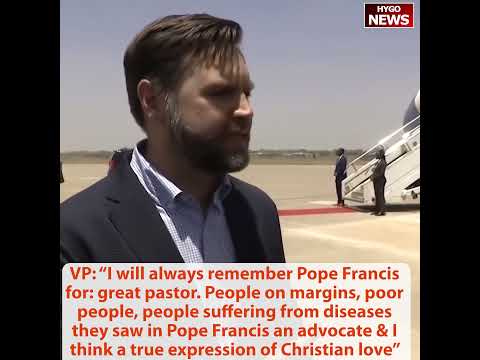
VP Vance from India: “Say Yes or the U.S. Walks Away” on Ukraine-Russia; Defends Hegseth; Remembers Pope Francis as “Great Pastor”
Vice President JD Vance, speaking from India during an official visit that included a family trip to the Taj Mahal, delivered an ultimatum on the Ukraine-Russia conflict in April 2025: “We’ve issued a very explicit proposal to both the Russians and the Ukrainians, and it’s time for them to either say yes or for the United States to walk away from this process.” He outlined the framework: “Stop the killing, freeze the territorial lines close to where they are today, and put in place long-term diplomatic settlement.” On Pete Hegseth, Vance expressed “100% confidence,” citing recruitment turnarounds as the “best testament to his leadership.” On Pope Francis: “He was a great pastor. People on the margins saw in him an advocate and a true expression of Christian love."
"Say Yes or We Walk Away”
Vance delivered the most detailed public description of the administration’s peace proposal.
“We’ve issued a very explicit proposal to both the Russians and the Ukrainians,” Vance said, “and it’s time for them to either say yes or for the United States to walk away from this process.”
He described the diplomatic investment: “We’ve engaged in an extraordinary amount of diplomacy, of on-the-ground work. We’ve really tried to understand things from the perspective of both the Ukrainians and the Russians.”
He explained the methodology: “What do the Ukrainians care the most about? What do the Russians care the most about? And I think that we’ve put together a very fair proposal.”
He set the timeline: “We’re going to see if the Europeans, the Russians, and the Ukrainians are ultimately able to get this thing over the finish line.”
He expressed cautious optimism: “Again, I feel pretty optimistic about it. I think everybody has been negotiating in good faith.”
He then outlined the substance: “But it’s now time, I think, to take if not the final step, one of the final steps — which is at a broad level the parties saying we’re going to stop the killing, we’re going to freeze the territorial lines at some level close to where they are today, and we’re going to actually put in place the kind of long-term diplomatic settlement that hopefully will lead to long-term peace.”
The Vance statement was the most explicit description any administration official had offered of what the peace deal would look like. Three elements were identified: a ceasefire (“stop the killing”), a territorial freeze (“close to where they are today”), and a long-term diplomatic framework. This was not a vague aspiration but a concrete proposal that had been presented to both parties.
The “freeze the territorial lines” element was the most controversial. It implied that Russia would retain some portion of the territory it had seized since the 2022 invasion. Ukraine and its most ardent Western supporters had insisted on a full restoration of pre-2022 borders. Vance’s formulation acknowledged the military reality that Secretary Rubio had identified earlier: neither side could achieve a decisive military victory, and a frozen conflict line was preferable to continued killing.
The Diplomatic Framework
Vance’s description of the negotiation process revealed a sophistication that media coverage often missed.
The administration had not approached the peace process with a predetermined outcome and demanded both sides accept it. Instead, it had listened to both parties — “what do the Ukrainians care most about, what do the Russians care most about” — and crafted a proposal that addressed both sets of concerns.
For Ukraine, the primary concern was security guarantees — assurance that Russia would not use a ceasefire to rearm and attack again. For Russia, the primary concerns were NATO expansion, the status of Russian-speaking populations in eastern Ukraine, and recognition of territorial realities.
The “very fair proposal” language suggested the administration believed it had found a framework that addressed both sets of concerns without giving either side everything it wanted. The “say yes or we walk away” deadline created urgency for both parties to accept a deal that might not be perfect but was better than continued war.
”100% Confidence” in Hegseth
Vance addressed the ongoing media campaign against Secretary of Defense Pete Hegseth with unequivocal support.
“I have 100% confidence in the secretary,” Vance said. “I know the president does, and really the entire team does.”
He described the pattern: “It’s one of the most bizarre things about the Hegseth nomination. From the very beginning, the media seemed to want to tank it, and when they failed and he got confirmed, they decided they wanted to keep on that effort to destroy Pete Hegseth as a man and as the Secretary of Defense.”
He assessed performance: “I think he’s doing a great job. I think that he’s brought a certain spirit back to the Department of Defense.”
He cited the evidence: “And if you look at our military recruitment numbers — that’s in my view the best testament to his leadership of the military. For the first time in a very long time, we don’t have terrible recruitment problems in the Army, the Navy, and the Air Force.”
He concluded: “That’s a great testament to his leadership. And I wish frankly the press talked more about that and not about anonymous sourcing from random staffers.”
The recruitment argument was Vance’s strongest point. The military recruiting crisis had been one of the most alarming trends in American national security — every branch failing to meet targets, the Army falling thousands short, and analysts warning that the all-volunteer force model was in jeopardy. Under Hegseth, recruitment had reversed dramatically, with the Navy posting its best numbers since 2002 and other branches showing similar improvements.
If the metric for evaluating a Secretary of Defense was whether more young Americans wanted to serve under his leadership, Hegseth was succeeding by any objective measure. The media’s focus on anonymous staffers and personal controversies rather than recruitment turnarounds and military operations (like the Houthi campaign) revealed coverage priorities that were political rather than substantive.
Pope Francis: “A Great Pastor”
Vance offered a thoughtful tribute to Pope Francis, speaking from personal experience.
“I was able to see him very briefly the morning of Easter Sunday,” Vance said. “I knew he was very ill. I didn’t realize how sick he was.”
He delivered his remembrance: “The thing that I will always remember Pope Francis for is that he was a great pastor. People on the margins, poor people, people suffering from diseases — they saw in Pope Francis an advocate and I think a true expression of Christian love.”
He expressed condolences: “We’re very saddened by it. Obviously our condolences to the Catholics all over the world, but especially back home who loved and honored the Holy Father.”
Vance’s tribute was notable for its generosity. As a convert to Catholicism, Vance had a personal connection to the papacy that many American politicians lacked. His characterization of Francis as “a great pastor” who embodied “Christian love” focused on the Pope’s most universally admired quality — his care for the poor and marginalized — while avoiding the more controversial aspects of Francis’s political positions.
The revelation that Vance had seen Francis “the morning of Easter Sunday” and “didn’t realize how sick he was” added a poignant personal dimension. The vice president had been among the last public figures to see the Pope alive, and the encounter had clearly made an impression.
The Taj Mahal Visit
The Second Family’s visit to the Taj Mahal provided the backdrop for Vance’s remarks. The video captured the challenge of photographing young children at a world landmark — “Can you just look ahead? I know buddy, it’s hard, just do it for three seconds” — before Vance shifted to geopolitics.
The juxtaposition of family photos at the Taj Mahal with ultimatums about Ukraine and tributes to a dead Pope captured the reality of vice-presidential life: personal and professional, familial and geopolitical, all compressed into the same moments.
The India visit itself was diplomatically significant. Vance’s trip — which included the announcement of trade “terms of reference” with Prime Minister Modi — demonstrated that the administration’s Asia strategy extended beyond China. India, as the world’s most populous country and a rapidly growing economy, was a critical partner in the administration’s vision of a rebalanced global trade order.
Key Takeaways
- Vance on Ukraine-Russia: “We’ve issued a very explicit proposal. It’s time to say yes or the U.S. walks away. Stop the killing, freeze territorial lines, put in place long-term settlement.”
- He expressed cautious optimism: “Everyone has been negotiating in good faith. I feel pretty optimistic.”
- On Hegseth: “100% confidence. Recruitment numbers are the best testament — for the first time in a long time, no terrible problems in Army, Navy, or Air Force.”
- On Pope Francis: “He was a great pastor. People on the margins saw in him an advocate and a true expression of Christian love.”
- The Second Family visited the Taj Mahal during the official India trip that produced trade framework talks with PM Modi.