 HYGO News
 VP: customary for outgoing VP to show house but Kamala rebuffed; Sec Bessent: tariff $300B revise up
VP: customary for outgoing VP to show house but Kamala rebuffed; Sec Bessent: tariff $300B revise up
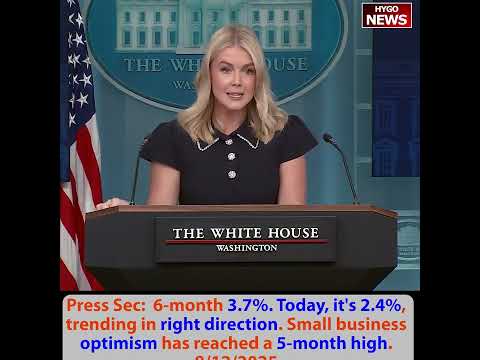
A combined segment covering VP JD Vance’s disclosure that Kamala Harris refused to show his family the Vice President’s Residence during the transition, Treasury Secretary Scott Bessent’s upward revision of projected tariff revenue past $300 billion, and Press Secretary Karoline Leavitt’s breakdown of the July 2025 CPI data. Vance on the VPR transition: “I think that normally it’s customary for the outgoing vice president to show the incoming vice president’s family the house. And we have three little kids … Usha really wanted to show them … So what we actually proposed is recognizing the weirdness of the politics. Can Usha take the kids over and just show them where they’re gonna be living for the next four years? And they were rebuffed.” Bessent: “Just on the tariff income, I’ve been saying 300 billion, but I think we’re gonna have to substantially revise that up. So well in excess, 1% of GDP … In terms of the committed investment by private industry, we’re well over 10 trillion.” Leavitt on July CPI: “In January, when this president showed up to the White House, the six month annualized core inflation rate was 3.7%. Today, six months later, the six month annualized core inflation rate is 2.4%."
"Customary for the Outgoing Vice President”
Vance’s explanation of the VPR transition. “And it was, there was a bit of a controversy. I don’t remember exactly what had happened, but I think that normally it’s customary for the outgoing vice president to show the incoming vice president’s family the house.”
The “customary” framing matters. Presidential transitions in the United States have specific informal courtesies. The outgoing first family typically shows the incoming first family the White House. Similarly, the outgoing vice president’s family shows the incoming vice president’s family the Vice President’s Residence at the Naval Observatory. That courtesy is transition tradition regardless of partisan friction.
“We have three little kids. So I guess at the time our kids were like seven, five, and two, I guess they had never seen this house and Usha really wanted to show them.”
Vance’s three children. Ages seven, five, and two at the time of the transition. Usha Vance, the Second Lady, wanted to show the children their future home. That is a reasonable family request regardless of political dynamics.
”Rebuffed”
“So what we actually proposed is recognizing the weirdness of the politics. Can Usha take the kids over and just show them where they’re gonna be living for the next four years? And they were rebuffed.”
“The weirdness of the politics” is Vance’s diplomatic framing of the contentious 2024 transition. The Vance family recognized that JD Vance himself might not be welcome given his campaign rhetoric against Harris. So they proposed a scaled-down request — Usha and the children only, not JD. That narrower request would have honored the tradition while avoiding political friction.
“Rebuffed.” That is Vance’s specific word. The Harris camp did not accept even the scaled-down request. Usha and the children were not permitted to visit the VPR during the transition.
That is a breach of tradition. Vance is documenting it publicly to illustrate the Harris camp’s post-election posture. The transition was not merely difficult — it fell below the minimum courtesies that even hostile transitions (Clinton-Bush, Obama-Trump) had maintained.
The “Old Diagrams and Old Photos”
“So we took some like old diagrams and some old photos and tried to show the kids. Actually a friend of ours, since daddy had a book about the vice president’s residence. And so we would show the kids what it would look like, but that’s as close they were got to it.”
The workaround. The Vances used old photos and diagrams to show their children their future home — because the actual home visit was refused. A friend’s father had written a book about the VPR, which provided reference material.
That is an extraordinary detail. The sitting Vice President-elect’s family used third-party photo books to preview their home because the sitting Vice President refused the in-person preview that tradition would have provided. The children saw photographs of their future home rather than visiting it directly.
”President Trump Jokes with Me”
“But it’s a really beautiful house. So President Trump always jokes with me that I actually have the nicest house because the White House is a bit of a fishbowl, as you know very well. The VPR is this beautiful sort of 150 year old mansion, but it’s got 30 acres of private property, private space. So it actually feels like a real family home for us, which is really nice.”
Trump’s joke about the relative housing. The White House is a fishbowl — every window visible from the public sidewalks on Pennsylvania Avenue, every movement subject to media observation. The VPR at One Observatory Circle has 30 acres of grounds. Private. Shielded.
“150 year old mansion.” The VPR house dates to 1893 (more than 130 years old, closer to Vance’s rounding). It was originally built for the Superintendent of the Naval Observatory, later assigned to the Chief of Naval Operations, and ultimately became the Vice President’s Residence in 1974.
“It actually feels like a real family home for us, which is really nice.” That is the personal note. For a family with three young children, privacy and space matter. The VPR provides both. The Vance family can have a relatively normal family life — kids playing outdoors, family meals, private moments — in a way the White House does not permit.
Bessent: “Substantially Revise That Up”
Pivoting to Secretary Scott Bessent. “Just on the tariff income, I’ve been saying 300 billion, but I think we’re gonna have to substantially revise that up. So well in excess, 1% of GDP.”
$300 billion in projected annual tariff revenue. Bessent is revising that upward. “Well in excess of 1% of GDP” suggests annual tariff revenue exceeding $300 billion and moving toward $400-$500 billion depending on how the revision lands.
1% of U.S. GDP is approximately $280 billion (given 2025 GDP around $28 trillion). “Well in excess” of that suggests 1.5% to 2% of GDP — approximately $420-$560 billion. That is substantially larger than the early projections and represents meaningful federal revenue.
The revision matters for the tariff-dividend discussion Trump referenced in the earlier segment. Larger tariff revenue leaves more surplus after debt paydown. That surplus could fund dividends, tax cuts, or infrastructure spending.
”$10 Trillion” in Committed Investment
“And then with the new investments, they’re the sovereign investments that we talk about. But then in terms of the committed investment by private industry, we’re well over 10 trillion.”
$10 trillion in committed private industry investment. That is an extraordinary figure. For context, total annual U.S. business investment (private fixed investment) is approximately $5-$6 trillion. $10 trillion in committed investment represents nearly two years of typical business investment capacity concentrated into specific Trump-era initiatives.
“Sovereign investments” — referring to foreign sovereign wealth funds (Saudi Arabia’s PIF, UAE investment authorities, Qatar Investment Authority, etc.) and sovereign-like entities committing capital to U.S. projects.
“Committed investment by private industry” — referring to major pharmaceutical, semiconductor, data center, and manufacturing investments announced in response to Trump’s policies. TSMC’s $300 billion Arizona expansion. AstraZeneca’s $50 billion U.S. manufacturing expansion. Various other announcements totaling into the trillions.
July CPI: “Trending in the Right Direction”
Leavitt’s inflation breakdown. “And you look at the key categories that we always look at, energy, food and shelter. Energy fell by 1.1% that was largely driven because of gas prices falling in the month of July by 2.2%.”
Energy down 1.1%. Gasoline down 2.2%. That is a specific month-over-month decline in gasoline prices — July 2025 showed gasoline costs reducing compared to June 2025.
“Look at that food. I mean, this is where people spend their money, right? Food every single day. Food flat, 0% and actually down at the grocery store by 0.1%.”
Food flat at the aggregate level. Grocery prices actually down 0.1%. That matters because grocery prices had been a specific inflation pain point throughout 2022-2024. July 2025 showed groceries declining month-over-month.
“Shelter, we always usually see an increase because that is what people are paying on rent and we know that rents are rising.”
Shelter increased — rent and housing costs continue to rise. That is a known challenge. But energy and food moving in the opposite direction offset some of the shelter pressure on aggregate CPI.
”3.7% to 2.4%” Core Inflation Trajectory
Leavitt’s specific inflation comparison. “In January, when this president showed up to the White House, the six month annualized core inflation rate was 3.7%. Today, six months later, the six month annualized core inflation rate is 2.4%.”
January 2025 six-month annualized core inflation: 3.7%. That reflects the Biden-era late inflation trajectory.
August 2025 six-month annualized core inflation: 2.4%. That reflects the Trump-era inflation reduction in the first six months of the administration.
From 3.7% to 2.4% is a 130-basis-point reduction in core inflation in six months. Core inflation (which excludes volatile food and energy) is the key metric the Federal Reserve watches for monetary policy decisions. 2.4% is much closer to the Fed’s 2% target than 3.7% was.
“So we are trending in the right direction, moving forward since President Trump took office for another six months, inflation will be tracking at 1.9%.”
Projected inflation at 1.9% over the next six months. That would be below the Fed’s 2% target — actual disinflation rather than merely reduced inflation.
”Falling” Prices List
“At this trajectory, you look at grocery prices they fell, energy prices fell, fuel oil fell, ship fares fell, propane fell, butter, margarine, eggs, non-prescription drugs, you go through the list of items that are falling.”
Specific categories falling:
- Grocery prices (aggregate)
- Energy prices
- Fuel oil
- Ship fares (surprising — reflects reduced shipping costs)
- Propane
- Butter
- Margarine
- Eggs
- Non-prescription drugs
“Eggs” is a specific political item. Egg prices had been a major inflation symbol during the Biden-era inflation peak. Eggs returning to lower prices is a visible consumer-level improvement.
“Small business optimism has reached a five month high.”
NFIB Small Business Optimism Index at a five-month high. Small business owners report improved confidence in the economic outlook. That reflects both inflation reduction and the tax-cut legislation Leavitt references.
”Largest Tax Cuts Into Law”
“We inherited an economic mess from the previous administration, but this administration is focused on fixing it every day. And part of that is signing the largest tax cuts into law to put more money back into the pockets of these small business owners.”
The One Big Beautiful Bill (OBBB). Signed July 4, 2025. Includes significant tax cuts — both extending the 2017 TCJA provisions and adding new features (no tax on tips, no tax on overtime, child tax credit expansion, senior tax relief).
“Put more money back into the pockets of these small business owners.” The small business provisions of OBBB — extension of the Section 199A pass-through deduction, accelerated depreciation, estate tax thresholds — provide specific relief to small businesses.
Cheryl Casone: “Coming in Lighter Than Expected”
Fox Business’s Cheryl Casone on the market reaction. “Energy prices actually down. And that looks like that’s what brought the headline number down less than expected. Energy prices down 1.1%, gasoline prices down 2.2%. New vehicle sales were flat for the month. So again, this coming in lighter than expected on the headline number.”
“Lighter than expected.” That is the market response to the July 2025 CPI. Economists had expected higher inflation. Actual inflation came in below expectations. That produces specific market responses — rate-cut expectations rising, bond yields falling, equities responding to the pricing-in of Fed accommodation.
“New vehicle sales were flat for the month.” Vehicle sales neither accelerated nor contracted. A flat reading at a time of concerns about tariff-induced price pressures on imported vehicles is itself a good sign — consumer demand did not collapse.
Three Distinct Stories
Vance’s VPR transition story (Kamala Harris denying the Vance family’s request). Bessent’s tariff revenue revision (upward, substantially, past $300 billion). Leavitt’s CPI breakdown (core inflation down from 3.7% to 2.4%).
Each story reinforces a specific administration narrative. Transition difficulties (Democrats refused standard courtesies). Economic overperformance (tariff revenue and private investment exceeding expectations). Inflation reduction (core CPI trajectory clearly downward).
The cumulative effect supports the administration’s claim that the first six months have outperformed expectations on multiple dimensions — economic, financial, and operational.
Key Takeaways
- VP Vance on Kamala Harris refusing to show the VPR to his family during transition: “It’s customary for the outgoing vice president to show the incoming vice president’s family the house … Can Usha take the kids over and just show them where they’re gonna be living for the next four years? And they were rebuffed.”
- The Vance family workaround: “We took some like old diagrams and some old photos and tried to show the kids” — using a friend’s book about the VPR.
- Treasury Secretary Bessent: “I’ve been saying 300 billion, but I think we’re gonna have to substantially revise that up … well in excess, 1% of GDP. In terms of the committed investment by private industry, we’re well over 10 trillion.”
- Press Secretary Leavitt on inflation trajectory: “In January, when this president showed up to the White House, the six month annualized core inflation rate was 3.7%. Today, six months later, the six month annualized core inflation rate is 2.4%.”
- Specific price declines: “grocery prices they fell, energy prices fell, fuel oil fell, ship fares fell, propane fell, butter, margarine, eggs, non-prescription drugs” — plus small business optimism at a five-month high.