 HYGO News
 VP: China sanction, Russians significant concessions; Jeffries turn Mamdani's proposals into actual
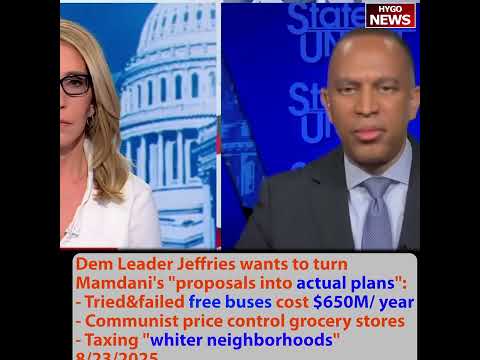
VP: China sanction, Russians significant concessions; Jeffries turn Mamdani’s proposals into actual
VP JD Vance covered multiple substantive topics in a comprehensive interview. DC crime reduction — 35% in 10 days — with Vance saying “step on the gas” rather than declaring mission accomplished. China as Russia’s largest oil buyer — Vance explaining the 54% PRC tariff as “pretty hefty sanctions.” Russia’s “significant concessions” to Trump ending 3.5 years of intransigence. Democratic Leader Hakeem Jeffries pushing to turn Mamdani’s proposals into actual plans (including $650 million free buses, price-controlled grocery stores, taxes on “whiter neighborhoods”). And Indian MP Harsimrat Badal calling for India to intervene on behalf of Harjinder Singh, the illegal alien who killed three Americans with a semitruck U-turn. Vance on DC: “Crime has dropped over 35% of the nation’s capital in 10 days because of what Donald J Trump has done … It’s not mission accomplished. When you make such big progress in a matter of a week and a half, I think that you step on the gas.” On China: “Obviously, we have a 54% tariff on the PRC right now, so we’ve already applied pretty hefty sanctions on the Chinese.” On Russia: “The Russians have made significant concessions to President Trump for the first time in three and a half years of this conflict. They’ve actually been willing to be flexible on some of their core demands.” On Mamdani: “Of course, we’ve got to figure out moving forward how we turn proposals into actual plans."
"35% in 10 Days”
Vance opening. “Crime has dropped over 35% of the nation’s capital in 10 days because of what Donald J Trump has done. So is that mission accomplished? I think that there’s so much more that we could do. Absolutely not.”
Updated statistic: 35% overall crime reduction in DC over 10 days. That is consistent with the 41% violent crime reduction cited earlier — “over 35%” as aggregate figure across all crime categories.
“Mission accomplished? Absolutely not.” Specific rejection of declaring victory prematurely. 35% reduction in 10 days is substantial. But it is not sufficient. Additional reduction is possible. Mission continues.
”Step on the Gas”
“When you make such big progress in a matter of a week and a half, I think that you step on the gas and try to make DC even more safe.”
Specific metaphor. “Step on the gas.” Acceleration rather than maintenance. Given specific success in 10 days, the administration should push harder rather than maintain current level of operation.
That framing matters. Many administrations would declare specific success and then reduce specific emphasis. Vance’s specific framework: specific success demonstrates specific capacity, which justifies specific additional investment to achieve specific additional gains.
China: “54% Tariff”
NBC’s question. “China is actually the largest buyer of Russian oil. They’re close. They’re about equal. Why no sanctions on China?”
Specific question. China is Russia’s largest oil customer. If Trump administration wants to pressure Russia economically, China should face specific sanctions for buying Russian oil (thereby funding Russia’s war effort).
Vance’s response. “Well, obviously we have a 54% tariff on the PRC right now. So we’ve already applied pretty hefty sanctions on the Chinese.”
Specific tariff level. 54% tariff on People’s Republic of China goods. That is substantial. Previous tariff baselines (Trump first-term, Biden-era) were typically in the 10-25% range for specific goods. 54% blanket tariff is specifically much higher.
“Pretty hefty sanctions.” Specific framing. The 54% tariff functions as specific economic pressure equivalent to or exceeding specific direct sanctions. Tariffs are structurally similar to sanctions — both increase costs of specific trade activity. The tariff route may be more politically sustainable than formal sanctions.
”Number of Conversations”
“And we’ve had a number of conversations at all levels of government to try to encourage the Chinese to be better partners and bring this war to a close. So again, I think the question betrays a misunderstanding of what’s going on.”
Specific diplomatic engagement with China. Multiple levels of government conversation. Direct encouragement for China to “be better partners” on ending the Russia-Ukraine war.
“The question betrays a misunderstanding of what’s going on.” Vance’s specific pushback on the NBC framing. The premise that no sanctions exist on China is specifically incorrect. The 54% tariff plus specific diplomatic engagement constitute specific substantial pressure.
“We are applying aggressive economic pressure to bring this war to a close. Maybe we’ll apply additional pressure. Maybe if we feel like we’re making progress, we’ll dial that pressure back. That give and take as part of the negotiation that we think is working.”
Specific diplomatic framework. Pressure is calibrated. When specific progress emerges, pressure can be dialed back specifically. When specific obstacles appear, pressure can be increased specifically. That specific flexibility is specifically part of the negotiation.
Mamdani: “Figure Out How We Turn Proposals Into Actual Plans”
Vance on Hakeem Jeffries’s Mamdani engagement. “The Assemblyman has actually spoken pretty forcefully and strongly about the need to deal with affordability in the city of New York. Of course, we’ve got to figure out moving forward how we turn proposals into actual plans so that he is successful if he becomes the next mayor.”
Interesting specific framing. Vance acknowledging Mamdani’s specific positions on affordability. Mamdani has spoken “forcefully” about affordability. Those specific positions have some merit.
“Figure out how we turn proposals into actual plans so that he is successful if he becomes the next mayor.”
That is striking. Vance referring to Jeffries’s engagement with Mamdani’s proposals. Whether Vance is mocking Jeffries or offering specific analytical framework is ambiguous. Either way, specific acknowledgment that Mamdani’s specific proposals require specific implementation pathways.
The specific Mamdani proposals documented in the segment:
- Free buses ($650 million annual cost)
- Price-controlled grocery stores (communist-style framework)
- Taxes on “whiter neighborhoods”
Each represents specific implementation challenges:
- Free buses: where does the $650 million come from?
- Price-controlled grocery stores: who runs them? What happens when prices don’t cover costs?
- Taxes on “whiter neighborhoods”: how is that constitutional? How does it survive Equal Protection challenge?
Jeffries specifically wanting to “turn proposals into actual plans” means Jeffries is committed to finding implementation pathways for those specific policies.
”Russians Have Made Significant Concessions”
Vance on Russia’s specific diplomatic movement. “I think the Russians have made significant concessions to President Trump for the first time in three and a half years of this conflict. They’ve actually been willing to be flexible on some of their core demands.”
“First time in three and a half years.” Specific historical framing. Throughout the Biden-era Ukraine diplomacy and the various other peace attempts, Russia had not made specific significant concessions. Trump’s specific engagement produced specific different outcome.
“Willing to be flexible on some of their core demands.” Russia has relaxed specific positions. The specific concessions are not publicly detailed (Rubio’s earlier framing about private diplomacy). But specific flexibility has occurred.
Russia’s typical core demands include:
- Ukraine not joining NATO
- Ukraine’s neutrality codified
- Russian language rights in Ukrainian territories
- Recognition of Russian territorial control
- Sanctions relief
- Security guarantees against NATO
Russia being “flexible on some” of those means Russia specifically agreed to compromise on some specific demands that had previously been non-negotiable.
”Haven’t Been Completely There Yet”
“They’ve talked about what would be necessary to end the war. Of course, they haven’t been completely there yet or the war would be over, but we’re engaging in this diplomatic process in good faith.”
Specific acknowledgment. Russia has explained what they would need to end the war. But the specific terms are not yet acceptable to Ukraine. That is why the war continues despite substantial progress.
“We’re engaging in this diplomatic process in good faith.” Specific framing. The administration is conducting diplomacy specifically in good faith. Not for specific political theater. Not for specific personal enrichment. For specific purpose of ending the war.
“We are trying to negotiate as much as we can with both the Russians and the Ukrainians to find a middle ground to stop the killing.”
Specific goal. Middle ground. Compromise acceptable to both Russia and Ukraine. Stopping the killing as the specific overriding priority.
”Not in Anyone’s Interest”
“I think what the President has tried to do here is try to engage in very aggressive, very energetic diplomacy because this war is not in anyone’s interest. It’s not in Europe or the United States’ interest. We don’t think it’s in Russia or Ukraine’s interest to keep going.”
Specific framework. The war harms all parties:
- Europe (refugees, economic disruption, security tension)
- United States (financial costs, strategic resource allocation)
- Russia (casualties, economic damage, international isolation)
- Ukraine (casualties, infrastructure destruction, population displacement)
If war harms everyone, rational analysis suggests all parties should want peace. The specific fact that the war continues despite that analysis reflects specific political barriers rather than specific interest calculations.
”Fits and Starts”
Vance’s specific diplomatic framework. “One final point about this, Kristen, if you look historically, whenever you have a complicated war with a lot of death and destruction, it kind of goes and fits and starts. There are hills and valleys to the negotiation.”
Specific historical pattern. Major war negotiations proceed unevenly. Periods of specific progress followed by specific setbacks. Specific breakthroughs followed by specific retreats. That specific pattern is the norm, not the exception.
“Hills and valleys.” The Russia-Ukraine negotiations are currently in specific valley (no immediate ceasefire, continued fighting). But specific recent hills have also occurred (Putin concessions, trilateral movement). The specific trajectory is not linear.
“We sometimes feel like we’ve made great progress with the Russians, and sometimes, as the President has said, he’s been very frustrated with the Russians.”
Specific emotional calibration. Trump has been publicly frustrated with Russia. That public frustration is specifically authentic. But specific progress also occurs. Both states — frustration and progress — are specifically legitimate assessments at different specific moments.
”Not Going to Happen Overnight”
“We’re going to keep on doing what we have to do to bring this thing to a close. I don’t think it’s going to happen overnight. I think that we’re going to continue to make progress, but ultimately, whether the killing stops, that determination is going to belong to whether the Russians and the Ukrainians can actually find some middle ground here.”
Specific expectation management. Not expecting specific immediate resolution. Continuing process. Specific progress expected to continue even without specific immediate conclusion.
“Ultimately, whether the killing stops … belongs to the Russians and the Ukrainians.” Specific accountability framework. U.S. can facilitate. U.S. can pressure. U.S. can provide mediation structure. But specific terms of agreement must be acceptable to Russia and Ukraine as specific principals.
That is consistent with Trump’s earlier framing (“it’s not for me to negotiate a deal for Ukraine”). The specific agreement is Ukraine-Russia. U.S. specifically facilitates.
The Indian MP Harsimrat Badal
The segment ends with an outlier story. “Indian MP Harsimrat Badal calls on India to intervene on behalf of Harjinder Singh (killed 3 Americans).”
Specific international dispute. Harjinder Singh — the illegal alien who killed 3 Americans with the semitruck illegal U-turn in Florida. Indian MP Harsimrat Badal is specifically requesting Indian government intervention on Singh’s behalf.
That is extraordinary. Singh is specifically in U.S. custody for specific criminal charges. Singh’s specific lack of English proficiency (documented earlier) is a specific reason the company employing him faces specific investigation.
Badal’s specific call suggests Indian government should specifically advocate for Singh. That would be specifically inappropriate — Singh is being prosecuted for specific crimes committed in U.S. territory. India’s specific diplomatic relationship with U.S. should not extend to intervening in specific criminal cases.
Five Distinct Elements
35% DC crime reduction with “step on the gas” mentality. China’s 54% tariff as specific economic pressure equivalent to sanctions. Russian significant concessions for first time in 3.5 years. Jeffries working to implement Mamdani’s specific proposals. Indian MP requesting intervention for specific criminal illegal alien.
Each reflects specific administration or political dimensions. Ongoing DC operational success. Specific tariff strategy. Specific Russia diplomatic progress. Specific Democratic Party shift toward Mamdani-style policies. Specific international friction over immigration enforcement.
Key Takeaways
- VP Vance on DC: “Crime has dropped over 35% of the nation’s capital in 10 days because of what Donald J Trump has done … It’s not mission accomplished. When you make such big progress in a matter of a week and a half, I think that you step on the gas.”
- On China sanctions: “Obviously, we have a 54% tariff on the PRC right now, so we’ve already applied pretty hefty sanctions on the Chinese … I think the question betrays a misunderstanding of what’s going on.”
- On Russian concessions: “The Russians have made significant concessions to President Trump for the first time in three and a half years of this conflict. They’ve actually been willing to be flexible on some of their core demands.”
- On Mamdani’s proposals: “We’ve got to figure out moving forward how we turn proposals into actual plans so that he is successful if he becomes the next mayor.”
- On the Russia-Ukraine negotiation rhythm: “Whenever you have a complicated war with a lot of death and destruction, it kind of goes and fits and starts. There are hills and valleys to the negotiation.”