 HYGO News
 VP: big fat tax break or big fat tariff; Trump on Jerome Powell: too late, terrible Fed Chair; Rubio
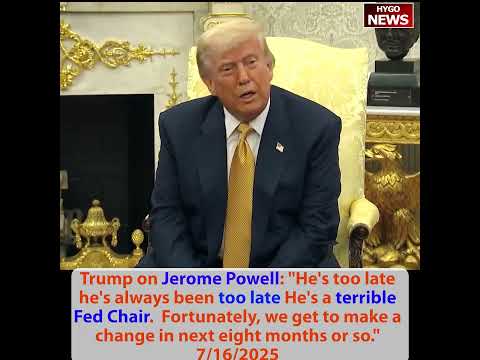
VP: big fat tax break or big fat tariff; Trump on Jerome Powell: too late, terrible Fed Chair; Rubio
Vice President JD Vance delivered the compact, memorable framing of the second-term trade policy: “If you’re building here, if you’re making here, if you’re working in the United States of America, we just gave you a big, fat tax break. But if you’re going to ship American jobs overseas thanks to Donald Trump, you’re going to pay a big, fat tariff.” Secretary of State Marco Rubio addressed a delicate Middle East flare-up: Druze-Bedouin rivalries in southwestern Syria that produced Israeli strikes against Syrian forces — “a misunderstanding it looks like between the Israeli side and the Syrian side” — with the administration working “all morning long and all night long with both sides” to de-escalate within hours. And Trump laid out the sharpest Powell critique yet: “I was surprised he was appointed … He’s a terrible Fed Chair … Fortunately, we get to make a change in the next eight months or so."
"Big Fat Tax Break, Big Fat Tariff”
Vance’s framing compressed the trade-policy argument into two clauses that mirror each other. The symmetry is the design. Build here: tax break. Build there: tariff.
“For years, our government has done the exact opposite,” Vance said. “We have rewarded people who shipped American jobs overseas and penalized the great small businesses who invested right here in America, right here at home, and the President Trump’s leadership were flipping that on its head.”
The claim that previous policy “rewarded people who shipped American jobs overseas” is the argument that has animated industrial-policy populism across both parties for the past decade. The corporate income tax regime that allowed deferral of foreign earnings until repatriation; the lack of import tariffs that would have differentiated between domestic and foreign-produced goods; the free-trade architecture that treated American manufacturing and foreign manufacturing as economically equivalent — each of those, in the Vance framing, was a reward for offshoring.
“If you’re building here, if you’re making here, if you’re working in the United States of America, we just gave you a big, fat tax break. But if you’re going to ship American jobs overseas thanks to Donald Trump, you’re going to pay a big, fat tariff.”
“Big fat” is the operative modifier, used twice for rhetorical parallelism. The phrase is deliberately non-technocratic. Tax policy and tariff policy are usually described in percentages, brackets, and phase-ins. “Big fat tax break” and “big fat tariff” are the vocabulary of a populist reframing.
”Time to Invest in Our Own Country”
“It’s time to invest in our own country and our own people once again, and we’re doing it.”
“And we’re doing it” — the present tense — is the political claim that matters. The Vance framing is not aspirational. It is declarative. The tax break is passed. The tariffs are operational. The investment is flowing. The policy package that was debated through the campaign is now the status quo.
Whether the claim holds up through the business cycle is a separate question. Reshoring takes years. Tariff effects propagate through supply chains on multi-year horizons. But the political claim — that the administration has flipped the incentive structure from offshoring to onshoring — is the case the VP is making to a reshoring-focused audience.
Syria: “An Unfortunate Situation”
Secretary of State Marco Rubio’s Syria comments addressed a developing situation. “Yeah, it’s complicated, obviously. These are historic, longtime rivalries between different groups in the southwest of Syria, Bedouins, the Druze community, and it led to an unfortunate situation.”
“A misunderstanding it looks like between the Israeli side and the Syrian side. So we’ve been engaged with them all morning long and all night long with both sides.”
The background: the southwestern Syria town of Suwayda — a Druze-majority area — saw clashes with armed Bedouin groups, which then triggered Syrian government forces’ intervention, which triggered Israeli concern for the Druze community and Israeli strikes against Syrian regime targets. Israel has long positioned itself as a security guarantor for the Druze minority.
Rubio’s “misunderstanding” framing is the diplomatic shorthand that allows all parties to save face. The Israelis struck Syrian forces. The Syrians are processing what that means. The Druze community is protected by Israeli action. Rubio’s team is working to de-escalate so the incident does not become a wider crisis.
”Hopefully Get Back on Track”
“And we think we’re on our way towards a real de-escalation and then hopefully get back on track in helping Syria build the country and arriving at a situation there in the Middle East is far more stable.”
“Helping Syria build the country” is a phrase that reflects the administration’s broader posture toward post-Assad Syria. With the fall of the Assad regime, the U.S. has been engaging with the interim government in Damascus to help stabilize the country, integrate various factional and regional actors, and prevent the vacuum from being filled by Iran, Russia, or radicalized elements.
The Druze-Bedouin clash is precisely the kind of sub-state friction that can destabilize the broader reconstruction effort. Rubio’s “real de-escalation” framing signals that Washington sees the incident as manageable and has pre-positioned diplomatic capacity to manage it in hours, not days.
“So in the next few hours, we hope to see some real progress to end what you’ve been seeing over the last couple hours.” That is a tight timeline. Rubio is committing, on camera, to resolution “in the next few hours.” That kind of commitment is only made when the diplomatic machinery is already close to delivering.
Powell: “Too Late”
The reporter then pivoted back to domestic policy. “Do you have plans or are you back considering firing drone Powell? And what’s your justification if you’re thinking about this to do this?”
Trump: “He’s always been too late. Hence his nickname, too late. He should have cut interest rates a long time ago. Europe has cut him 10 times in the short period of time and we cut him none.”
The ten-vs.-none framing is Trump’s preferred comparison. The European Central Bank has indeed been cutting rates aggressively over 2024-2025, responding to weaker European growth. The Federal Reserve has held rates relatively high. Trump’s argument: if Europe can cut with its weaker economy, the Fed’s refusal to cut with the stronger American economy is policy malpractice.
”The Only Time He Cut Was Just Before the Election”
Trump then raised a specific grievance. “The only time he cut him was just before the election to try to help Kamala or Biden, whoever the hell it was, because nobody really knew. Obviously that didn’t work, but he tried to cut him for the Democrats, Kamala. How did that work out? You’ll tell me. It didn’t work out too well, did it?”
The reference is to the Fed’s September 2024 rate cut, which came shortly before the presidential election. Trump’s accusation is that the cut was politically timed to help Kamala Harris. Whether that accusation is correct is disputed — the Fed’s stated rationale was data-driven — but the appearance of political timing has been the subject of commentary in conservative media for the past year.
“How did that work out?” — the sarcastic question — is Trump’s reminder that whatever the Fed’s intended political effect, Trump won the election anyway.
”I Was Surprised He Was Appointed”
Trump then delivered what may be the sharpest Powell line yet. “I think he does a terrible job. He’s costing us a lot of money. The country has become so successful that it doesn’t have a big impact, but it does hurt people wanting to get a mortgage. People want to buy a house. He’s a terrible, he’s a terrible Fed shi- I was surprised he was appointed.”
“He’s a terrible Fed shi-” — cut off as Trump caught himself — was almost certainly heading to “terrible Fed sh*t,” with the self-censorship landing on “Fed Chair.”
“I was surprised he was appointed. I was surprised, frankly, that Biden put him in and extended him.”
Powell was originally appointed by Trump in 2017, then re-appointed by Biden in 2021. Trump’s “surprised” framing is a rare acknowledgment of his own earlier appointment being, in retrospect, a mistake. The “surprised that Biden extended him” is harder to parse — Biden’s decision to re-appoint Powell was widely seen as a move toward continuity with a chair who had performed well during COVID. Trump’s framing treats it as baffling.
”No, We’re Not Planning on Doing Anything”
Despite the critique, Trump confirmed no immediate action. “No, we’re not planning on doing anything. We’re very concerned. He’s doing a little renovation for 2.5 billion of the Fed. Innovation and they have a close to 900 million dollar cost over on.”
The $2.5 billion renovation figure remains the administration’s point of pressure. The “close to 900 million dollar cost overrun” is a slight increase from the earlier $700 million figure — the numbers seem to be climbing in real time as the administration’s ongoing audit of the project develops.
”The Biggest Cost Overrun Is Interest Rates”
Trump’s killer line tied the renovation critique to the rate-policy critique. “It’s a shame, but the biggest cost overrun is the cost overrun for interest rates, because we should be paying three points lower. And we would save a trillion dollars a year in interest if that were the case. And all it is is the stroke of a pen.”
“The stroke of a pen” is the framing designed to portray the Fed’s resistance to cuts as arbitrary. Powell could, in Trump’s framing, cut three points tomorrow. He has the statutory authority. He is choosing not to. Every day he chooses not to, in Trump’s framing, costs the country billions.
“It goes for his board too, because his board is not doing the job, because they should try and rein this guy in.” That is Trump extending the critique beyond Powell to the entire Fed governing board — the other governors and regional presidents who could theoretically push back against the chair’s rate posture.
”Eight Months or So”
Trump ended with the practical note. “So he’s doing a lousy job, but no, I’m not talking about that. Fortunately, we get to make a change in the next, what, eight months or so. Pick somebody that’s good and we’ll pick somebody. I just want a fair job. We want to see lower interest rates. Our country deserves it.”
Eight months is the approximate window until the next Fed chair decision point. Powell’s term as chair expires in May 2026. Trump’s “we get to make a change” is a forward-looking note that, without removing Powell prematurely, the administration can simply wait — and is counting down to the moment when a replacement can be named.
”No Inflation, Record Everything”
Trump closed with the economic summary. “We’re making a lot of money. We’re doing great as a country. We have no inflation, stock market, record business, record everything. Everything’s a record now. We had the worst inflation in history under Biden, and now we have almost no inflation. We’ve done a great job and we should have the interest rates cut.”
The list — no inflation, record stock market, record business, record everything — is Trump’s greatest-hits litany of second-term economic claims. Each element is separately contestable in technical terms. The cumulative framing is the political point: things are going well, therefore the Fed’s refusal to cut rates is indefensible.
Three Frames, One Policy Posture
VP on trade (tax breaks for building here, tariffs for shipping overseas), Rubio on Syria (hours-to-de-escalation diplomacy), and Trump on Powell (fair job, lower rates, eight-month countdown). Three different lanes, one common posture: the administration pressing on every front, with the confidence that comes from a set of economic data the critics did not predict.
Key Takeaways
- VP Vance delivered the crispest second-term trade framing: “If you’re building here … we just gave you a big, fat tax break. But if you’re going to ship American jobs overseas thanks to Donald Trump, you’re going to pay a big, fat tariff.”
- Secretary of State Marco Rubio addressed Syria flare-up: Druze-Bedouin rivalries triggered “a misunderstanding” between Israel and Syria, with the administration working “all morning long and all night long with both sides” for “real de-escalation” within hours.
- Trump on Powell: “He’s a terrible Fed Chair … I was surprised he was appointed … I was surprised, frankly, that Biden put him in and extended him.”
- Trump claimed the Fed renovation cost overrun is “close to 900 million dollar” while arguing “the biggest cost overrun is the cost overrun for interest rates” — “we would save a trillion dollars a year in interest … all it is is the stroke of a pen.”
- Trump not firing Powell, but counting down: “Fortunately, we get to make a change in the next, what, eight months or so. Pick somebody that’s good … We want to see lower interest rates.”