 HYGO News
 VP: Americans can use Pell grants for trade schools! poor Americans compete low-wage jobs illegals
VP: Americans can use Pell grants for trade schools! poor Americans compete low-wage jobs illegals
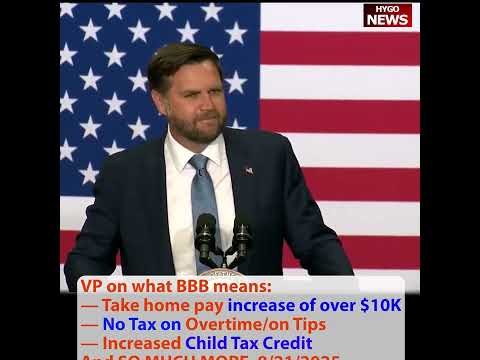
Vice President JD Vance delivered a comprehensive economic argument covering the One Big Beautiful Bill’s provisions, the Pell Grants trade school expansion, blue-collar wage improvement, and the specific economic harm of illegal immigration to low-income American workers. Georgia Senator Jon Ossoff threatened a “reckoning” for Trump administration officials involved in immigration enforcement. Vance on trade schools: “If you want to get a four-year degree — great. But if you want to be a plumber or an electrician or a pipe fitter, your government ought to fight for you too.” On wages: “If you go back 50, 60 years, what is the fastest period for blue collar wages rising in the United States of America? It is the time that we’re living in right now, thanks to the economic policies of Donald J. Trump.” On illegal immigration: “You know what the worst thing for people at the bottom of the income ladder is? It’s when you flood the country with millions upon millions of illegal aliens and force our poor Americans to compete for jobs against low-wage foreigners who don’t even have the legal right to be here.” On OBBB: “Your take-home pay is going to go up over $10,000 over the next few years … We are not going to tax tips anymore … We eliminated taxes on overtime … We had the biggest tax cut for families that this country has ever seen.” Ossoff: “There at some point is going to be a reckoning for all of this."
"Pursue Their American Dream”
Vance’s opening. “We want Americans to be able to pursue their American dream. Whether that means going to a trade school or going to a four-year education, going to the military, we want to give you as many options as possible.”
That is the specific framing. The American dream is not limited to four-year college. Trade school. Military service. Four-year college. All are legitimate pathways. Government should support all of them equally rather than privileging one.
“And what happened for a long time in this country is that you had both parties, both sets of leaders saying no, no, no. The only pathway that we’re going to fund, the only pathway we’re going to help you with is if you want to get a four-year degree.”
That is specific bipartisan critique. Both Republicans and Democrats for decades have privileged four-year college funding. Pell Grants, federal student loans, tax incentives for college savings — all have focused on four-year college. Trade schools, apprenticeships, military education benefits have received less emphasis.
“If you want to get a four-year degree, great. But if you want to be a plumber or an electrician or a pipe fitter, your government ought to fight for you too.”
Plumber. Electrician. Pipe fitter. Three specific skilled trades. Those trades have been experiencing specific labor shortages. Workers in those trades earn substantial incomes — often more than four-year college graduates in many fields. But federal education funding has not supported trade school education at levels comparable to four-year college funding.
”Pell Grants for Trade Schools”
The specific policy change. The One Big Beautiful Bill (OBBB) extended Pell Grants to cover trade school education. Students who choose plumbing, electrical, or pipe fitting training now have access to federal grant support equivalent to what four-year college students have received.
That is a substantial policy change. Pell Grants provide up to approximately $7,395 per year for specific students with financial need. Trade schools that qualify under the OBBB provisions can now accept Pell Grant funding for student tuition.
The political significance. Generations of American families with specific preferences for skilled trades have been disadvantaged by Pell Grant restrictions. Now those families have equivalent federal educational support. That is specifically appealing to working-class voters who have historically been disconnected from federal education benefits.
”Fastest Period for Blue Collar Wages Rising”
“If you go back 50, 60 years, what is the fastest period for blue collar wages rising in the United States of America? It is the time that we’re living in right now, thanks to the economic policies of Donald J. Trump.”
That is specific economic claim. Blue-collar wages — production workers, construction workers, skilled trades, manufacturing workers — have been rising faster in the past specific period than in any period over the past 50-60 years.
The underlying data. Specific economic indicators show substantial blue-collar wage growth since Trump’s second-term policies took effect. Tariffs creating specific demand for domestic manufacturing. Immigration enforcement reducing specific labor supply competition. Tax cuts reducing overall costs for specific working-class households.
“Thanks to the economic policies of Donald J. Trump.” Vance attributing the wage growth specifically to Trump’s policies rather than to macroeconomic conditions or prior administration contributions.
”Worst Thing for People at the Bottom”
Vance’s economic framing of illegal immigration. “You know what the worst thing for people at the bottom of the income ladder is? It’s when you flood the country with millions upon millions of illegal aliens and force our poor Americans to compete for jobs against low-wage foreigners who don’t even have the legal right to be here. That is what destroys the wages and the livelihoods of people who are struggling in this country.”
That is specific economic argument. Illegal immigration specifically harms low-income Americans. The labor market operates on supply and demand. Adding millions of workers with specific willingness to accept low wages increases labor supply, which reduces wages for everyone competing in the same labor markets.
The specific affected population. Low-wage Americans — particularly those without college degrees — compete most directly with illegal immigrants for specific job categories. Construction. Service work. Low-skilled manufacturing. Agricultural labor. Those sectors have been specifically affected by immigration-driven wage suppression.
“Force our poor Americans to compete for jobs against low-wage foreigners who don’t even have the legal right to be here.” That is the specific injustice framing. American citizens — who have specific legal right to be in the country and specific claim on the country’s labor market — are being forced to compete with individuals who have no such rights.
”Empower Them to Live the American Dream”
“We want to empower them to live the American dream. That’s why we’re protecting their jobs, lowering their taxes, and fighting to make their country safe again.”
The specific policy package Vance describes:
- Protecting jobs (through immigration enforcement and trade policy)
- Lowering taxes (OBBB provisions)
- Making the country safe (public safety operations in DC and elsewhere)
Each element specifically targets the American working class. Jobs, taxes, safety — concerns that working-class voters identified as priorities in 2024 polling. The OBBB and related administration actions address each concern specifically.
Ossoff: “Reckoning”
Georgia Senator Jon Ossoff’s extraordinary statement. “There at some point is going to be a reckoning for all of this. These folks who are working at these private prison companies who are on Christine Noem’s staff right now, they are at some point going to have to testify under oath about what is happening in the facilities that they’re currently running.”
“Reckoning.” That is specific vocabulary. Not accountability. Not oversight. Reckoning — specifically threatening tone suggesting consequences beyond ordinary political disagreement.
“These folks who are working at these private prison companies who are on Christine Noem’s staff right now.” Ossoff targeting specific individuals by name-category. Private prison company personnel. Homeland Security Secretary Kristi Noem’s staff.
“Testify under oath about what is happening in the facilities that they’re currently running.” The specific consequence Ossoff predicts. Forced testimony about specific facility conditions. That testimony could generate specific legal consequences.
Whether Ossoff’s framing represents legitimate future congressional oversight (Congress has specific authority to require testimony under oath) or represents threat of political retribution (targeting specific individuals for being politically associated with Trump administration policies) is the interpretive question.
Either interpretation reflects specific political commitment. Ossoff is not advocating for specific policy alternatives. He is threatening specific consequences for specific individuals involved in current administration operations.
Vance: “Over $10,000” Take-Home Pay Increase
“What this law means for you is that your take-home pay is going to go up over $10,000 over the next few years.”
That is specific economic forecast. $10,000+ in cumulative take-home pay increase for typical American families over the next few years from OBBB provisions.
The specific mechanisms producing that increase:
- Lower marginal tax rates (extension of TCJA)
- No tax on tips (for tip workers)
- No tax on overtime (for overtime workers)
- Expanded Child Tax Credit (for families with children)
- Lower corporate tax rates affecting wages indirectly
- Various other provisions
Cumulative effect approximately $10,000 for typical family. That is substantial. For a family earning $75,000 per year, $10,000 represents approximately 13% of annual income. Over “the next few years,” that is specific recurring benefit.
”No Tax on Tips”
“Do you have any single moms out there? Any single dads? Any people who work hard every single day? I had a single mom and for a time my mom worked at a restaurant. She waited tables like a lot of folks out there.”
Vance’s personal reference. His own mother was a single mom and worked as a waitress for specific periods. That personal experience informs specific policy empathy for tipped workers.
“And you know what we did in this new law? We said that if you’re working hard and you’re making your income via tips, we are not going to tax tips anymore because we want to give everybody out there that’s working hard for those tips a little bit of relief.”
The specific “No Tax on Tips” provision. Tip income — which had been subject to standard income tax — is now exempt (up to specific limits) from federal income tax. For service workers, that represents specific meaningful income.
The political significance. “No Tax on Tips” was a specific Trump campaign promise. Critics characterized it as unworkable or too narrow to matter. The provision was implemented in OBBB and now provides specific economic benefit to millions of service workers.
”Biggest Tax Cut for Families”
“If you’re working hard and played by the rules, you ought to have a government that stands up for you instead of fights against you. That’s why we increased the Child Tax Credit in the Working Families Tax Cut. That’s why we eliminated taxes on overtime and on tips and that’s why we had the biggest tax cut for families that this country has ever seen because we believe that you ought to keep more of your hard-earned money.”
The specific OBBB provisions for working families:
- Increased Child Tax Credit (from $2,000 to $2,500 per child, with increased refundability)
- Elimination of tax on overtime
- Elimination of tax on tips
- Various other working-family provisions
“Biggest tax cut for families that this country has ever seen.” That is strong claim. Whether it is literally accurate depends on specific comparison methodology. TCJA 2017 was also substantial for families. Reagan tax cuts were substantial. OBBB is substantial. Characterizing any specific tax cut as “biggest” requires specific criteria.
“Busting your rear end every single day the government ought to make it easier for you and not harder for you. And that’s why we fought for that legislation.”
The specific normative framing. Hard-working Americans should have government that eases their lives rather than making them harder. OBBB provisions are specifically designed to reduce government burden on working families. That is the specific moral framework.
Three Distinct Economic Stories
Pell Grants for trade schools (educational expansion beyond four-year college). Blue-collar wage growth (specific economic success of Trump policies). Working families tax cuts ($10,000 take-home increase). All three connect to the same underlying theme — specific benefits for working-class Americans.
Plus the Ossoff threat (Democratic political hostility toward specific administration personnel). That provides the political contrast. While the administration delivers specific working-class benefits, Democratic political figures threaten specific consequences for administration personnel.
The political landscape. Working-class voters receiving specific economic benefits under the administration face specific Democratic threats against the administration’s capacity to continue delivering those benefits. That dynamic favors continued Republican political support among working-class demographics.
Key Takeaways
- VP Vance on Pell Grants for trade schools: “If you want to get a four-year degree — great. But if you want to be a plumber or an electrician or a pipe fitter, your government ought to fight for you too.”
- On blue-collar wages: “If you go back 50, 60 years, what is the fastest period for blue collar wages rising in the United States of America? It is the time that we’re living in right now, thanks to the economic policies of Donald J. Trump.”
- On illegal immigration’s economic impact: “The worst thing for people at the bottom of the income ladder is when you flood the country with millions upon millions of illegal aliens and force our poor Americans to compete for jobs against low-wage foreigners who don’t even have the legal right to be here.”
- On OBBB’s working family provisions: “Your take-home pay is going to go up over $10,000 over the next few years … We increased the Child Tax Credit … we eliminated taxes on overtime and on tips … the biggest tax cut for families that this country has ever seen.”
- Georgia Sen. Jon Ossoff’s threat: “There at some point is going to be a reckoning for all of this. These folks who are working at these private prison companies who are on Christine Noem’s staff right now, they are at some point going to have to testify under oath.”