 HYGO News
 Vance: '40 Years of Lost Manufacturing -- Workers Will Benefit'; Trump on Iran: 'They're Tapping Us Along'; Cognitive: 'Highest Mark'
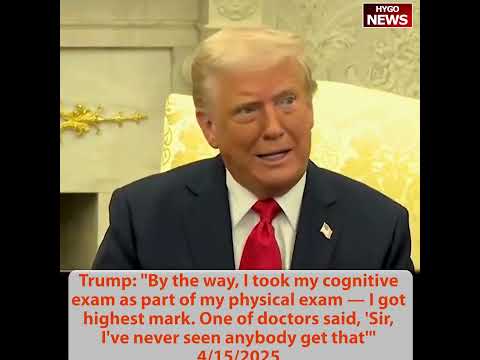
Vance: “40 Years of Lost Manufacturing — Workers Will Benefit”; Trump on Iran: “They’re Tapping Us Along”; Cognitive: “Highest Mark”
A mid-April 2025 compilation featured VP JD Vance making the intellectual case for tariffs — “For 40 years, we have lost manufacturing capacity. We don’t make enough of the pharmaceuticals, antibiotics, or weapons we need. Workers are going to benefit as we reindustrialize” — alongside Trump’s most pointed warning to Iran: “They’re tapping us along because they were so used to dealing with stupid people. Iran has to get rid of the concept of a nuclear weapon. If we have to do something very harsh, we’ll do it.” Trump also revealed his cognitive exam results: “I got the highest mark. One of the doctors said, ‘Sir, I’ve never seen anybody get that.’”
Vance: “40 Years”
VP Vance delivered the most concise intellectual framework for the tariff policy.
“For 40 years, we have lost manufacturing capacity,” Vance said. “Workers have seen their wages stagnate. And some of the most critical things that we need — from the pharmaceuticals, the drugs that we give to our children, the antibiotics that we give to our kids, to the weapons that we actually need to fight a war, if God forbid we had to fight a war — we don’t make enough of that stuff.”
He connected the tariffs to Trump’s mandate: “And so President Trump ran explicitly on changing that.”
Vance acknowledged the short-term cost: “Yes, as the president mentioned, it caused a little bit of disruption in the market.”
But he predicted the long-term outcome: “But I actually think over the long term, workers are going to benefit, stocks are going to go up, American businesses are going to benefit as we reinvest and reindustrialize our country.”
Vance’s framing was the most effective distillation of the tariff argument because it connected three seemingly separate concerns — pharmaceutical security, military readiness, and worker wages — into a single diagnosis. The loss of manufacturing capacity was simultaneously a public health crisis (America couldn’t make its own antibiotics), a national security crisis (America couldn’t make its own weapons), and an economic crisis (American workers’ wages had stagnated). Tariffs addressed all three by incentivizing the return of manufacturing to American soil.
The “reindustrialize” language was deliberate. America had been “deindustrialized” over four decades — a process that had been treated as natural and inevitable by economists and policymakers who believed the United States would transition to a “service economy” and that manufacturing would migrate permanently to lower-cost countries. Vance was arguing that this process was neither natural nor inevitable — it was the result of policy choices that could be reversed through different policy choices.
Trump: “Tapping Us Along”
Trump provided a blunt assessment of the Iran negotiations.
“Iran wants to deal with us, but they don’t know how,” he said. “They really don’t know how.”
He described the pace: “We had a meeting with them on Saturday. We have another meeting scheduled next Saturday. I said, that’s a long time. You know, that’s a long time.”
His assessment: “So I think that might be tapping us along.”
Then the red line, stated with absolute clarity: “But Iran has to get rid of the concept of a nuclear weapon. They cannot have a nuclear weapon. He can’t have a nuclear weapon. Nobody can have it.”
Trump diagnosed the Iranian strategy: “I think they’re tapping us along because they were so used to dealing with stupid people in this country.”
He cited his first-term record: “I had Iran perfect. You had no attacks. You would have never had October 7th in Israel, the attack by Hamas. Because Iran was broke. It was stone cold broke when I was president.”
He restated his preference: “And I don’t want to do it. I want them to be a rich, great nation.”
The condition: “The only thing — one thing, simple. It’s really simple. They can’t have a nuclear weapon.”
The urgency: “And they’ve got to go fast because they’re fairly close to having one. And they’re not going to have one.”
The threat: “And if we have to do something very harsh, we’ll do it. And I’m not doing it for us. I’m doing it for the world.”
The characterization: “And these are radicalized people. And they cannot have a nuclear weapon.”
The “tapping us along” phrase revealed Trump’s suspicion that Iran was using the negotiations to buy time — engaging in talks while continuing nuclear development. The scheduled Saturday-to-Saturday meeting cadence suggested that Iran was not negotiating with urgency, which Trump interpreted as a delaying tactic inherited from dealing with previous administrations that had allowed negotiations to drag on for years without resolution.
Cognitive Exam: “The Only One to Take One”
Trump provided additional detail on his cognitive test.
“By the way, I took my cognitive exam as part of my physical exam,” he said. “And I got the highest mark. And one of the doctors said, ‘Sir, I’ve never seen anybody get that kind of…’ That was the highest mark.”
He provided context: “They said to me, ‘Sir, would you like to take a cognitive test?’ I said, ‘Did Biden take one?’ No. ‘Did anybody take one?’ No, not too many people took them. I said, ‘What about Obama? Did he take one?’ No, he didn’t take one either.”
His decision: “I said, let me be the only one to take one.”
He added: “But I’ve actually taken them three times already. I like taking them because they’re sort of — they’re not too tough for me to take.”
He praised Walter Reed: “The doctors, who are total professionals — Walter Reed Medical Center, they’re great, great people. I was there for five, six hours. I took a full physical and it came out perfect.”
The voluntary cognitive testing established a precedent that Trump was using for political advantage. No previous president had voluntarily taken and publicized cognitive testing. By being “the only one,” Trump created a standard that future opponents would be measured against — and that Biden had conspicuously failed to meet.
Key Takeaways
- Vance: “40 years of lost manufacturing — we don’t make enough pharmaceuticals, antibiotics, or weapons. Workers will benefit as we reindustrialize.”
- Trump suspects Iran is “tapping us along because they were used to dealing with stupid people.” Next meeting scheduled for Saturday.
- Iran red line: “They have to get rid of the concept of a nuclear weapon. They’re fairly close to having one. If we have to do something very harsh, we’ll do it.”
- Trump cited his first-term record: “Iran was stone cold broke. You would have never had October 7th.”
- Cognitive exam: “I got the highest mark. One doctor said, ‘I’ve never seen anybody get that.’ I’m the only president to take one.”