 HYGO News
 Voters record number, Biden wrong on Jim-Crow 2.0 or does he stand by?
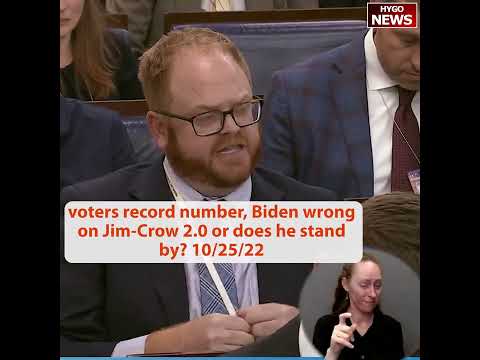
Georgia Smashes Turnout Records — 70% More Than 2018; Reporter Asks If Biden Was Wrong to Call Voting Law “Jim Crow 2.0”; KJP: “High Turnout and Voter Suppression Can Take Place at the Same Time”
On 10/25/2022, a reporter confronted White House Press Secretary Karine Jean-Pierre with data that contradicted one of Biden’s most incendiary claims: Georgia’s early voting had “smashed midterm records” with over 1 million votes cast — 70% more than 2018 and on par with presidential election turnout — under the very voting law Biden had compared to “Jim Crow in the 21st century.” The reporter asked directly: “Was President Biden wrong with his assessment, or does he stand by that Jim Crow comparison?” KJP refused to acknowledge the contradiction, insisting “high turnout and voter suppression can take place at the same time” — a logically tortured claim that the record-breaking participation was occurring despite voter suppression, not because the suppression narrative was wrong.
”Jim Crow in the 21st Century”
The reporter laid out the factual context. “President Biden last year likened the new Georgia voting law to ‘Jim Crow in the 21st century,’” the reporter said. “But turnout so far in the state’s midterm elections has smashed midterm records. Today topped 1 million votes overall. That’s about 70 percent more than 2018, on par with the presidential election turnout.”
“Was President Biden wrong with his assessment of Georgia’s voting law, or does he stand by that Jim Crow comparison?” the reporter asked.
The question was devastating because it was built entirely on data — not Republican talking points, not partisan interpretation, but actual voter turnout numbers from the state of Georgia. Biden had warned that Georgia’s 2021 Election Integrity Act would suppress votes, particularly minority votes, on a scale comparable to the Jim Crow era. The data showed the opposite: voters were turning out in record numbers.
Biden’s “Jim Crow 2.0” comparison had been among his most extreme rhetorical salvos. Jim Crow refers to the system of legal racial segregation, poll taxes, literacy tests, grandfather clauses, and violent intimidation that denied Black Americans the right to vote for nearly a century following the Civil War. Comparing a law that expanded weekend voting hours and required voter ID to present a free state-issued identification to the systematic disenfranchisement of millions of Black Americans was a comparison many observers — including some Democrats — found historically illiterate and deeply offensive.
”I Got to Be Careful”
KJP’s initial response invoked the Hatch Act — the same shield she used whenever questions about political topics became uncomfortable. “As you know, I got to be careful. I cannot get into politics from here,” KJP said. “So I won’t comment specifically on that race or on the elections or the data that’s coming out of Georgia.”
The Hatch Act dodge was strategically convenient. By declining to address “the data coming out of Georgia,” KJP avoided having to reconcile Biden’s Jim Crow comparison with the record-shattering turnout numbers. The data was the question; refusing to discuss it was refusing to answer.
But the Hatch Act limitation was selective. KJP had been discussing midterm dynamics throughout the briefing — talking about “stark choices,” Republican threats to the economy, and Democratic messaging strategies. The Hatch Act apparently restricted comments only when the data was inconvenient.
”Anti-Voter Policies”
Despite claiming she couldn’t discuss politics, KJP then made several political assertions. “The President has been very clear that based on the Big Lie, there have been a host of anti-voter policies forced on states that challenge America’s fundamental right to vote — the access to voting,” KJP said.
“And so this is against our most basic values, including respect for the law and the Constitution,” KJP added.
The description of the Georgia law as “anti-voter” persisted despite the record turnout. The law’s provisions — requiring voter ID for absentee ballots, expanding early voting access, mandating drop boxes, and setting standards for ballot processing — had been characterized by Democrats as voter suppression. In practice, they had coincided with the highest midterm turnout in the state’s history.
The disconnect between “anti-voter” rhetoric and record voter participation raised a fundamental question: if these policies were suppressing votes, how was turnout breaking records? The answer either meant the policies weren’t actually suppressive, or that voters had overcome suppression so successfully that turnout reached unprecedented levels — which would undermine the urgency of the “Jim Crow 2.0” framing.
”High Turnout and Voter Suppression Can Take Place at the Same Time”
KJP’s most memorable — and most criticized — statement came next. “And speaking generally, of course — more broadly — of course, high turnout and voter suppression can take place at the same time,” KJP said. “They don’t have to be — one doesn’t have to happen on its own. They could be happening at the same time.”
The claim required accepting a premise that defied both logic and historical context. Voter suppression, by definition, reduces voter participation. Jim Crow-era suppression achieved exactly that — Black voter registration in Mississippi, for example, fell below 7% at the height of Jim Crow enforcement. The entire purpose and effect of voter suppression is lower turnout among targeted populations.
To argue that voter suppression and record-high turnout can coexist is to argue that suppression can exist without suppressing anything — that it can be present and effective while producing the opposite of its intended result. It’s the equivalent of claiming a flood and a drought are happening in the same place at the same time.
KJP’s framing suggested the existence of a theoretical voter suppression that produces no measurable impact on voter participation — a category of suppression so ineffective that its targets vote in higher numbers than ever before. If this is what “Jim Crow 2.0” looked like, the comparison to the actual Jim Crow era — where entire populations were denied the franchise through violence and legal barriers — was even more offensive than it appeared on the surface.
The Georgia Law’s Actual Provisions
Georgia’s Election Integrity Act of 2021 (SB 202) included provisions that both parties selectively cited:
Provisions Democrats called suppressive: Voter ID requirements for absentee ballots (previously required only a signature), restrictions on who could distribute food and water to voters in line (within 150 feet of a polling place), shortened window for requesting absentee ballots.
Provisions that expanded access: Added a mandatory Saturday of early voting (previously optional), expanded early voting hours, required large precincts with long wait times to add more voting equipment or split into smaller precincts, and created a statewide online portal for absentee ballot requests.
The mixed nature of the law made blanket characterizations — whether “Jim Crow 2.0” or “election integrity” — oversimplifications of a bill that contained both restrictions and expansions of voting access.
Biden’s History With the Claim
Biden had first deployed the “Jim Crow” comparison in March 2021, immediately after Georgia passed SB 202. “This is Jim Crow in the 21st century. It must end,” Biden said. He later escalated to “Jim Crow 2.0” and used the comparison to push for the John Lewis Voting Rights Act and other federal voting legislation.
The rhetoric had consequences beyond Georgia. Major corporations, including Coca-Cola and Delta Air Lines (both headquartered in Atlanta), faced pressure to oppose the law. Major League Baseball moved the 2021 All-Star Game from Atlanta to Denver in response to Biden’s characterization — a decision that cost Atlanta businesses an estimated $100 million in revenue, disproportionately affecting the Black-owned businesses in the area that Biden’s rhetoric was ostensibly designed to protect.
Key Takeaways
- Georgia’s early voting shattered records — over 1 million votes, 70% above 2018, on par with presidential turnout — under the law Biden called “Jim Crow in the 21st century.”
- A reporter asked if Biden was wrong or stood by the comparison; KJP refused to address the data directly, citing the Hatch Act.
- KJP claimed “high turnout and voter suppression can take place at the same time” — arguing record participation coexisted with the suppression Biden alleged.
- The Georgia law actually expanded early voting hours and added a mandatory Saturday voting day, alongside the voter ID provisions Democrats criticized.
- Biden’s “Jim Crow 2.0” rhetoric had already caused MLB to move the All-Star Game from Atlanta, costing local businesses an estimated $100 million.
Transcript Highlights
The following is transcribed from the video audio (unverified — AI-generated from audio).
- Biden likened the new Georgia voting law to Jim Crow in the 21st century. But turnout has smashed midterm records — 70% more than 2018.
- Was President Biden wrong with his assessment? Does he stand by that Jim Crow comparison?
- I won’t comment specifically on that race or the data coming out of Georgia.
- Based on the Big Lie, there have been a host of anti-voter policies that challenge America’s fundamental right to vote.
- High turnout and voter suppression can take place at the same time. They don’t have to be — one doesn’t have to happen on its own.
- This is against our most basic values, including respect for the law and the Constitution.
Full transcript: 200 words transcribed via Whisper AI.