 HYGO News
 Virus caused inflation & low approval rating, no economic crisis, won't say Harris '2024 bid
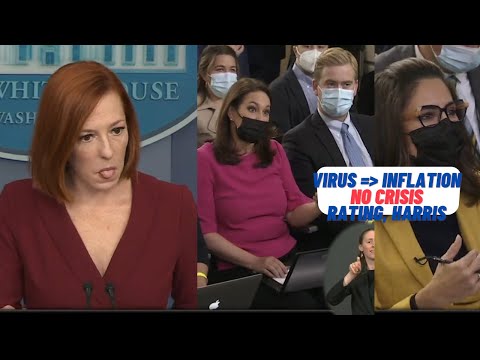
Psaki Blames COVID for Inflation and Low Approval Ratings, Says “Not a Historic Economic Crisis,” Won’t Back Harris 2024
On November 15, 2021, White House Press Secretary Jen Psaki held a briefing that covered multiple politically sensitive topics. She attributed both inflation and Biden’s declining approval ratings to COVID-19 fatigue, declared that the country was “not in the middle of a historic economic crisis,” refused to say whether Biden would endorse a future Kamala Harris presidential bid amid reports of the vice president’s unhappiness, dismissed concerns that $1.75 trillion in new spending would worsen inflation, and defended the administration’s position on federal oil and gas leasing after a court forced the resumption of sales the president had tried to pause.
COVID Blamed for Everything: Inflation, Consumer Sentiment, Approval Ratings
A reporter confronted Psaki with a stark data point: the University of Michigan Consumer Sentiment Survey had fallen to its lowest level since November 2011. With Biden’s approval at 41 percent and his handling of the economy at 39 percent, the reporter asked what the White House believed was driving the decline.
Psaki’s answer was consistent: it was all about COVID. “Because of COVID, because of the impact of the pandemic, that has led to inflation. That has led to supply chain issues. And we know that even on a fundamental human level, people are tired of the pandemic,” she said. “It’s hard to get into the psychological mind, which this is a measure of.”
When asked whether infighting within the Democratic Party was contributing to the president’s low numbers, Psaki redirected again to the pandemic: “There’s a fatigue from COVID. We see that in poll after poll, in your poll, in many other polls that have come out around the country. People are sick and tired of COVID and the impacts on the economy.”
The framing was notable because Biden had campaigned on a promise to “shut down” the virus, creating an expectation that his administration would be judged on its success in doing so. By attributing his own poor ratings to the persistence of the pandemic, Psaki was implicitly acknowledging the failure to deliver on that signature promise while simultaneously using it as an explanation for every negative indicator.
”We Are Not in the Middle of a Historic Economic Crisis”
Psaki made a statement that drew immediate attention when she was asked about the timeline for Americans to feel the benefits of the administration’s legislation.
“Sometimes people compare this to the Recovery Act of 2009. It is not that. We are not in the middle of an economic, a historic economic crisis right now,” she said. “This is an opportunity to build our country back better.”
The assertion that November 2021 did not qualify as a “historic economic crisis” was made while inflation was running at a 31-year high, consumer sentiment was at a decade low, supply chain disruptions were leaving store shelves bare for the holidays, and gas prices were climbing to levels not seen in years. Critics argued the statement revealed a White House that was disconnected from the economic reality facing ordinary Americans.
Build Back Better Won’t Worsen Inflation — Because Economists Say So
A reporter pressed Psaki directly: with inflation at a 31-year high and Americans watching their paychecks stretch less, why should they not be concerned that injecting another $1.75 trillion would further raise inflation?
Psaki’s answer relied on authority rather than mechanism: “Because no economist out there is projecting that this will have a negative impact on inflation. And actually, what it will help do, it will help increase economic productivity. It will help economic growth in this country.”
When pressed on what the president was doing “now, like immediately” to help Americans struggling with rising costs, Psaki acknowledged that “the number one thing that the President can do is help get COVID under control. That, we know, is the root cause of inflation.”
She then pivoted to longer-term Build Back Better provisions: “Cutting childcare costs in half, making preschool free for families starting in 2022, saving families $8,600.” The gap between the immediate pain Americans were experiencing and the administration’s focus on programs that would not take effect for months or years remained a persistent challenge for the White House’s economic messaging.
Psaki Won’t Endorse a Harris Presidential Bid
Fox News’ Peter Doocy asked whether Biden would support a presidential bid by Vice President Harris, either in 2024 or 2028. The question came amid a wave of reports that Harris was feeling sidelined within the administration and that key members of her staff were unhappy.
Psaki’s response was carefully calibrated to praise Harris without making any commitment. She called the vice president “a key partner” and “bold leader” and said Biden had selected her “because he felt she was exactly the person he wanted to have by his side to govern the country.”
But on the actual question of endorsement, Psaki deflected: “I don’t have any predictions of whether she will run or when she will run. I will leave that to her.”
When Doocy pressed on whether the White House had heard that Harris or her staff were unhappy, Psaki offered what amounted to a non-denial denial: “There’s been a lot of reports out there and they don’t reflect his view or our experience with the vice president.”
She described Harris as “somebody who is not only taking on issues that are challenging, she’s not looking for a cushy role here.” The careful language — praising Harris’s willingness to take on difficult assignments without actually endorsing her political future — left the impression that the question of Harris’s ambitions was a source of tension within the administration.
Rittenhouse and Oil Leasing
The briefing also touched on two additional flashpoints. When asked about Biden’s earlier suggestion that Kyle Rittenhouse, then on trial in Kenosha, was a white supremacist, Psaki offered a limited response: “The President’s view is that we shouldn’t have, broadly speaking, vigilantes patrolling our communities. Beyond that, I’m not going to speak to any individuals or this case.” Rittenhouse’s mother had publicly accused Biden of defaming her son to win votes.
On energy, Psaki addressed the administration’s position on federal oil and gas leasing after a federal court in Louisiana had blocked Biden’s executive order pausing new leases. The court ruled that the Interior Department was legally required to proceed with lease sale 257 in the Gulf of Mexico.
Psaki emphasized that the administration was complying under protest: “We believe the decision is wrong and the Justice Department is appealing it. We’re required to comply with the injunction.” She stressed the forced sale was “not aligned with our view, the President’s policies, or the executive order that he signed.”
The irony was not lost on critics: the administration was being forced by courts to allow oil production at the same time it was asking OPEC to pump more oil and telling Americans it was “monitoring” high gas prices with unspecified “tools in our arsenal.”
Key Takeaways
- Psaki blamed COVID for both inflation and Biden’s 41% approval rating, saying “people are sick and tired of COVID,” while declaring the U.S. was “not in the middle of a historic economic crisis” even as inflation hit a 31-year high and consumer sentiment fell to its lowest since 2011.
- She refused to say whether Biden would endorse a future Kamala Harris presidential bid amid reports of the VP’s unhappiness, calling Harris a “key partner” and “bold leader” while acknowledging she had “no predictions” about Harris’s political future.
- The administration argued $1.75 trillion in new spending would ease rather than worsen inflation because “no economist out there is projecting” a negative impact, while being forced by a federal court to resume Gulf of Mexico oil and gas lease sales the president had tried to block.