 HYGO News
 Very very clear border not open, KJP Nonsensical Word Salad About Border
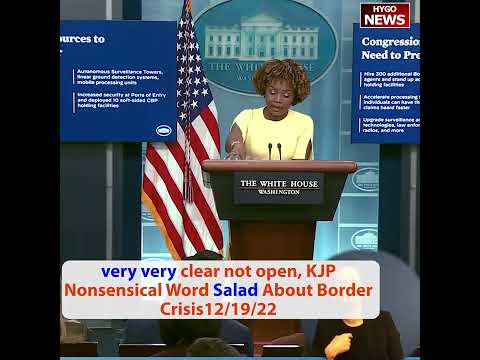
KJP Urges Migrants “Very Very Clear” Border Not Open — Cites Title VIII (Not Title 42) and Smuggler Disinformation
On 12/20/2022, White House Press Secretary Karine Jean-Pierre repeatedly emphasized to potential migrants that the border would not be “open” after Title 42’s anticipated end. A reporter asked what message in English should be communicated to migrants considering coming after Wednesday. “I just laid that really clear. It would be wrong to think that the border is open. It is not open. And I just want to be very, very clear about that,” KJP said. She then explained the reasoning: “One of the reasons that I want to be very clear to folks that the border is not open and we will remove using Title VIII is because by not being very clear on that, we are doing the work of the smugglers who are going to put forth misinformation.” The “Title VIII” reference was notable — it’s the legal framework for removals, different from the more commonly known Title 42.
The “Very Very Clear” Message
KJP emphasized clarity with repetition. “It would be wrong to think that the border is open. It is not open. And I just want to be very, very clear about that,” KJP said.
The repetition had features:
Multiple clarity emphasis — “Very, very clear.”
Binary message — Open/not open.
Correction framing — “Wrong to think.”
Strong assertion — Without hedging.
Administration positioning — Against open border narrative.
The emphatic repetition served administration messaging purposes but also suggested concern that the message wasn’t getting through. If the message had been widely understood, “very, very clear” emphasis wouldn’t have been needed. The repetition suggested awareness that the opposite message — that the border was effectively open — was also circulating.
The Message Target
The reporter’s question had specified the target. “In English to migrants who might be thinking about it, what should they do after Wednesday?” the reporter asked.
“In English” was specific. It acknowledged:
Most migrants spoke other languages — Primarily Spanish.
English audience existed — For administration messaging.
Direct migrant messaging — Typically in Spanish.
General public messaging — In English.
Media audience — In English.
The administration’s “border not open” message was being delivered in English for American audiences and media. Whether it was being communicated effectively to Spanish-speaking potential migrants was a separate question.
”Title VIII” Reference
KJP’s technical reference was notable. “We will remove using Title VIII,” KJP said.
Title VIII refers to:
Immigration and Nationality Act — Chapter 8 of U.S. Code.
Removal procedures — For unauthorized entrants.
Legal framework — For deportation.
Standard enforcement — Pre-existing law.
Independent of Title 42 — Different authority.
The distinction between Title 42 and Title VIII was important:
Title 42 — Public health authority used for expedited expulsion.
Title VIII — Standard immigration enforcement framework.
Different processes — With different procedures.
Different outcomes — For migrants.
Different capacities — For enforcement.
When Title 42 ended, processing would shift to Title VIII procedures. These were more lengthy but fundamentally different. Title VIII processing required:
Full asylum hearings — For those claiming asylum.
Immigration court backlogs — Affecting timing.
Due process — Including attorney access.
Appeals — Multiple levels.
Removal orders — After process complete.
The administration’s “Title VIII removal” framing was technically accurate but misleading. Title VIII removals could take years to complete. Many migrants granted Title VIII processing ended up remaining in the U.S. for extended periods, regardless of ultimate deportation orders.
The Smuggler Disinformation Concern
KJP explained her emphasis. “By not being very clear on that, we are doing the work of the smugglers who are going to put forth misinformation,” KJP said.
The smuggler disinformation concern was legitimate:
Smugglers profit — From migrant journeys.
They spread false information — About U.S. entry.
Previous surges — Driven partly by smuggler claims.
Economic incentive — To encourage migration.
Media manipulation — By smuggling networks.
Whenever U.S. policy changed, smugglers had incentive to claim:
Border was opening — Encouraging journeys.
New opportunities existed — For specific groups.
Previous restrictions removed — Misleading migrants.
Current moment special — For urgent decisions.
U.S. policy favored migrants — Without qualification.
These false claims generated migrant interest in making the journey. Each time, the administration’s clear messaging was necessary to counter smuggler narratives.
”Doing the Work of the Smugglers”
KJP’s framing that unclear messaging would “do the work of smugglers” was rhetorically strong. It positioned:
Clear administration messaging — As anti-smuggler.
Unclear messaging — As helping smugglers.
Responsibility framing — For effective communication.
Humanitarian concern — About migrant exploitation.
Enforcement logic — For deterrent messaging.
But the framing had complications:
Messaging alone — Couldn’t overcome smuggler interest.
Actions mattered more — Than words.
Experience-based decisions — By potential migrants.
Multiple information sources — Beyond U.S. messaging.
Economic desperation — Overriding deterrence.
Smugglers had direct contact with potential migrants. U.S. government messaging reached potential migrants indirectly. Even perfectly clear messaging couldn’t fully counter smuggler narratives.
The Message Consistency Challenge
The administration’s “border not open” message faced consistency challenges:
Administration actions — Various enforcement practices.
Local outcomes — Release of some migrants.
Success stories — Of migrants establishing residence.
Media coverage — Of border conditions.
Social media — Sharing migrant experiences.
Each time a migrant successfully entered and established residence, the “border not open” message was challenged. Smugglers could point to specific cases. Potential migrants would evaluate administration messaging against observed outcomes.
This was the fundamental challenge. Administration messaging was clear enough. Administration actions didn’t consistently match the messaging. The gap created opportunities for smuggler counter-messaging.
The “Nonsensical Word Salad” Headline
The article’s headline characterized KJP’s response as a “nonsensical word salad.” The “word salad” framing was pointed criticism:
Word salad — Disorganized speech.
Lacking coherence — Poor communication.
Technical references — Without clear explanation.
Repetitive emphasis — “Very, very” phrases.
Mixed messaging — Multiple unclear points.
Whether KJP’s response was “nonsensical” was a matter of interpretation. She had conveyed:
Clear message — Border not open.
Technical legal framework — Title VIII.
Reasoning for clarity — Anti-smuggler concern.
Repeated emphasis — For communication.
Critics could argue the response was clear messaging. Supporters of the “word salad” characterization could point to:
Technical legal references — Not accessible to general audiences.
Repeated identical phrases — Without new content.
Circular reasoning — About needing clarity.
No specific operational plans — For implementation.
Disconnect between message and reality — At actual border.
The Title 42 Status
At the time of this briefing, Title 42 was scheduled to end December 21, 2022. But the Supreme Court had been considering intervention:
Republican-led states — Had filed emergency stay request.
Chief Justice Roberts — Was evaluating.
Administration preparing — For multiple scenarios.
Uncertain timing — Of court action.
Communications challenges — During uncertainty.
The “Title VIII removal” reference suggested the administration was preparing for Title 42’s end regardless of court action. But the actual Title VIII implementation would depend on:
Court timing — When Title 42 actually ended.
Legal constraints — On Title VIII processing.
Administrative capacity — For different procedures.
Political factors — Affecting implementation.
International cooperation — For returns.
The Broader Communication Challenge
KJP’s response exemplified administration communication challenges:
Clear message needed — Complex situation existed.
Technical framework — Required for accuracy.
Political implications — Affected framing.
Multiple audiences — With different needs.
Credibility concerns — With all audiences.
The “very, very clear” emphasis revealed the underlying communication difficulty. When messaging required such emphatic repetition, it suggested the basic message wasn’t being received effectively. Administration communications on the border throughout 2022 had this quality — emphatic messages about enforcement alongside limited enforcement operational evidence.
The Immigration Question Context
KJP referenced “your immigration question” from earlier. “I do want to go back for a second to your immigration question,” KJP said.
This indicated:
Previous question — About immigration.
KJP returning to it — After initial response.
Reconsideration — Of prior answer.
Additional message — She wanted to emphasize.
Communication priority — For administration.
Returning to an earlier question to emphasize points suggested KJP wasn’t satisfied with her original answer. She wanted to reinforce the “border not open” message specifically.
The Repetition Pattern
KJP’s response had multiple repetitions:
“Very, very clear” — About border status.
“Very clear” — Again later.
“Very clear to folks” — Repetition emphasis.
“Very clear on that piece” — More repetition.
The repetition pattern of “very clear” variations suggested:
Message rehearsal — Practicing key phrase.
Emphasis through repetition — Rhetorical technique.
Limited vocabulary — Under pressure.
Talking point adherence — Following script.
Communication anxiety — About reception.
Whether the repetition was effective communication was debatable. “Very, very clear” used multiple times in short succession could sound more nervous than emphatic. Skilled communicators often use varied language for emphasis rather than pure repetition.
The 2023 Reality
When Title 42 eventually ended in May 2023, the “border not open” message was tested by reality:
Title VIII was implemented — As KJP had indicated.
Asylum procedures continued — With backlogs.
Many migrants entered — Via various pathways.
CBP One app — Created appointment system.
Humanitarian parole — For specific populations.
Various enforcement actions — Alongside releases.
The outcome was complex. Technically, the border wasn’t “open” — there were procedures and enforcement. But many migrants did enter and remain, at least temporarily. The “not open” message was technically accurate but practically misleading for many migrants’ experiences.
KJP’s late 2022 messaging would be evaluated against these eventual outcomes. The “very, very clear” emphasis from December 2022 would be remembered when May 2023 outcomes didn’t match the simple “not open” framing.
Key Takeaways
- KJP emphasized to migrants considering journeys that the border would not be “open” after Title 42 ended.
- She used repeated “very, very clear” phrasing multiple times for emphasis.
- KJP referenced Title VIII (standard immigration enforcement framework) as the mechanism for continued removals.
- Her reasoning for emphatic messaging: unclear communication would be “doing the work of the smugglers who are going to put forth misinformation.”
- The exchange captured administration communication challenges — clear messages delivered against complex reality that wouldn’t match simple framings.
- When Title 42 eventually ended in May 2023, the “border not open” message faced testing against actual outcomes that often included migrant entry and residence.
Transcript Highlights
The following is transcribed from the video audio (unverified — AI-generated from audio).
- In English to migrants who might be thinking about it, what should they do after Wednesday?
- I just laid that really clear. It would be wrong to think that the border is open. It is not open.
- I just want to be very, very clear about that.
- One of the reasons that I want to be very clear to folks that the border is not open and we will remove using Title VIII.
- Is because by not being very clear on that, we are doing the work of the smugglers who are going to put forth misinformation.
- So we want to be very clear on that piece.
Full transcript: 121 words transcribed via Whisper AI.