 HYGO News
 Use $3B money to solve border; blame GOPs; Biden working on since Day One
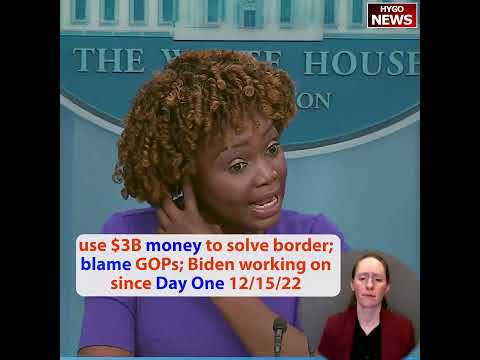
KJP on Title 42 End: Blames GOP for Blocking $3B Border Plan, Claims COVID Tools Ready, Recycles “Day One” Biden Work Framing
On 12/15/2022, a reporter asked White House Press Secretary Karine Jean-Pierre about preparations if Title 42 did end — including resources for overwhelmed border communities and concerns about a potential COVID spike. “What kind of preparations are being done in case it doesn’t end? Communities do get overwhelmed and need some resources. And also, does the administration fear that the end of Title 42 will lead to a spike in COVID cases of the country?” the reporter asked. KJP pointed to a $3 billion border funding request: “We put forth some $3 billion plan that we are asking for Congress to support.” She pivoted on the COVID question to claim “the American people have tools” because of Biden’s work. She concluded by recycling her standard framing: “It is something that the president has been working on since day one of his administration.”
The $3 Billion Request
KJP cited a specific dollar figure. “So let me just talk a little bit about the three, but there’s $3 billion for Board of Funding. So a couple of things, you know, again, if Republicans are serious about this, we put forth some $3 billion plan that we are asking for Congress to support,” KJP said.
The $3 billion figure referenced a supplemental funding request the administration had made to Congress for border-related operations. The request included:
Border Patrol resources — Personnel, equipment, infrastructure.
Processing capacity — Facilities and staff.
Transportation — For migrant movements.
Contract services — NGO partnerships.
Detention capacity — Various holding facilities.
Technology investments — Surveillance and monitoring.
The request had been made to Congress but had not been approved. This allowed the administration to:
Claim it had requested resources — Showing engagement.
Blame Congress for not providing — Shifting responsibility.
Maintain request as ongoing — Rather than conceding failure.
Use Republican opposition — As political fodder.
”If Republicans Are Serious”
The “if Republicans are serious” framing was another attack on Republicans. By questioning Republican seriousness, KJP was suggesting that:
Republican rhetoric didn’t match action — They talked border but blocked funding.
Republicans were performative — Not actually seeking solutions.
Democratic seriousness was established — By making the request.
Republican cooperation was needed — To achieve results.
The framing put Republicans in a bind. If they supported the $3 billion request, they’d be funding the administration’s approach to the border. If they opposed it, they’d be “not serious” about the issue. This framing made Republican cooperation seem like the only way for them to demonstrate genuine engagement.
But the framing oversimplified political reality. Republicans had their own proposals for border funding and policy. The administration’s proposal wasn’t the only legitimate approach. Republicans could be substantively opposed to specific provisions while still being serious about border issues.
The Communities Overwhelmed Question
The reporter had asked about overwhelmed communities. “Communities do get overwhelmed and need some resources,” the reporter had said.
This was a substantive concern. Border communities — El Paso, Del Rio, Laredo, Yuma, and others — had been experiencing:
Increased migration traffic — Passing through on way to interior destinations.
Strained services — Hospitals, shelters, law enforcement.
Economic impacts — On local businesses and infrastructure.
Political pressure — From residents on local officials.
Federal coordination issues — Between local and federal roles.
Communities that had been coping with Title 42-era flows worried about what would happen if those flows increased significantly. They needed resources to manage the situation.
KJP’s response didn’t specifically address community resources. The $3 billion figure was for federal operations, not for local community support. This gap — between federal spending on federal operations and local community needs — wasn’t addressed in KJP’s response.
The COVID Spike Question
The reporter’s second question was about COVID. “Does the administration fear that the end of Title 42 will lead to a spike in COVID cases of the country?” the reporter asked.
This was a genuinely complex question. Title 42 had been invoked as a COVID public health measure. Its end raised questions about:
Public health implications — Whether COVID spread would increase.
Pretextual nature — Whether Title 42 was genuinely about COVID.
Ongoing concern — Given COVID variants and continued transmission.
Administrative logic — Why end a COVID measure if COVID concerns remained.
Testing and vaccination — For migrants crossing the border.
The COVID aspect of Title 42 had always been somewhat contested. Some viewed it as a genuine public health measure. Others viewed it as immigration enforcement masquerading as public health. Ending it required the administration to address whether COVID was no longer a concern.
”American People Have Tools”
KJP responded to the COVID question indirectly. “To your question about the winter surge, how Dr. Jha was talking about this from the podium, look, because of the president’s work and what he’s been able to do throughout his administration, the American people have tools. We know what works,” KJP said.
The response pivoted to COVID tools generally:
Dr. Ashish Jha — The administration’s COVID coordinator.
“American people have tools” — Vague capability reference.
“We know what works” — Claim of understanding.
“The president’s work” — Credit to Biden.
This framing avoided the specific question about whether Title 42’s end would increase COVID spread. Instead of addressing that question, KJP pivoted to a general discussion of COVID tools.
The pivot made political sense. The administration couldn’t honestly say that ending a COVID measure wouldn’t affect COVID spread. But it also couldn’t say Title 42’s end would cause COVID problems — that would undermine the administration’s acceptance of the end.
The general “tools” reference provided an escape route. Regardless of whether Title 42’s end affected COVID, Americans had tools. Vaccines, testing, treatments all existed. These tools would be available regardless of border policy.
The Missing COVID Analysis
What KJP didn’t address was the specific linkage between Title 42 and COVID. An honest engagement would have acknowledged:
Title 42 had been a COVID measure — In its stated justification.
COVID still existed — In December 2022.
Variants were still emerging — Including XBB subvariants.
Migrant screening was limited — At the border.
Local healthcare strain — Was already occurring.
Policy priorities had shifted — From COVID-centric to immigration-centric.
None of this substantive analysis appeared in KJP’s response. The generic “tools” framing avoided engagement with these specific factors.
”On Top Of This”
KJP claimed administration vigilance. “It’s been on top of this. We are prepared. We are ready to do this in a humane way and in a safe way,” KJP said.
The “on top of this” phrasing was informal but conveyed attention. The “prepared” and “ready” claims were the familiar administration assurances.
“Humane way and safe way” referenced administration priorities:
Humane — Not causing migrant suffering.
Safe — For both migrants and Americans.
These value statements were appropriate for administration messaging. But they didn’t address the specific question about preparation. Being humane and safe was a goal, not a preparation.
”Since Day One” Again
KJP concluded with her standard framing. “And so it is something that the president has been working on since day one of his administration,” KJP said.
The “since day one” framing appeared yet again. The repetition across briefings was notable:
Consistent messaging — Administration kept returning to this frame.
Familiar language — Even to reporters tired of hearing it.
Deflective content — Suggested ongoing work without specifics.
Credit maximization — Claiming long-term engagement.
The frequency of the “since day one” reference suggested it was a conscious administration talking point. Every border-related briefing included some version of this framing. The consistency suggested communications staff had identified it as effective messaging.
But whether it was actually effective was debatable. Reporters and observers had heard it repeatedly. Any rhetorical power it once had was diminished by overuse. The framing became a placeholder where actual information might have been.
The Overall Pattern
The exchange exemplified the administration’s complete border messaging package:
$3 billion funding request — Showing engagement. Republican blame — If they weren’t serious. COVID tools claim — Without specific linkage. “Prepared” and “ready” — Generic assurances. “Humane and safe” — Value statements. “Since day one” — Long-term engagement.
Each component served a political purpose. Together, they produced messaging that addressed multiple audiences without providing substantial operational detail on any specific concern.
The Six-Point Plan Context
This briefing came after KJP had referenced DHS Secretary Mayorkas’s six-point plan in earlier exchanges. The six-point plan and the $3 billion request were different things:
Six-point plan — Operational framework for border response. $3 billion request — Funding for operational activities.
The plan specified what would be done; the funding specified how much resources would be available. Both were administration responses to the approaching Title 42 deadline.
KJP’s shifting between references — six-point plan in one briefing, $3 billion request in another — suggested a grab-bag approach to border messaging. Different talking points served different briefing moments. No single comprehensive framework was being presented consistently.
The Fed and the Border
The administration’s border messaging contrasted with its approach to Federal Reserve monetary policy. On inflation, KJP claimed significant credit for Biden’s agenda while not crediting the Fed. On the border, KJP claimed preparation and engagement while not detailing specifics.
Both patterns served political purposes:
Inflation — Claim credit for positive developments. Border — Claim preparation despite ongoing challenges.
In both cases, the administration’s messaging was optimistic about its own contributions. Specific operational details that might have qualified the optimism were consistently avoided.
The Political Context
By December 2022, border issues had significant political weight. The 2022 midterms had shown:
Immigration as voter concern — In many districts.
Republican border messaging — Had resonance.
Democratic vulnerability — On border issues.
Specific state concerns — Border states particularly sensitive.
The administration needed to show competence on border matters without:
Admitting problems — That would confirm Republican criticisms.
Making specific commitments — That might not be met.
Blaming Democrats — Who had internal disagreements.
Alienating progressive base — On immigration enforcement.
This political balance required the careful messaging KJP was providing. Specific operational claims could be verified and might fail. General engagement claims couldn’t be disproven. The administration preferred the generalities.
Key Takeaways
- A reporter asked about preparations for overwhelmed border communities and potential COVID spike concerns from Title 42’s end.
- KJP cited the administration’s $3 billion border funding request to Congress: “If Republicans are serious about this, we put forth some $3 billion plan.”
- On COVID, she pivoted to generic tools discussion: “Because of the president’s work… the American people have tools.”
- KJP assured “we are prepared” and “ready to do this in a humane way and in a safe way.”
- She concluded with the recycled framing: “The president has been working on since day one of his administration.”
- The response didn’t address specific resources for overwhelmed communities or engage with the substantive COVID-Title 42 linkage.
Transcript Highlights
The following is transcribed from the video audio (unverified — AI-generated from audio).
- What kind of preparations are being done in case it doesn’t end? Communities do get overwhelmed and need some resources.
- Does the administration fear that the end of Title 42 will lead to a spike in COVID cases of the country?
- If Republicans are serious about this, we put forth some $3 billion plan that we are asking for Congress to support.
- Because of the president’s work and what he’s been able to do throughout his administration, the American people have tools. We know what works.
- It’s been on top of this. We are prepared. We are ready to do this in a humane way and in a safe way.
- It is something that the president has been working on since day one of his administration.
Full transcript: 176 words transcribed via Whisper AI.