 HYGO News
 US carried out massive precision strikes on three key nuclear facilities; either peace or tragedy
US carried out massive precision strikes on three key nuclear facilities; either peace or tragedy
The night the decision window closed came not with the full two weeks Trump had advertised but with action executed earlier. The United States military conducted precision strikes against three of the most sensitive targets in the Iranian nuclear program — Fordow, Natanz, and Isfahan — in what Trump described as a “spectacular military success” and what, if the damage assessments hold, represents the most consequential American military action in the Middle East since the 2011 operation against Osama bin Laden. The strikes were delivered by platforms and munitions — including the B-2 Spirit and the GBU-57 Massive Ordnance Penetrator — that no other military in the world possesses. Trump addressed the nation from the White House, stated the objective, declared it achieved, and delivered the ultimatum: Iran must now make peace, or further targets will be hit. This is the article on the night the posture changed from “two weeks” to executed action.
”Massive Precision Strikes”
Trump’s opening was formal. “A short time ago, the U.S. military carried out massive precision strikes on the three key nuclear facilities in the Iranian regime, Fordow, Natanz, and Esfahan.”
The three site names are the ones that have dominated Iran nuclear reporting for two decades. Fordow is the deeply buried enrichment facility that has been the most technically challenging target. Natanz is the primary enrichment site. Isfahan is the uranium conversion facility. Together, these three sites form the core of Iran’s nuclear weapons-relevant infrastructure.
”Everybody Heard Those Names For Years”
Trump’s aside was candid. “Everybody heard those names for years as they built this horribly destructive enterprise.”
The observation is historically accurate. American intelligence assessments, international inspections reports, Israeli public statements, and think tank analysis have named these three sites repeatedly over the past 15 years. The sites have been at the center of the nuclear dispute with Iran from the beginning. Any American president has known their names.
”Spectacular Military Success”
Trump delivered the operational verdict. “Our objective was the destruction of Iran’s nuclear enrichment capacity and a stop to the nuclear threat posed by the world’s number one state sponsor of terror. Tonight, I can report to the world that the strikes were a spectacular military success.”
The adjective “spectacular” is significant. Presidents after military operations typically describe them as “successful” or “effective.” “Spectacular” is a stronger claim that implies dramatic results beyond routine operational achievement.
”Completely And Totally Obliterated”
Trump’s characterization of the damage was maximal. “Iran’s key nuclear enrichment facilities have been completely and totally obliterated.”
The claim is extraordinary. “Completely and totally obliterated” is the strongest possible damage assessment. The reality of post-strike damage assessment is that subsequent imagery, subsequent intelligence, and subsequent reporting will refine the claim. Nuclear facilities, particularly underground facilities, are complex structures where damage to above-ground elements can coexist with preservation of below-ground functions. The “completely and totally” framing is the president’s public claim, not necessarily the final intelligence community assessment.
But the framing matters politically. If the claim is even approximately true, the strikes have achieved the administration’s objective — removing Iran’s near-term capacity to produce nuclear weapons. Iran would need to rebuild significant infrastructure before the weapons program could be restarted, and the rebuilding would take years.
”Iran Must Now Make Peace”
Trump then delivered the ultimatum. “Iran, the bully of the Middle East, must now make peace. If they do not, future attacks will be far greater and a lot easier.”
The structure is the classical threat-plus-offer. The offer: peace, with an implicit framework for what peace would look like — likely including Iranian commitment not to reconstitute the nuclear program and other regional concessions. The threat: if the offer is rejected, further attacks that will be “far greater and a lot easier.”
“A lot easier” is the operational point. The first-night strikes included Fordow, which has been the hardest target in the world. With Fordow gone, the remaining Iranian nuclear infrastructure is less well-protected. Subsequent strikes can be executed with greater confidence in their effectiveness because the target set is less technically demanding.
The 40-Year Framing
Trump provided the historical context. “For 40 years, Iran has been saying death to America, death to Israel. They have been killing our people, blowing off their arms, blowing off their legs with roadside bombs. That was their specialty. We lost over a thousand people and hundreds of thousands throughout the Middle East and around the world have died as a direct result of their hate.”
The “40 years” anchor places the conflict in the context of the Iranian Revolution of 1979 and the subsequent four-plus decades of Iranian-American hostility. The hostage crisis, the Beirut barracks bombing, the Khobar Towers bombing, the Iraq-era IED network, the proxy wars in Lebanon, Syria, Yemen, and Iraq — all of it traces back to the same regime.
”Blowing Off Their Arms, Blowing Off Their Legs”
The specific reference to IEDs is significant. Iranian-provided explosively formed penetrators (EFPs) were responsible for a substantial portion of U.S. military casualties during the Iraq War. The Iranian contribution to American casualties was a matter of public record, but it was not typically foregrounded in American political discourse. Trump’s explicit naming of this contribution is an indictment that has been accumulating, waiting for the moment.
Soleimani And The Casualty Count
Trump named the architect. “In particular, so many were killed by their general, Qassem Soleimani. I decided a long time ago that I would not let this happen. It will not continue.”
Soleimani, commander of the Iranian Quds Force, was killed in a U.S. drone strike in January 2020 during Trump’s first administration. His name in this address is a reminder of the prior actions the administration has taken against Iranian military leadership.
“I decided a long time ago that I would not let this happen. It will not continue.” The assertion of personal decision — “I decided” — places the strike in the context of Trump’s long-standing view that Iranian-sponsored violence against Americans needed to be addressed with force, not diplomacy.
”Either Peace Or Tragedy”
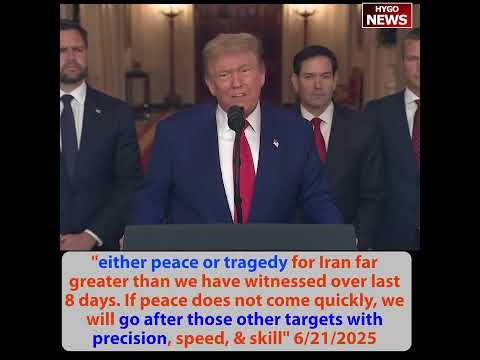
Trump’s most consequential phrasing was the binary framing. “With all of that being said, this cannot continue. There will be either peace or there will be tragedy for Iran far greater than we have witnessed over the last eight days.”
“Either peace or tragedy” is the choice presented to Tehran. The scale of the tragedy — “far greater than we have witnessed over the last eight days” — is the implicit threat. The past eight days have been devastating for Iran. The next eight could be worse.
”Targets Left”
Trump listed the tactical reality. “Remember, there are many targets left. That was the most difficult of them all by far and perhaps the most lethal. But if peace does not come quickly, we will go after those other targets with precision, speed, and skill. Most of them can be taken out in a matter of minutes.”
The structure is specific. Many targets remain. Fordow was the hardest. The remaining targets can be attacked rapidly. Iran’s decision window is therefore not just “make peace now.” It is “make peace now or accept further rapid destruction."
"No Military In The World Could Have Done What We Did Tonight”
Trump made the explicit capability claim. “There is no military in the world that could have done what we did tonight, not even close. There has never been a military that could do what took place just a little while ago.”
The claim is factually defensible. The combination required for the Fordow strike — B-2 Spirit bombers flying from the continental United States, refueling multiple times, delivering GBU-57 Massive Ordnance Penetrators against an underground facility in hostile airspace — is a capability set that no other country possesses.
Russia has the bombers but not the penetrators. China has some of each but not in the combination. Britain and France have sophisticated forces but not the specific capability. The statement is not hyperbole. It is an accurate description of the American monopoly on this specific mission profile.
”The Great American Patriots”
Trump credited the aircrews. “I want to congratulate the great American patriots who flew those magnificent machines tonight and all of the United States military on an operation the likes of which the world has not seen in many, many decades.”
The acknowledgment of the aircrews is important. The pilots who flew the B-2s conducted a mission of historic consequence. Their names will not be publicly released for operational security reasons, but their role in the night’s events is permanent. The president’s public acknowledgment of their work is the formal recognition that their service has earned.
”Hopefully We Will No Longer Need Their Services”
Trump closed with the hope that further action will not be required. “Hopefully we will no longer need their services and this capacity. I hope that’s so.”
The hope is genuine. Trump does not want to strike additional targets. The purpose of the first-night action is to make additional action unnecessary. If Iran accepts the binary — peace or further tragedy — and chooses peace, the operation is complete.
If Iran chooses to continue, the operation continues. Trump is telling American aircrews to prepare for possible subsequent missions while simultaneously hoping those missions will not be required.
Return To Andrews And The White House
The video closes with Trump’s return to Joint Base Andrews and then to the White House. The return flight from wherever the president was during the strikes is the standard presidential movement pattern during major military operations. Presidents typically remain in secure locations during active combat operations and return to the White House once the initial phase is complete.
The ceremonial arrival — wheels down at Andrews, motorcade to the White House — is the public marker that the acute phase has passed. The president is back at his post. The nation has just seen the United States conduct the most consequential military action in a decade. The work of managing the aftermath — diplomatic, military, and political — begins.
The Two-Week Window Question
Observers will note the tension between Leavitt’s statement days earlier — that Trump would make his decision within “the next two weeks” — and the action executed within days of that statement. Two explanations are consistent with both facts.
First, the two-week window was a ceiling, not a floor. Trump reserved the option to act anytime within that window. Executing earlier is consistent with the announced policy.
Second, the two-week window was itself a diplomatic tool. Announcing a longer window gave Iran the impression of more time. Acting within a shorter window denied Iran the opportunity to complete whatever defensive preparations the longer window might have enabled.
Both readings are consistent with the administration’s operational behavior and with the outcome. The president reserved flexibility, used strategic ambiguity, and executed action in a window that preserved both operational advantage and legal authority.
Key Takeaways
- Trump: “The U.S. military carried out massive precision strikes on the three key nuclear facilities in the Iranian regime, Fordow, Natanz, and Esfahan…Iran’s key nuclear enrichment facilities have been completely and totally obliterated.”
- The ultimatum: “Iran, the bully of the Middle East, must now make peace. If they do not, future attacks will be far greater and a lot easier.”
- The binary framing: “There will be either peace or there will be tragedy for Iran far greater than we have witnessed over the last eight days.”
- Targets remaining: “Remember, there are many targets left…Most of them can be taken out in a matter of minutes.”
- The capability claim: “There is no military in the world that could have done what we did tonight, not even close.”