 HYGO News
 Twitter files released About Hunter Biden Laptop Scandal, official finding hacked materials clause?
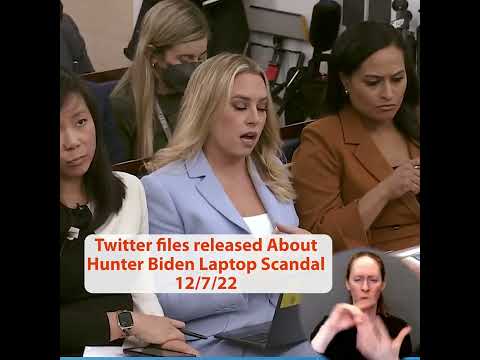
Reporter to KJP: Twitter Files Show No “Hacked Materials” Finding Triggered Laptop Suppression — Did Biden Team Tell Twitter the Materials Were Hacked?
On 12/5/2022, a reporter pressed White House Press Secretary Karine Jean-Pierre on a specific revelation from the Twitter Files about Twitter’s 2020 suppression of the Hunter Biden laptop story. The reporter noted that Twitter’s own “hacked materials” policy typically required an official or law enforcement finding that materials were hacked in order to justify restricting distribution — but Twitter Files journalist Matt Taibbi had reported that no such finding appeared in the Hunter Biden laptop materials. “Did anyone from the Biden team communicate to Twitter that this material was from, or this reporting stemmed from hacked materials?” the reporter asked. The question cut to the heart of the Twitter Files controversy: if Twitter cited a hacked materials policy to suppress the story, but no finding of hacking existed, where had the suppression rationale come from? The reporter specifically asked about potential Biden campaign or family communications to Twitter that might have influenced the suppression decision.
The Twitter Hacked Materials Policy
The reporter’s question referenced a specific Twitter policy. “The Twitter files have released that the company typically required an official or law enforcement finding that materials were hacked in order to exercise their company policy to restrict certain stories or reporting,” the reporter said.
This was an accurate description of Twitter’s stated policy at the time. Twitter’s content rules included restrictions on distribution of “hacked materials” — content obtained through unauthorized access to private systems. The policy’s purpose was to prevent Twitter from being used as a distribution channel for stolen data that could harm victims.
But the policy had a specific trigger requirement: an official or law enforcement determination that materials were, in fact, hacked. Without such a finding, the policy shouldn’t apply. This safeguard existed to prevent the policy from being invoked arbitrarily based on political claims rather than factual determinations.
The Twitter Files revealed that this safeguard had apparently been bypassed in the Hunter Biden laptop case.
The Absence of Official Finding
The reporter cited the specific Taibbi reporting. “The journalist who released the material noted that in this case around the Hunter Vine laptop story there was no official or law enforcement finding appeared in the material that he was given,” the reporter said.
“Hunter Vine” was a transcription error for Hunter Biden. But the substantive point was clear: Matt Taibbi, reviewing Twitter’s internal documents about the laptop story suppression, had not found any official or law enforcement determination that the laptop materials were hacked.
This absence was critical. If no official finding of hacking had occurred, then:
- The “hacked materials” policy shouldn’t have applied
- Twitter had suppressed the story based on something other than its stated policy
- Someone had influenced Twitter’s decision outside the normal policy framework
- The real decision basis wasn’t the one Twitter had publicly cited
The question became: what had actually driven Twitter’s suppression decision if not the hacked materials policy properly invoked?
The Key Question
The reporter asked the substantive question. “Did anyone from the Biden team communicate to Twitter that this material was from, or this reporting stemmed from hacked materials?” the reporter asked.
This was the specific accountability question at the heart of the Twitter Files story. If the Biden campaign (or other Biden associates) had communicated to Twitter that the materials were hacked, that communication might have influenced Twitter’s decision to suppress the story even without an official finding.
The question had several dimensions:
Coordination — Was there a coordinated effort to suppress the story?
Influence — Did campaign communications actually affect Twitter’s decision?
False claims — Were the hacking claims accurate or convenient fictions?
Improper suppression — Had a presidential campaign helped suppress damaging news about its candidate?
If the answer to the underlying question was yes — that the Biden team had communicated hacked materials claims to Twitter — that would represent significant coordination between a presidential campaign and a major social media platform to suppress damaging news during the closing weeks of the election.
KJP’s Clarification Request
KJP’s first response was a clarification-seeking dodge. “Are you talking about the campaign?” KJP asked.
This was the same technique she had used in earlier exchanges — forcing the reporter to restate and clarify, buying time for composition. The clarification request was also somewhat disingenuous. The reporter had already said “the Biden team,” which in the 2020 electoral context clearly meant the campaign and related organizations.
The Reporter’s Clarification
The reporter expanded the question scope. “It would have been the campaign or anyone around the family,” the reporter said.
The expansion to include “anyone around the family” was significant. Hunter Biden’s own legal and communications team had been active during the 2020 campaign. His lawyers had made various statements about the laptop materials. Family representatives had pushed back on the New York Post coverage. Any of these actors might have communicated with Twitter about the materials’ provenance.
The reporter was covering all potential communication channels — the formal campaign, family representatives, family legal teams, or other associates who might have had contact with Twitter.
The Re-Statement of the Question
The reporter then restated the question more fully. “Just wondering because in the Twitter files released and what Matt Tabe said he noted that typically the company would require a law enforcement or official finding that something was hacked in order to exercise…,” the reporter said, with the transcript cutting off mid-sentence.
The re-statement added context that the initial question had compressed. The reporter was explaining:
- Twitter’s policy required an official finding
- No such finding appeared in the Twitter Files
- Yet Twitter had invoked the policy
- Something else must have triggered the invocation
The question was whether that “something else” had been communications from the Biden team.
The Significance of the Question
This was among the most pointed questions KJP had faced about the Twitter Files. Unlike general questions about whether the 2020 suppression was “appropriate,” this question focused on specific factual matters:
Did Biden team members communicate with Twitter? — A yes/no factual question.
Did those communications claim hacking? — A yes/no factual question.
Did Twitter rely on those communications? — A causal question.
Was the reliance proper? — A procedural question.
These were questions that admitted factual answers. The administration either knew (or could determine) whether the Biden team had communicated with Twitter about the laptop story. The question required substantive engagement rather than rhetorical deflection.
The Context of Coordination
The broader question raised significant constitutional and political issues. During the 2020 campaign, the Trump administration had been criticized for attempting to influence social media companies to take down content about Trump. Democrats had criticized such efforts as inappropriate government pressure on private platforms.
But the Twitter Files suggested that the Biden campaign might have engaged in the same type of pressure — communicating with Twitter to influence content moderation decisions. If this had occurred, the Biden side’s current ownership of the same criticism became awkward:
“Government shouldn’t pressure platforms” — If Biden’s campaign had pressured a platform, this principle applied to them too.
“Content decisions should be private matters” — If the Biden campaign had influenced a supposedly-private decision, that line was crossed.
“Platforms shouldn’t coordinate with political actors” — If Twitter had coordinated with the Biden campaign, this principle was violated.
The administration’s handling of Twitter Files questions — deflecting to “distraction” and “old news” characterizations — suggested awareness of these implications.
The Family Question
The expansion to “anyone around the family” added another layer of concern. Hunter Biden’s business activities had been the subject of the laptop materials. Communications from Hunter Biden’s representatives claiming the materials were hacked would have been self-interested — protecting the source of Hunter’s potential legal and reputational exposure.
If family representatives had made hacking claims that triggered Twitter’s suppression, the situation involved:
Self-interested actors making claims — The family had direct interest in suppression.
No supporting official finding — The claims weren’t verified by law enforcement.
Effective suppression of damaging story — Regardless of claim accuracy.
Benefit to presidential campaign — The suppression helped Biden’s campaign timing.
This pattern — self-interested actors making unverified claims that happened to benefit a presidential campaign at a critical moment — would have significant implications for understanding how information control worked during the 2020 election.
The 2023 Hearings
The Twitter Files exchanges in December 2022 previewed what would become extensive 2023 congressional scrutiny. House Republicans, taking control in January 2023, held multiple hearings on:
- Twitter executives’ decisions about the laptop story
- FBI communications with social media platforms
- Other platforms’ actions regarding the same story
- Biden campaign communications with platforms
Former Twitter executives testified. Documents were subpoenaed. Communications were examined. The investigations produced mixed findings — some evidence of FBI-Twitter communications, some evidence of platform self-censorship, but incomplete pictures of specific Biden campaign coordination.
The December 2022 KJP exchanges were early moments in what became a prolonged national conversation about social media, political campaigns, and content moderation. The administration’s refusal to engage substantively with the Twitter Files revelations set the tone for how administration officials would handle related questions throughout 2023.
The Unresolved Question
The question the reporter asked on December 5, 2022 — whether the Biden team had communicated hacking claims to Twitter — was never publicly answered by the Biden administration. KJP’s responses consistently deflected. The administration never denied that such communications had occurred. The administration never affirmed they had occurred. The question remained in the unanswered space that protected the administration from either admission.
This pattern — neither confirming nor denying, while characterizing the question as not worth engaging — became the administration’s standard posture on Twitter Files matters. The questions that merited direct answers received evasion instead. The questions about specific coordination received procedural dismissal.
Key Takeaways
- A reporter pressed KJP on specific Twitter Files revelations showing that Twitter’s “hacked materials” policy typically required an official or law enforcement finding of hacking to justify content suppression.
- Matt Taibbi’s Twitter Files reporting noted that no such finding had appeared in Twitter’s internal documents about the Hunter Biden laptop story.
- The reporter asked directly: “Did anyone from the Biden team communicate to Twitter that this material was from, or this reporting stemmed from hacked materials?”
- KJP sought clarification (“Are you talking about the campaign?”) rather than answering.
- The reporter expanded the question to include campaign staff or anyone around the Biden family who might have communicated with Twitter.
Transcript Highlights
The following is transcribed from the video audio (unverified — AI-generated from audio).
- The Twitter files have released that the company typically required an official or law enforcement finding that materials were hacked in order to exercise their company policy to restrict certain stories or reporting.
- The journalist who released the material noted that in this case around the Hunter Biden laptop story there was no official or law enforcement finding appeared in the material that he was given.
- Did anyone from the Biden team communicate to Twitter that this material was from, or this reporting stemmed from hacked materials?
- Are you talking about the campaign?
- It would have been the campaign or anyone around the family.
- The company would require a law enforcement or official finding that something was hacked in order to exercise…
Full transcript: 146 words transcribed via Whisper AI.