 HYGO News
 Tulsi Strips 37 Security Clearances Tied to Russia Hoax; CA redistricting transparent process
Tulsi Strips 37 Security Clearances Tied to Russia Hoax; CA redistricting transparent process
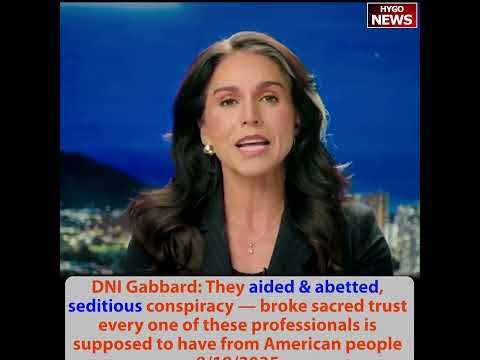
DNI Tulsi Gabbard revealed specific consequences from the Russia-hoax declassifications — 37 individuals had security clearances revoked for their involvement in what Gabbard characterized as a “seditious conspiracy.” And a California state senator overseeing the redistricting effort refused for nearly four minutes to answer who actually drew the congressional maps, while characterizing the process as “most transparent in the nation.” Gabbard: “Some of those folks and those 37 individuals that we revoked directed the revocation of security clearances from today, by under the direction of President Trump. They aided and abetted in this action, this seditious conspiracy that undermined our democracy, undermined our Republic, and broke that sacred trust that every one of these professionals is supposed to have from the American people.” The California evasion: Question: “Who was looking over CRC’s criteria to create the maps? Was it Paul Mitchell of Paul Mitchell’s strategies?” Response: “It was input, again … testimony that was given to the CRC.” Repeated question: “Don’t they deserve to know who drew these maps?” Response: “Again, this is the most transparent process in the nation."
"Not Just Your View”
Gabbard’s opening. “People who say, well, Tulsi, this is just your view or your interpretation, no. It’s all in hundreds of pages of documents that I’ve declassified and released that show point by point exactly what happened through this timeline.”
That is specific methodological framing. Gabbard’s Russia-hoax conclusions are not opinion. They are documented in declassified materials — hundreds of pages of specific documents showing the specific timeline of events during the Obama-Biden transition to the first Trump administration.
“Point by point exactly what happened through this timeline.” Specific chronological evidence. Specific actors named. Specific decisions documented. Specific intelligence assessments modified. Specific leaks coordinated.
“That showed this very dangerous thing that occurred in the creation of Russiagate, the creation of this manufactured intelligence assessment that essentially had the intent of undermining the voices and votes of the American people who elected Donald Trump.”
“Manufactured intelligence assessment.” That is specific framing. The 2017 Intelligence Community Assessment (ICA) on Russia election interference was, per Gabbard’s declassified documents, manufactured rather than rigorously developed. The assessment was designed for specific political outcomes rather than to reflect the underlying intelligence.
”Not Happy with the Outcome”
“They were not happy with the outcome of that election. And so they created this politicized, weaponized piece of fake intelligence that, as you mentioned, then went on to serve as a foundation for everything that came after, the multiple investigations, the years-long Mueller investigation, two congressional impeachments, investigations in the raid at Mar-a-Lago. The list goes on and on.”
The specific consequences. The ICA served as foundation for:
- Multiple congressional investigations
- The Mueller investigation (approximately 2 years, $32 million spent)
- Trump’s two impeachments
- The Mar-a-Lago raid
- Multiple other official actions
Each of those actions was predicated — per Gabbard’s framing — on intelligence that was manufactured to produce specific political outcomes. If the foundation was fraudulent, the structure built on that foundation was tainted.
”37 Individuals”
“Some of those folks and those 37 individuals that we revoked directed the revocation of security clearances from today, by under the direction of President Trump.”
37 individuals with revoked security clearances. Specific numeric accountability. The individuals who participated in creating or maintaining the manufactured ICA now face specific professional consequences.
Security clearance revocation is substantial. Most senior intelligence community professionals have security clearances that extend beyond their specific government positions. Revocation limits future intelligence consulting, think tank positions, and various private-sector national security roles.
”Seditious Conspiracy”
“They aided and abetted in this action, this seditious conspiracy that undermined our democracy, undermined our Republic, and broke that sacred trust that every one of these professionals is supposed to have from the American people.”
“Seditious conspiracy.” That is specific legal language. 18 U.S.C. § 2384 defines seditious conspiracy as an agreement to overthrow the government, levy war, or oppose government authority by force. Whether the specific actions taken meet the statutory definition is a specific legal question.
If the declassified documents substantiate the specific framework — coordinated action by intelligence community personnel to undermine a duly elected president through manufactured intelligence — that could potentially meet some seditious conspiracy elements. But seditious conspiracy typically requires force or violence, which the intelligence community actions did not involve directly.
More likely: specific individuals face professional consequences (clearance revocations) without criminal prosecution. Some may face specific criminal charges on narrower theories (false statements, obstruction, specific procedural violations). The “seditious conspiracy” framing may be Gabbard’s characterization rather than specific prosecutorial theory.
”Sacred Trust”
“Broke that sacred trust that every one of these professionals is supposed to have from the American people.”
The specific breach. Intelligence community professionals hold positions of specific public trust. Their loyalty is to the Constitution and the American people, not to specific political parties or officeholders. Using intelligence capabilities for partisan political purposes — specifically to undermine an elected president — violates that specific trust.
“Sacred” is strong language. Not merely professional ethics. A sacred trust — carrying specific moral weight beyond typical employment relationships. The specific breach is characterized as more serious than ordinary rule violations.
California Redistricting: “Most Transparent Process”
The segment pivots to California. The specific exchange between committee members.
Question: “So the rules committee was responsible of putting the maps onto our public website, the committee on elections.”
Follow-up: “Okay, so did this committee meet then to draw the lines? And we were just trying to ascertain who exactly is responsible for drawing these maps at this point.”
Response: “So the criteria has remained the same from the CRC. The reality is we are in an emergency, and this is our emergency response. We’re giving Californians over two and a half months to review these maps thoroughly and make a decision on whether or not we move forward with this constitutional amendment.”
That is evasive response. The question: who drew the maps? The answer: the criteria came from CRC (Citizens Redistricting Commission). The answer does not identify who actually drew the specific maps. Criteria versus map-drawing are different activities.
Multiple Specific Questions
“What is it? So is the State Senate elections committee, we drew these maps? Like you’re ready to say that?”
“The Senate Rules Committee drew these, put these maps, the census tracks onto the website.”
“So legislators drew the maps? Can we say that to our viewers?”
“Again, this was from CRC’s criteria. But who was looking over CRC’s criteria to create the maps? Was it Paul Mitchell of Paul Mitchell’s strategies?”
“It was input, again, for refusing to say who drew the maps. It was testimony that was given to the CRC.”
That sequence shows specific evasion. The questioner repeatedly asks who drew the maps. The responder repeatedly references process details (criteria, testimony, website) without naming the specific map-drawer.
“Paul Mitchell of Paul Mitchell’s strategies” — the questioner is specifically identifying a likely source. Paul Mitchell of Redistricting Partners / “Paul Mitchell’s strategies” is a well-known California Democratic-aligned redistricting consultant who has drawn maps for Democratic political purposes across multiple states.
If Mitchell drew California’s redistricting maps, that fact matters. It would indicate partisan Democratic map-drawing rather than independent or bipartisan process. The senator’s refusal to confirm or deny Mitchell’s role suggests he was involved.
”Texas Is Literally Making the Decision”
“By who were remaining consistent, making sure we’re… And that is what we’re doing different from Texas. Texas is literally making the decision for voters. They are choosing their voters as opposed to letting voters choose who their representatives are. California does it differently.”
The specific Texas contrast. Texas Republicans are “literally making the decision” through legislative redistricting. California is doing it “differently” through the specific amendment process.
But California’s specific process is itself a constitutional amendment that overrides the state’s existing Citizens Redistricting Commission. The CRC was created precisely to prevent legislative redistricting. California legislators overriding the CRC to draw new maps for partisan purposes is structurally similar to what Texas is doing — both involve legislators making specific decisions about congressional districts.
“And we would hope that Texas would follow our lead, and they still have an opportunity to pull back and not move forward with this rigging of the election.”
“Rigging the election.” That is Democratic vocabulary for Republican redistricting. Democrats doing the same thing through different procedure is characterized as legitimate. Republicans doing it through legislative process is “rigging.”
That asymmetry is noticeable. Redistricting is inherently about partisan advantage. Both parties do it when they have the power. Characterizing one party’s redistricting as legitimate democracy while the other party’s redistricting is “rigging” requires specific partisan framework.
”Not Going to Stand Idle By”
“This is our response. We are not going to stand idle by while Trump’s in office rigging the elections.”
“Trump’s in office rigging the elections.” That is specific attribution. Trump is characterized as specifically rigging elections while in office. The specific actions: possibly referring to administration policies on voter ID, mail-in voting restrictions, redistricting support for Republicans, etc.
“Stand idle by” — Democratic framing of their redistricting as active resistance. Not offensive redistricting. Defensive redistricting against Republican rigging. That framework justifies specific aggressive Democratic redistricting actions.
”Don’t They Deserve to Know Who Drew These Maps?”
The continuing exchange. “Madam Chair, California voters deserve to know who drew these maps. That’s what we are asking. Don’t they deserve to know who drew these maps?”
“Again, this is the most transparent process in the nation.”
“So then who drew the maps? This is the most transparent process.”
“Can we ask a few questions? If you’re interested in answering, can we ask a few other questions? Sure.”
“Or not exactly. If we’re not going to get an answer yet, please.”
That specific exchange is telling. The senator claims “most transparent process in the nation” while refusing to answer a specific basic question (who drew the maps). If the process were genuinely transparent, that information would be readily available. Refusal to answer while claiming transparency is specifically self-contradictory.
“Most transparent process in the nation” — not a substantive answer. A repeated rhetorical assertion. The questioner notes the non-responsiveness and asks to continue with other questions since the specific question is not being answered.
Two Distinct Stories
Gabbard’s 37 security clearance revocations (specific consequences for Russia-hoax participants). California’s evasive redistricting process (senators claiming transparency while refusing to name map-drawers).
Each reflects specific political dynamics. Accountability is being imposed for past intelligence community misconduct. Current Democratic political operations involve specific process choices that do not match their rhetorical framings.
The common pattern: specific actions versus stated principles. Intelligence professionals claimed to serve the public while specifically serving partisan political interests. California Democrats claim transparency while operating a non-transparent process.
Key Takeaways
- DNI Tulsi Gabbard on the 37 revocations: “Some of those folks and those 37 individuals that we revoked directed the revocation of security clearances from today, by under the direction of President Trump. They aided and abetted in this action, this seditious conspiracy that undermined our democracy, undermined our Republic.”
- On the specific framing: “It’s all in hundreds of pages of documents that I’ve declassified and released that show point by point exactly what happened … this manufactured intelligence assessment that essentially had the intent of undermining the voices and votes of the American people who elected Donald Trump.”
- California redistricting evasion — asked who drew the maps: “So the criteria has remained the same from the CRC … Senate Rules Committee drew these, put these maps, the census tracks onto the website.”
- Repeated refusal to answer: “California voters deserve to know who drew these maps. That’s what we are asking. Don’t they deserve to know who drew these maps?” Response: “Again, this is the most transparent process in the nation.”
- The specific Texas contrast Democrats claim: “Texas is literally making the decision for voters … California does it differently” — despite California legislators also drawing new maps through legislative process.