 HYGO News
 Trump-Macron Press Conference: 'More Progress in One Month Than Three Years'; Europe Must Bear the Cost
Trump-Macron Press Conference: “More Progress in One Month Than Three Years”; Europe Must Bear the Cost
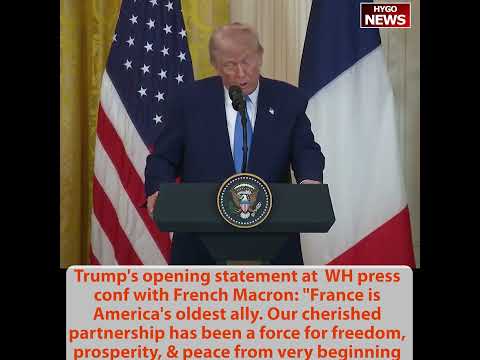
President Trump opened his February 25, 2025, joint press conference with French President Emmanuel Macron by invoking the centuries-old Franco-American alliance before pivoting to the urgent mission of the meeting: ending the Ukraine war. Trump declared that “since my return to the White House, we’ve made more progress toward that goal in one month than occurred in the past three years,” cited the $300 billion versus $100 billion spending disparity between the U.S. and Europe on Ukraine, and announced progress on the critical minerals deal. He praised Macron for agreeing that “the cost and burden of securing the peace must be borne by the nations of Europe, not alone by the United States” and warned that without action, the conflict “could evolve into a Third World War."
"France Is America’s Oldest Ally”
Trump opened with a diplomatic tribute that placed the meeting in its broadest historical context.
“France is America’s oldest ally,” Trump said. “Our cherished partnership has been a force for freedom, prosperity, and peace from the very beginning.”
He traced the relationship through America’s defining conflicts. “In the American Revolution, French support helped us to seize our destiny as an independent nation,” Trump said. “In the first and second world wars, our citizens shed blood together on the battlefields of Europe.”
Trump then invoked a personal memory with Macron. “I’ll never forget joining President Macron six years ago on the 75th anniversary of D-Day,” he said. “That was some day.”
The historical framing served a diplomatic purpose. By establishing the depth of the alliance before addressing the contentious topics of defense burden-sharing and Ukraine, Trump was demonstrating that his demands came from within the alliance, not against it. The message to Macron and to the French public was: we are friends who share a history of sacrifice, and it is precisely because of that friendship that we must speak honestly about the present.
”More Progress in One Month Than in Three Years”
Trump then stated the purpose of the meeting in terms that doubled as a rebuke of his predecessor.
“The purpose of our meeting today is to end another battle, a really horrible one, a war, something that we haven’t seen since the Second World War, that is ravaging European soil,” Trump said.
He cited the pace of diplomatic progress: “Since my return to the White House, we’ve made more progress toward that goal in one month than occurred in the past three years. And I’ve spoken with both President Putin and President Zelensky. A lot of good things toward peace are happening, moving it, I think, pretty quickly.”
Trump recounted the recent diplomatic activity: “Last week, Secretary of State Marco Rubio, National Security Advisor Michael Waltz, Special Envoy Steve Witkoff conducted successful talks in Saudi Arabia with the delegation from Russia.”
He thanked the hosts: “I’d like to thank the Kingdom of Saudi Arabia, the King, and Mohammed — great people, really working hard to get this done.”
The framework was clear: the United States was leading the diplomatic process, Saudi Arabia was providing the venue, and the results were coming faster than anyone had achieved in the previous three years of war.
”Could Evolve into a Third World War”
Trump injected urgency by raising the most alarming possible escalation scenario.
“I believe that Emmanuel agrees with me on many of the most important issues,” Trump said. “Chief among them is this is the right time — it may be the only time. You know, that’s a very interesting and horrible situation, and that could evolve into a Third World War. We’re not going to let that happen.”
The Third World War reference was the strongest language Trump had used publicly about the risk of escalation. By stating it at a joint press conference with the French president, he was making the argument to the entire Western alliance: the alternative to a negotiated peace was not a managed stalemate but a potential global catastrophe.
“Should have never started, but it did,” Trump added. “And what a mess, what a horrible, bloody mess.”
The $300 Billion vs. $100 Billion Disparity
Trump then addressed the financial burden-sharing issue that had been a source of tension between the United States and Europe throughout the conflict.
“The United States has put up far more aid for Ukraine than any other nation,” Trump said. “Hundreds of billions of dollars. We’ve spent more than $300 billion, and Europe has spent about $100 billion. One hundred billion — that’s a big difference.”
He continued: “At some point we should equalize. But hopefully we won’t have to worry about that. We have other things happening that maybe take that out of the realm of necessity.”
The 3-to-1 ratio — $300 billion American to $100 billion European — quantified the imbalance that the administration had been denouncing. Europe, which had a larger combined GDP than the United States, had contributed one-third as much to the defense of a European country against a European threat.
Trump also drew a qualitative distinction between the types of aid. “While we’ve given vast amounts of military aid and money in the form of grants, much of Europe’s contribution has been economic relief and structured as loans, for which they’ll be repaid,” he said. In other words, European aid was largely recoverable; American aid was a gift.
The Minerals Deal and Taxpayer Recovery
Trump linked the burden-sharing argument to the minerals deal with Ukraine.
“Like the Europeans, I believe that taxpayers in the United States also deserve to recoup the colossal amounts of money that we’ve sent,” Trump said. “The previous administration never even thought of that. They didn’t think of a lot of things, like why did they let it start in the first place?”
He described the minerals deal as the mechanism for recovery. “That is why we must have an agreement with Ukraine — critical minerals and rare earths and various other things as security,” Trump said. “And I think that’s happening. I think we’ve made a lot of progress.”
Trump noted that he had received a positive update just before the press conference. “I had a report just given to me before walking in that we’ve made a great deal of progress toward getting that,” he said.
”A Decisive Break with the Past”
Trump concluded with a philosophical statement about the direction of American foreign policy.
“I’ve been elected by the American people to restore common sense to Washington and indeed to the world,” he said. “I believe strongly that it’s in the best interest of the United States, the best interest of Europe, the best interest of Ukraine, and indeed the best interest of Russia.”
He characterized his approach as a fundamental departure. “My administration is making a decisive break with the foreign policy values of the past administration and frankly, the past,” Trump said. “I ran against a very foolish foreign policy establishment, and their recklessness has led to the death of many, many people.”
Trump then returned to his most effective comparison. “When I left office for the first term, we had no wars, we had no problems. We didn’t have October 7th with Israel. We didn’t have Russia and Ukraine going at it. We didn’t have the problems in other parts of the Middle East. We didn’t have inflation. It was a whole different world.”
He added one more item to the list: “And you know what else? We didn’t have millions of people pouring through our country.”
Key Takeaways
- Trump opened the Macron press conference by calling France “America’s oldest ally” and recalling their joint visit to the D-Day anniversary six years earlier.
- He declared “more progress in one month than occurred in the past three years” toward Ukraine peace, citing talks in Saudi Arabia and calls with both Putin and Zelensky.
- Trump quantified the burden-sharing gap: the U.S. had spent $300 billion on Ukraine versus Europe’s $100 billion, noting European aid was largely structured as recoverable loans while American aid was grants.
- He warned that the conflict “could evolve into a Third World War” and said “we’re not going to let that happen.”
- Trump announced progress on the minerals deal with Ukraine, saying taxpayers “deserve to recoup the colossal amounts of money” and that the previous administration “never even thought of that.”