 HYGO News
 Trump After Zelensky Expulsion: 'He Overplayed His Hand'; 'Without Us, He Doesn't Win'
Trump After Zelensky Expulsion: “He Overplayed His Hand”; “Without Us, He Doesn’t Win”
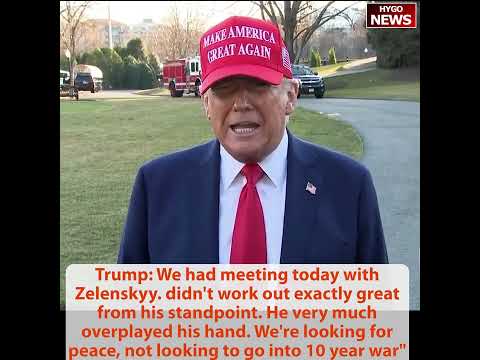
As he departed the White House for Florida on the evening of February 28, 2025, President Trump stopped to answer reporters’ questions about the explosive meeting with Ukrainian President Zelensky that had ended in the latter’s expulsion from the White House. Trump said Zelensky had “very much overplayed his hand,” accused him of wanting to “sign up” American power and “keep fighting” rather than negotiate peace, and laid out the stark binary: “Either we’re going to end it, or let him fight it out. If he fights it out, it’s not going to be pretty, because without us, he doesn’t win.” Trump demanded an immediate ceasefire and said Zelensky “doesn’t have the cards” without American backing.
”He Very Much Overplayed His Hand”
Trump opened with his assessment of the meeting that had just concluded with Zelensky’s departure.
“We had a meeting today, as you know, with President Zelensky, and I would say it didn’t work out exactly great from his standpoint,” Trump said. “I think he very much overplayed his hand.”
He stated the core disconnect between the two leaders’ objectives. “We’re looking for peace. We’re not looking for somebody that’s going to sign up a strong power and then not make peace because they feel emboldened,” Trump said. “And that’s what I saw happening.”
The “emboldened” characterization was the key to Trump’s assessment. He believed that Zelensky’s strategy was to secure the minerals deal — which would give Ukraine American economic partnership and implicit security guarantees — and then use that strengthened position to continue fighting rather than negotiate. In Trump’s reading, Zelensky wanted the cards that American backing provided, not to play them at the negotiating table but to use them as justification for prolonging the war.
“I’m looking for peace. We’re not looking to go into a 10-year war and play games. We want peace,” Trump said.
The Cards Metaphor
Trump developed the card-game analogy into a comprehensive framework for explaining the diplomatic standoff.
“Now, if we don’t do anything, he’s going to have to make peace, but he’s dealing with a very weak set of cards,” Trump said. “If we sign, he’s dealing with a very strong set of cards — and then he doesn’t want to make peace.”
The paradox was clear: American support was supposed to strengthen Ukraine’s negotiating position, but Trump believed Zelensky would use that strength to avoid negotiating altogether. A Zelensky with weak cards would be forced to negotiate. A Zelensky with strong cards would choose to fight. Trump wanted neither outcome — he wanted a Zelensky with strong cards who used them to make peace.
“So that’s where we are. It’s very simple,” Trump said.
He repeated the framework to ensure it was understood. “He doesn’t have the cards. When we sign up, he’s got all of the cards. That doesn’t mean he can fight. He’s got to stop the fighting,” Trump said. “He says he wants it now, or he wants to come back right now, but I can’t do that."
"He’s Looking to Fight, Fight, Fight”
Trump described what he perceived as Zelensky’s true objective.
“It was just my impression that if we do that, if we sign up, he’s looking for something that I’m not looking for,” Trump said. “He’s looking to go on and fight, fight, fight.”
Trump then addressed the humanitarian dimension that motivated his position. “Somebody would say, why do you care about Ukraine and Russian soldiers? I care about them. I care about everybody,” he said.
The statement reaffirmed the emotional foundation of Trump’s peace push. He was not pursuing a ceasefire merely for strategic reasons. He was disturbed by the daily slaughter on both sides — the “Gettysburg” images from satellite, the “meat grinder” descriptions, the thousands killed weekly. Zelensky’s apparent willingness to continue that killing, in Trump’s view, was both strategically foolish and morally objectionable.
The Ceasefire Demand
Trump revealed that the ceasefire question had been a specific point of contention in the meeting.
“They should have an immediate ceasefire. That was the other thing — he didn’t want to do a ceasefire,” Trump said.
He explained the logic: “A ceasefire could take place immediately. A contract, if you want to end the war, you sign up an agreement — that’s going to take a period of time. It takes time. I want it to end immediately. I want a ceasefire now.”
Trump characterized Zelensky’s refusal as evidence of the emboldening problem. “He says, ‘Oh, I don’t want a ceasefire.’ Well, all of a sudden he’s a big shot because he has the U.S. on his side,” Trump said.
The ceasefire debate exposed a fundamental tactical disagreement. Zelensky feared that a ceasefire would freeze the battle lines in Russia’s favor and remove the military pressure that might force Russia to make territorial concessions. Trump argued that the killing needed to stop immediately and that territorial questions could be resolved at the negotiating table once the bullets stopped flying. Neither leader was wrong within their own framework — but Trump held the leverage because American support was the variable that determined whether Ukraine could fight at all.
”Either We End It or Let Him Fight It Out”
Trump stated the binary choice in the starkest terms he had used yet.
“Either we’re going to end it, or let him fight it out,” Trump said. “If he fights it out, it’s not going to be pretty. Without us, he doesn’t win.”
The statement was both an assessment and a warning. If Zelensky refused to engage in peace negotiations on terms acceptable to the United States, Trump was prepared to withdraw American support and let Ukraine face Russia alone. The outcome of that scenario — “it’s not going to be pretty” — was left to the audience’s imagination, but the implication was clear: without American weapons, intelligence, and financial support, Ukraine would face military defeat.
Trump reinforced the point: “I want anybody that’s going to make peace. If he’s capable of making peace, which he may or may not be, but I want somebody that’s going to make peace.”
The phrase “which he may or may not be” raised the possibility that Trump was beginning to question whether Zelensky was the right leader to negotiate a settlement. If Zelensky proved incapable of making peace, the implication was that someone else — whether a different Ukrainian leader or a deal negotiated over Zelensky’s head — might be necessary.
”He’s Got to Say, ‘I Want to Make Peace’”
Trump described the specific behavior he needed to see from Zelensky.
“He’s got to say, ‘I want to make peace.’ He doesn’t have to stand there and say about Putin this, Putin that, all negative things,” Trump said. “He’s got to say, ‘I want to make peace. I don’t want to fight a war any longer.’”
The demand was for a fundamental shift in Zelensky’s public posture — from defiance to acceptance, from fighting to negotiating, from attacking Putin to seeking terms. Trump was not asking Zelensky to surrender; he was asking him to publicly acknowledge that the war needed to end and that he was willing to negotiate the terms of that ending.
“I don’t trust or distrust anybody,” Trump said. “I just want to get a deal done. And if the deal happens, good.”
Departing for Florida
Trump delivered these remarks while heading to Marine One for the flight to Florida, giving the exchange the informal quality of a impromptu press gaggle rather than a formal statement. The setting reinforced the message: this was not a carefully worded diplomatic communique but the honest reaction of a president who had just experienced a diplomatic confrontation and was sharing his unfiltered assessment with the press and the public.
“We’re setting a lot of records. Economically, we’re setting records, and I think every way we’re setting records,” Trump added, pivoting briefly to the domestic agenda before returning to the central point. “One of the best is the right track, wrong track.”
The pivot to economic indicators served as a reminder that Ukraine was one issue among many — and that the American public’s priorities centered on the economy and domestic governance, not on indefinite support for a foreign war whose leader had just been expelled from the White House for disrespecting the president.
Key Takeaways
- Trump said Zelensky “very much overplayed his hand” and accused him of wanting to “sign up” American power to “keep fighting” rather than negotiate peace.
- He laid out the binary: “Either we’re going to end it, or let him fight it out. If he fights it out, without us, he doesn’t win.”
- Trump said Zelensky refused an immediate ceasefire because “all of a sudden he’s a big shot because he has the U.S. on his side.”
- He demanded Zelensky say “I want to make peace” instead of attacking Putin, saying “he doesn’t have to stand there and say about Putin this, Putin that.”
- Trump questioned whether Zelensky was capable of making peace — “which he may or may not be” — raising the possibility that a different interlocutor might be needed.