 HYGO News
 Trump: Zelensky Coming Friday to Sign Minerals Deal -- 'Taxpayer Gets Their Money Back, Plus'; Copper EO Signed
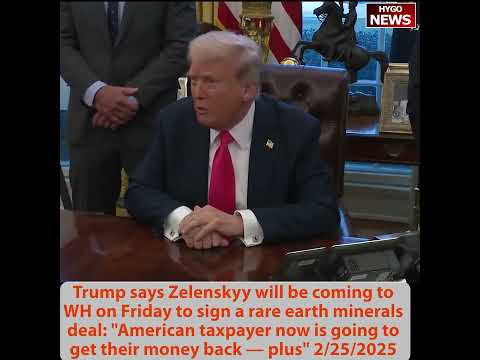
Trump: Zelensky Coming Friday to Sign Minerals Deal — “Taxpayer Gets Their Money Back, Plus”; Copper EO Signed
President Trump confirmed on February 26, 2025, that Ukrainian President Zelensky would visit the White House on Friday to sign the rare earth minerals deal, describing it as potentially “a trillion-dollar deal” that would ensure “the American taxpayer now is going to get their money back — plus.” Trump contrasted the U.S. spending of “$350 billion” in grants with Europe’s “$100 billion” in recoverable loans, and criticized Biden for “throwing money around like it’s cotton candy.” He also signed an executive order to protect America’s copper industry from foreign dumping, declaring: “It’s time for copper to come home.”
Zelensky Coming Friday: “A Very Big Deal”
A reporter asked whether Zelensky was expected on Friday and whether the minerals deal was finalized. Trump confirmed both.
“I hear that he’s coming on Friday. Certainly it’s okay with me if he’d like to,” Trump said. “And he would like to sign it together with me, and I understand that’s a big deal. Very big deal.”
He connected the deal to public sentiment. “I think the American people — even if you look at polling — they’re very happy,” Trump said. “Because, you know, Biden was throwing money around like it’s cotton candy.”
Trump then described the potential scale of the agreement. “It could be a trillion-dollar deal, it could be whatever, but it’s rare earths and other things,” he said.
The “trillion-dollar deal” characterization, if accurate, would make the Ukraine minerals agreement one of the largest bilateral economic arrangements in history. Ukraine’s reserves of rare earth elements, lithium, titanium, graphite, and other critical minerals had been estimated in the trillions of dollars by geological surveys. The deal would give the United States equity stakes in developing those resources, transforming the Ukraine relationship from a one-way transfer of aid into a long-term economic partnership.
The $350 Billion vs. $100 Billion Gap
Trump reiterated the spending disparity that had become a central talking point in his Ukraine messaging.
“We’re spending hundreds of billions of dollars on Ukraine and Russia fighting a war that should have never, ever happened,” Trump said. “That’s a war that would have never happened if I were president. And it didn’t happen for four years.”
He addressed skeptics directly: “People say, ‘How do we know?’ It didn’t happen for four years. It would have never happened.”
Trump quantified the Biden-era spending: “This guy went into this situation and he spent money like nobody’s ever seen — $350 billion.”
He then highlighted the structural unfairness. “The other thing that we don’t like is that Europe has spent $100 billion, we’ve spent $350 billion,” Trump said. “Europe gets their money back because they spent it in the form of a loan. And we just gave them — whether it’s $300 to $350 billion, nobody really knows. They can’t even tell me the answer to that. Means probably more than that.”
The revelation that the administration could not get a precise figure for total U.S. spending on Ukraine — “they can’t even tell me the answer to that” — reinforced the argument for the minerals deal as a recovery mechanism. If the government could not even quantify how much it had spent, the case for securing tangible assets in return was even stronger.
”Taxpayer Gets Their Money Back — Plus”
Trump framed the minerals deal as both a recovery mechanism and a positive investment.
“What we’re doing is now we’re saying, look, we want to be secured, we want to get that money back,” Trump said. “We’re helping a country through a very, very big problem, a problem like very few people have had. Shouldn’t have had this problem because it shouldn’t have happened, but it did happen. So we have to straighten it out.”
He delivered the bottom line: “But the American taxpayer now is going to get their money back. Plus.”
The “plus” was significant. Trump was not merely promising to recoup the $350 billion in aid; he was suggesting that the minerals deal would generate returns beyond the recovery of past spending. If Ukraine’s mineral reserves were worth trillions, even a modest equity stake could eventually exceed the amount of aid that had been provided, turning the entire Ukraine experience from a sunk cost into a profitable investment.
The Copper Executive Order
Trump then signed a separate executive order aimed at protecting the American copper industry from foreign dumping.
An administration official introduced the order: “Copper is a critical material, and the supply of copper is vital to our national security. In recent years, we’ve dealt with a significant issue of the dumping of foreign copper into the American market that significantly impacted the domestic production and manufacture of copper and copper materials.”
The official described the mechanism: “This executive order charges your Secretary of Commerce with starting the process to potentially impose tariffs or other trade barriers to prevent this ongoing dumping of copper and to protect the American manufacture and production of copper.”
Trump then read from a Truth Social post that was “about to go out,” providing the public announcement in real time.
“Like our steel and aluminum industries, our great American copper industry has been decimated by global actors attacking our domestic production,” Trump read. “To build back our copper industry, I’ve requested my Secretary of Commerce and USTR to study copper imports and end unfair trade, putting Americans out of work.”
He continued: “Tariffs will help rebuild our American copper industry and strengthen our national defense. American industries depend on copper, and they should be made in America. No exemptions, no exceptions. America First creates American jobs and protects our national security.”
Trump concluded with the declaration that would headline the copper policy: “It’s time for copper to come home.”
The copper order followed the same template as the steel and aluminum tariffs: identify a critical domestic industry threatened by foreign dumping, direct the Commerce Secretary to investigate, and signal that tariffs or trade barriers would follow. Copper was essential for electrical wiring, construction, electronics, and military equipment. The administration’s argument was that depending on foreign suppliers for a material this fundamental was a national security vulnerability that could not be tolerated.
The Pattern: Critical Minerals at Every Level
The day’s events illustrated the administration’s comprehensive approach to critical minerals. At the international level, the Ukraine minerals deal would secure access to rare earths and lithium. At the domestic level, the copper executive order would protect American mining and manufacturing. Together, they represented a strategy to ensure that the United States controlled — or had secure access to — every link in the critical minerals supply chain.
The connection between the two initiatives was not coincidental. Many of the rare earth elements in Ukraine would eventually be processed using copper-based industrial equipment. By securing both the raw materials (through the Ukraine deal) and the processing infrastructure (through the copper tariffs), the administration was building an integrated supply chain that reduced dependence on foreign sources at every stage.
Key Takeaways
- Trump confirmed Zelensky would visit the White House on Friday to sign the minerals deal, calling it potentially “a trillion-dollar deal” in rare earths and other resources.
- He said “the American taxpayer now is going to get their money back — plus,” contrasting U.S. grants of $350 billion with Europe’s $100 billion in recoverable loans.
- Trump criticized Biden for “throwing money around like cotton candy” and noted the government could not even provide a precise total of Ukraine spending.
- He signed an executive order to protect the copper industry from foreign dumping, declaring: “It’s time for copper to come home. No exemptions, no exceptions.”
- The minerals deal and copper order together represented a comprehensive critical minerals strategy covering both international supply (Ukraine) and domestic production (copper tariffs).