 HYGO News
 Trump Warns Zelensky: 'He Better Not Be Right' About Long War; 'No Room Left' for Canada-Mexico Tariff Deal
Trump Warns Zelensky: “He Better Not Be Right” About Long War; “No Room Left” for Canada-Mexico Tariff Deal
President Trump responded to a Zelensky statement predicting a prolonged war by warning “he better not be right about that,” confirmed that tariffs on Canada and Mexico would proceed with “no room left” for a deal before the midnight deadline, and celebrated the TSMC investment that would bring U.S. chip manufacturing to “close to 40% of the market.” Trump said Zelensky needed to “be more appreciative” and that Europe had been “a lot smarter than Joe Biden” by structuring its Ukraine aid as recoverable loans while America sent “$350 billion” in grants with no expectation of repayment.
”He Better Not Be Right About That”
Trump reacted to reports that Zelensky had predicted the war would continue for a long time.
“President Zelensky supposedly made a statement today in AP,” Trump said. “I’m not a big fan of AP, so maybe it was an incorrect statement, but he said he thinks the war is going to go on for a long time.”
Then the warning: “And he better not be right about that. That’s all I’m saying.”
The phrase “that’s all I’m saying” carried an implicit threat that was more powerful for its restraint. Trump was not spelling out the consequences of a prolonged war — he was leaving them to Zelensky’s imagination. The possibilities ranged from a complete withdrawal of American support to the pursuit of a peace deal over Zelensky’s head. By leaving the threat undefined, Trump maintained maximum leverage.
The exchange also reflected the administration’s concern that Zelensky was publicly signaling an intent to fight indefinitely — the exact posture Trump had identified in their Oval Office confrontation as incompatible with American support.
”Be More Appreciative”
A reporter asked what Trump needed to see from Zelensky to restart negotiations.
“I just think he should be more appreciative, because this country has stuck with them through thick and thin,” Trump said. “We’ve given them much more than Europe.”
He explained why Europe’s contribution, while smaller in dollar terms, represented a smarter strategy. “Europe should have given more than us, because as you know, that’s right there. That’s the border. This country really was like the fence on the border. It was very important to Europe,” Trump said.
“I’m not knocking Europe. I’m saying that they were a lot smarter than Joe Biden, because Joe Biden didn’t have a clue,” Trump continued. “He just gave money hand over fist, and they should have been able to equalize with us. In other words, if we gave a dollar, they should have given.”
He quantified the disparity: “We gave $350 billion. They probably gave $100 billion. But on top of it all, they get their money back because they are doing it in the form of a loan, and it’s a secured loan.”
Trump then explained why the minerals deal was the corrective. “When I saw that, I said it’s time for us to be smart,” he said. “At the same time, it’s great for them because they get us in the country taking the rare earth, which is going to fuel this big engine. And we get something, and we’re there. We have a presence there.”
But the bottom line remained: “I want one thing to happen. I want all of those young people to stop being killed."
"No Room Left for Mexico or Canada”
A reporter asked whether there was any possibility of a last-minute deal to avoid the tariffs set to take effect at midnight.
“On the tariffs, is there any room left for Canada and Mexico to make a deal before midnight?” the reporter asked.
Trump’s answer was definitive: “No room left for Mexico or for Canada. No. The tariffs, you know, they’re all set. They go into effect tomorrow.”
He immediately connected the tariffs to the fentanyl crisis. “Just so you understand, vast amounts of fentanyl have poured into our country from Mexico,” Trump said. “And as you know, also from China, where it goes to Mexico and goes to Canada. And China also had an additional 10. So it’s 10 plus 10. And it comes in from Canada and it comes in from Mexico.”
The fentanyl linkage was the administration’s primary justification for the tariffs beyond the pure trade imbalance. By framing tariffs as a response to drug trafficking as well as unfair trade, the administration placed the policy on national security grounds that were legally stronger and politically more compelling than economic arguments alone.
TSMC and the 40% Market Share Goal
Trump circled back to the semiconductor investment to provide the strategic context.
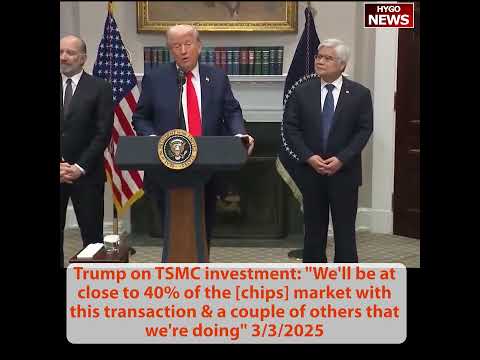
“A big percentage of chips with this investment will be made now — a big percentage worldwide,” Trump said. “We had very little, almost none. We used to have a lot with Intel, but we had very little. And we’ll be at close to 40% of the market with this transaction and a couple of others that we’re doing.”
He emphasized the significance: “That’s a tremendous leap. Like a leap that nobody would have really said was possible.”
The 40% target was transformational. The United States had seen its share of global semiconductor manufacturing decline from over 35% in the 1990s to approximately 12% by 2024. Reaching 40% would not only restore but exceed America’s historical position, fundamentally reducing the geopolitical risk of dependence on Taiwan.
”Without Chips, Nothing Runs”
Trump explained the national security imperative in accessible terms.
“Without the chips and semiconductors, nothing runs today,” he said. “You can’t buy a car without them. You can’t get a radio or television. You can’t get anything.”
He described the dual motivation. “We thought it was very important, obviously business-wise, but we thought even in terms of national security to have this large percentage of the chips, semiconductors, and other things that they make — the most important product and not a product that you can really copy. It takes years and years.”
Trump marveled at the technology itself: “On the needle of a pin is total genius. I mean, they can put things — something the size of the point of a pin — they put information that is just not even believable.”
The description — advanced semiconductor technology reduced to the image of information on a pin’s point — was vintage Trump: making complex technology accessible to a general audience by expressing genuine wonder at it.
Key Takeaways
- Trump warned Zelensky “he better not be right” about predicting a long war, following up the Oval Office expulsion with an implicit threat of consequences.
- He said Zelensky needed to “be more appreciative” and that Europe had been “smarter than Biden” by structuring $100B in Ukraine aid as recoverable loans versus America’s $350B in grants.
- Trump confirmed “no room left” for Canada or Mexico to avoid tariffs, which would take effect the following day, linking them to “vast amounts of fentanyl” flowing through both borders.
- He celebrated the TSMC investment as bringing U.S. chip manufacturing to “close to 40% of the market” — up from “almost none” — calling it “a leap nobody would have said was possible.”
- Trump described semiconductors as essential for national security: “Without chips, nothing runs today.”