 HYGO News
 Trump: 'I Think I Have the Power to End This War' -- 'Much More Confident' After Saudi Arabia Talks
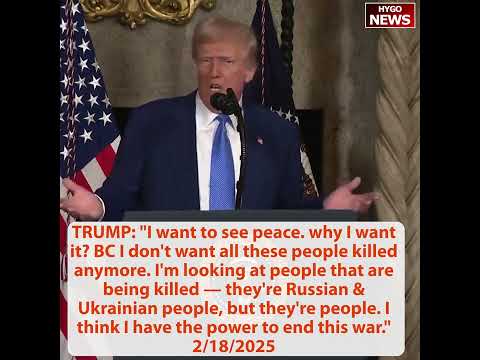
Trump: “I Think I Have the Power to End This War” — “Much More Confident” After Saudi Arabia Talks
Following the first direct U.S.-Russia diplomatic meetings in Saudi Arabia in February 2025, President Trump delivered his most emotionally charged public remarks about the Ukraine war. “I don’t want all these people killed anymore,” Trump said. “They’re Russian and Ukrainian people, but they’re people. It doesn’t matter where they’re from on the whole planet. And I think I have the power to end this war.” When asked whether he was more or less confident of a deal after the day’s talks, Trump replied: “Much more confident. Russia wants to do something. They want to stop the savage barbarianism.” He compared the battlefields to Gettysburg and criticized Biden for failing to prevent a war that “would have never happened if I was President."
"I Think I Have the Power to End This War”
Trump opened with a statement that combined personal conviction with presidential authority. “I want to see peace,” he said. “Look, you know why I want it? Because I don’t want all these people killed anymore.”
The emotional register was unusual for Trump, who typically framed geopolitical issues in terms of strength, strategy, and negotiation. Here, he was speaking about the human cost in personal terms.
“I’m looking at people that are being killed. And they’re Russian and Ukrainian people, but they’re people,” Trump said. “It doesn’t matter where they’re from on the whole planet. And I think I have the power to end this war. And I think it’s going very well.”
The declaration “I think I have the power to end this war” was both a statement of confidence and an assumption of responsibility. By claiming the power to end the conflict, Trump was also accepting that the outcome would be judged against his ability to deliver. It was a high-stakes bet — but one that the Saudi Arabia talks appeared to be validating.
The Deal Biden Could Have Made
Trump then delivered a counterfactual that he had alluded to before but articulated more fully here. He argued that before the invasion, a diplomatic deal was available that would have prevented the war entirely.
“I could have made a deal for Ukraine that would have given them almost all of the land, everything, almost all of the land, and no people would have been killed and no city would have been demolished and not one dome would have been knocked down,” Trump said.
The implication was that a negotiated agreement before the invasion — one that addressed Russia’s security concerns about NATO expansion while preserving Ukraine’s sovereignty over most of its territory — had been achievable. Trump was arguing that Biden’s provocative rhetoric about NATO membership and his “minor incursion” gaffe had closed the diplomatic window that might have prevented the conflict.
“But they chose not to do it that way,” Trump said. “And President Biden, in all fairness, he doesn’t have a clue. He was so bad for this. He was so bad, so pathetic, so sad.”
Trump connected the counterfactual to his own first-term record. “When I left, there was no chance that this could have happened. But it happened because we had incompetent leadership at many different levels."
"Much More Confident” After Saudi Arabia Talks
A reporter asked the direct question: “Can you tell us a little bit more about the Russia talks, your impression of how they went today, and if you’re perhaps more confident or less confident of a deal after what happened today?”
Trump’s answer was immediate. “Much more confident,” he said. “They were very good. Russia wants to do something. They want to stop the savage barbarianism.”
The phrase “savage barbarianism” was striking language from a president who typically avoided moralistic characterizations of geopolitical adversaries. Trump was describing the war itself — not any particular side’s conduct — as barbaric, reinforcing his argument that the continued killing was senseless and unjustifiable.
“I mean, what’s going on over there?” Trump continued. “Soldiers are being killed by the thousands on a weekly basis. It’s ridiculous.”
He noted the international dimension of the casualties. “They’re not American soldiers. They’re Russian soldiers and they’re Ukrainian soldiers largely, although a lot of Koreans have been killed, as you know. Quite a bit of them have been killed. They came over to fight, and a large portion have been wiped out.”
The reference to North Korean soldiers fighting alongside Russia was one of the more underreported aspects of the conflict. North Korea had deployed troops to assist Russia, and Trump’s acknowledgment that “a large portion have been wiped out” provided a rare public assessment of their fate.
The Gettysburg Comparison
Trump then offered a visual comparison that brought the war’s carnage home to an American audience.
“I see pictures that you don’t see, but I see pictures of fields that look just horrible,” Trump said. “It looks like Gettysburg. If you see the old pictures of Gettysburg, it’s soldiers lying all over the field, body parts all over the field. They’re all dead. And this is going on on a daily basis.”
The Gettysburg comparison was powerful because it invoked the bloodiest battle in American history — a touchstone that every American understood — and applied it to daily conditions in Ukraine. The Battle of Gettysburg in July 1863 killed approximately 7,500 soldiers over three days. Trump was claiming that comparable scenes were playing out in Ukraine “on a daily basis.”
“It’s a horrible thing,” Trump said. “Both Russia and Ukraine, they’re losing thousands and thousands of soldiers.”
He suggested that the true civilian death toll was being underreported. “I think people are going to be surprised at how many people, not only soldiers, have been killed in Ukraine,” Trump said. “A lot more people than you think.”
Zelensky’s Polling and the Devastation
In one of his most pointed observations, Trump connected Ukraine’s political situation to the physical destruction of the country.
“When they say they took a poll, and Zelensky is at 4 percent — who’s living there?” Trump said. “I mean, people are — it’s hard to believe that people live there. Their cities are being knocked down.”
The rhetorical question — “who’s living there?” — captured the disconnect between conventional polling and the reality of a country that had been physically devastated by war. If large portions of Ukraine’s cities had been “knocked down to the ground,” the population that remained to be polled was not the same population that had existed before the war.
The reference to Zelensky’s low approval rating also served a diplomatic purpose. If Zelensky was deeply unpopular domestically, the argument for pressing him to accept a negotiated settlement gained strength. A leader with 4 percent approval was in no position to insist on maximalist terms, and the Ukrainian public’s war-weariness — reflected in the polling — suggested that ordinary Ukrainians might welcome a deal that their leaders were reluctant to accept.
”A Senseless War”
Trump concluded with his most concise indictment of the conflict. “It’s a senseless war,” he said. “It should have never happened. Would have never happened if I was President.”
The statement combined three elements that had defined Trump’s approach to the Ukraine issue throughout the campaign and into the presidency: the war was senseless (it served no one’s interests), it was preventable (different American leadership would have deterred it), and it was ending (because Trump was now in a position to negotiate its conclusion).
“We want to end it,” Trump said simply. The three-word declaration carried the weight of everything that had been said before it — the Gettysburg imagery, the criticism of Biden, the diplomatic progress in Saudi Arabia, and the emotional appeal about people dying “on a daily basis.”
Key Takeaways
- Trump declared “I think I have the power to end this war” and said he was “much more confident” of a deal after the Saudi Arabia talks, adding that “Russia wants to do something. They want to stop the savage barbarianism.”
- He claimed a pre-war deal was possible that “would have given Ukraine almost all of the land, everything” with “no people killed and no city demolished,” blaming Biden’s incompetence for its failure.
- Trump compared Ukrainian battlefields to Gettysburg, saying he had seen pictures of “soldiers lying all over the field, body parts all over the field” that were occurring “on a daily basis.”
- He noted that North Korean soldiers fighting alongside Russia had suffered heavy casualties, saying “a large portion have been wiped out.”
- Trump called the conflict “a senseless war” that “should have never happened” and “would have never happened if I was President.”