 HYGO News
 Trump & world leaders Family Photo; security guarantees & territorial exchanges; spoke to Putin
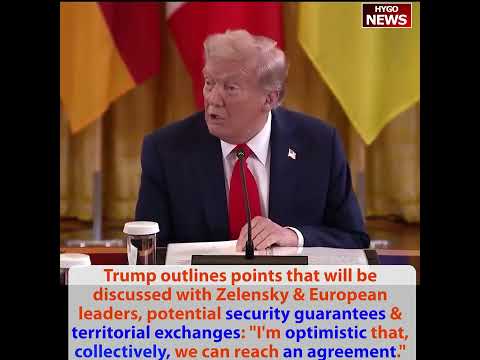
Trump & world leaders Family Photo; security guarantees & territorial exchanges; spoke to Putin
Trump and the assembled world leaders posed for a Family Photo in the White House Cross Hall before Trump outlined the specific substantive framework of the emerging deal — including security guarantees for Ukraine (which Putin has agreed Russia would accept) and potential territorial exchanges based on current line-of-contact positions. Trump also confirmed he had spoken to Putin indirectly and would call him directly after the European leaders’ meeting concluded. Trump: “I just spoke to President Putin indirectly, and we’re going to have a phone call right after these meetings today. And we may or may not have a trilat … If we have a trilat, there’s a good chance it may be ending it.” On security guarantees: “The Alaska summit reinforced my belief that while difficult pieces were then reached … President Putin agreed that Russia would accept security guarantees for Ukraine, and this is one of the key points that we need to consider.” On Ukraine’s decision-making role: “This is a decision that can only be made by President Zelensky and by the people of Ukraine working also together in agreement with President Putin.” On territorial exchanges: “We also need to discuss the possible exchanges of territory, taking into consideration the current line of contact.” On European burden: “I think that the European nations are going to take a lot of the burden. We’re going to help them, and we’re going to make it very secure.”
The Family Photo
The White House Cross Hall. The assembled world leaders. Trump, Zelensky, and the seven European leaders together. A Family Photo in the Cross Hall — the White House’s grand hallway traditionally used for major ceremonial occasions.
That photo is substantial diplomatic imagery. Coordinated Western leadership at the White House for specific Ukraine peace coordination. The visual communicates unity — Trump and European leaders together rather than in conflict over Ukraine policy.
The specific Cross Hall location carries additional weight. Previous presidents have hosted major diplomatic events there. The space is associated with gravity and formality appropriate to consequential diplomatic moments.
”I Just Spoke to President Putin Indirectly”
Trump’s update. “We just spoke to, I was just telling the president, I just spoke to President Putin indirectly, and we’re going to have a phone call right after these meetings today. And we may or may not have a trilat.”
“Indirectly” is specific diplomatic vocabulary. Not a direct conversation. But communication through intermediaries — likely the Russian delegation still present in Washington or through U.S. officials in contact with Russian counterparts.
“Phone call right after these meetings today.” Trump will call Putin after the European leaders’ discussion concludes. That is specific scheduling. The call will cover whatever Trump and the European leaders agree to communicate to Putin.
“We may or may not have a trilat.” The trilateral meeting remains possible but not yet confirmed. The decision depends on progress in the current European/Ukrainian coordination and Putin’s specific response to the Trump call.
”If We Have a Trilat, There’s a Good Chance It May Be Ending It”
“And the fighting continues. And if we do, we have a good chance. I think if we have a trilat, there’s a good chance it may be ending it.”
Specific Trump framing. If the trilateral meeting happens, the war likely ends at that meeting. Not months of additional negotiation. The trilateral meeting is the specific venue where final terms would be reached.
“He’s expecting my call when we’re finished with this meeting.” Putin is waiting for Trump’s call. Putin is engaged with the process. Putin is prepared to respond to whatever Trump communicates from the European/Ukrainian coordination.
”Putin Agreed That Russia Would Accept Security Guarantees”
“The Alaska summit reinforced my belief that while difficult pieces were then reached, and I believe that in a very significant step, President Putin agreed that Russia would accept security guarantees for Ukraine, and this is one of the key points that we need to consider.”
That is a substantial concession Putin has made. Russia accepting security guarantees for Ukraine. That means Russia agreeing that Ukraine would have specific protections against future Russian aggression.
The specific security guarantees under discussion include:
- Formal written commitments from Russia not to re-invade
- International monitoring mechanisms
- Potential specific military support commitments from NATO or specific NATO members
- Economic and financial mechanisms to enforce non-aggression
- Multilateral participation in guarantee enforcement
Putin’s acceptance matters. In prior years, Russia has rejected specific security guarantees for Ukraine because such guarantees would constrain Russian strategic options regarding Ukraine. Russia accepting specific guarantees represents substantial shift.
”Who Will Do What”
“Like, who will do what, essentially?”
That is the specific operational question. Security guarantees require specific enforcement mechanisms. Which countries specifically commit what specific support? In what specific circumstances does the enforcement activate? What specific consequences follow specific violations?
“Who will do what” is what the European leaders’ meeting will address. Each European country has specific capabilities, constraints, and willingness. Aligning those specifics into a coherent guarantee structure is the specific diplomatic task.
”Collectively We Can Reach an Agreement”
“I’m optimistic that collectively we can reach an agreement that would deter any future aggression against Ukraine.”
“Collectively” matters. Not U.S. alone. Not Ukraine alone. The Western coalition collectively providing deterrence against future Russian aggression.
“Deter any future aggression.” That is the specific purpose. Not merely ending the current war. Preventing future wars. The security architecture should make another Russian invasion practically impossible — because Russia would face specific, credible, pre-committed Western response.
”I Think That’s Largely Overrated”
“And I actually think there won’t be. I think that’s largely overrated, but we’re going to find out.”
Trump’s specific assessment. Future Russian aggression is “largely overrated” as a concern. Once this war is concluded with appropriate security architecture, additional Russian aggression becomes unlikely.
That framing is somewhat controversial. Russia’s behavior over the past two decades — Georgia 2008, Crimea 2014, various intervention patterns — has suggested continued expansionist tendencies. Trump is expressing skepticism about that extrapolation. With the right diplomatic and security architecture, Russia’s behavior may stabilize.
“We’re going to find out.” That is appropriate epistemic humility. The prediction cannot be proven without time. But the architecture Trump is constructing is designed to make any future Russian aggression costly and therefore unlikely.
”European Nations Are Going to Take a Lot of the Burden”
“And I think that the European nations are going to take a lot of the burden. We’re going to help them, and we’re going to make it very secure.”
That is the specific burden-sharing framing. European countries bear primary responsibility for European security. The U.S. supports but does not primarily finance or staff the security architecture.
That framing matches Trump’s broader NATO burden-sharing priorities. European allies have committed to increased defense spending under Trump administration pressure. European defense industrial capacity is expanding. European willingness to provide specific support to Ukraine has grown.
“We’re going to help them.” U.S. support continues. But as assistance to European leadership rather than primary U.S. commitment. The U.S. role is secondary — U.S. resources support European initiatives rather than the other way around.
”Possible Exchanges of Territory”
“We also need to discuss the possible exchanges of territory, taking into consideration the current line of contact. That means the war zone, the war lines that are pretty obvious. Very sad, actually, to look at them.”
“Line of contact.” That is specific military vocabulary. The current positions of Ukrainian and Russian forces. The boundary between what each side currently controls. Those lines run roughly along:
- Crimea (under Russian control since 2014)
- Parts of Donetsk, Luhansk, Zaporizhzhia, and Kherson oblasts (varying control)
- Specific village-level and urban-level positions
“Possible exchanges of territory” — each side potentially giving some territory and gaining other territory to produce more defensible or politically acceptable boundaries. That might include:
- Russia withdrawing from specific areas in exchange for recognition of other areas
- Ukraine ceding formal control of some areas in exchange for specific guarantees
- Buffer zones or demilitarized zones between the specific lines
“Very sad, actually, to look at them.” The lines represent destruction. Populated areas now fought over. Buildings destroyed. Civilians displaced. The specific geography reflects three years of war.
”Decision Can Only Be Made by President Zelensky”
“Ultimately, this is a decision that can only be made by President Zelensky and by the people of Ukraine working also together in agreement with President Putin.”
That is the specific principle. Ukraine’s sovereign decision. Not Trump’s decision. Not Europe’s decision. Ukraine’s decision — made by Zelensky as head of state with Ukrainian public legitimacy.
“Working also together in agreement with President Putin.” But the decision is not Ukraine alone. Russia must agree. The specific terms require both-side acceptance. Ukraine deciding unilaterally what it wants is not sufficient — Russia must also accept the terms.
“The people of Ukraine.” Public acceptance matters. Zelensky’s decision requires Ukrainian public support — through parliamentary approval, potential referendum, or demonstrated popular backing. Without public support, any agreement would collapse politically.
”I Have a Feeling You and President Putin Are Going to Work Something Out”
“And I have a feeling you and President Putin are going to work something out.”
Trump directly addressing Zelensky. His specific intuition. Zelensky and Putin — despite their current deep animosity — will ultimately reach specific terms. The war will end through their specific agreement.
“Good things are going to come of it.” Trump’s general optimism about the specific process. Not only ending the war. Good things — reconstruction, economic normalization, long-term peace — following the war’s end.
”I’ll Go to That Meeting”
“If you’d like, I’ll go to that meeting. And not that I want to do that, but I will do that because we want to save a lot of people from dying, a lot of people are dying, and we got to save them.”
Trump’s specific commitment. He will attend the Zelensky-Putin trilateral if his presence is needed. “Not that I want to do that” — Trump would prefer not to travel, not to add himself to the format, not to insert himself into what should be direct Ukraine-Russia negotiation. But he will do it.
“Because we want to save a lot of people from dying.” The specific motivation. The human cost overrides Trump’s personal preferences. If his presence at a meeting saves lives, his presence is required.
“A lot of people are dying.” The specific ongoing reality. Every day the war continues, more people die. Trump’s diplomatic effort is time-sensitive because delay produces more deaths.
Three Substantive Elements
Security guarantees (Russia accepting the specific framework). Territorial exchanges (based on line-of-contact). European burden-sharing (European nations taking primary responsibility).
Each element represents specific diplomatic progress. Russia’s security guarantee acceptance was previously considered impossible. Territorial exchanges based on realistic lines (rather than pre-war boundaries) represent specific diplomatic realism. European burden-sharing aligns with administration’s broader NATO priorities.
Together, they represent the specific framework of an emerging Ukraine peace deal. Not finalized. But substantive enough that the trilateral meeting — once scheduled — could conclude the agreement.
Key Takeaways
- Trump on the Putin call: “I just spoke to President Putin indirectly, and we’re going to have a phone call right after these meetings today. And we may or may not have a trilat … If we have a trilat, there’s a good chance it may be ending it.”
- On security guarantees: “In a very significant step, President Putin agreed that Russia would accept security guarantees for Ukraine, and this is one of the key points that we need to consider … I’m optimistic that collectively we can reach an agreement that would deter any future aggression against Ukraine.”
- On European burden-sharing: “I think that the European nations are going to take a lot of the burden. We’re going to help them, and we’re going to make it very secure.”
- On territorial exchanges: “We also need to discuss the possible exchanges of territory, taking into consideration the current line of contact.”
- On Ukraine’s sovereign role: “This is a decision that can only be made by President Zelensky and by the people of Ukraine working also together in agreement with President Putin.”