 HYGO News
 Trump withdraws WHO: That's a big one, we paid $500M, China $39M. I terminated it, Biden reversed it
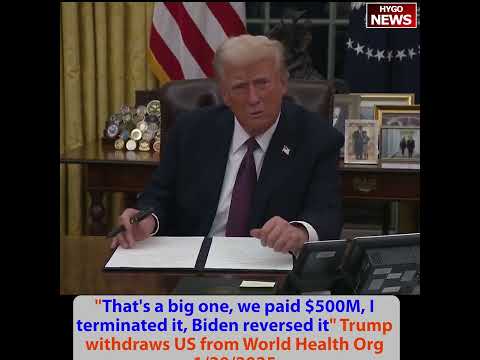
Trump withdraws WHO: That’s a big one, we paid $500M, China $39M. I terminated it, Biden reversed it
WHO Withdrawal
“What is this withdrawing from the World Health Organization? Ooh, that’s a big one.”
Trump’s framework — major order, significant decision.
The WHO withdrawal:
- Executive order signed January 20, 2025
- Formal notification to WHO
- One-year withdrawal period
- Funding cessation
- Political signal
Funding Disparity
“So we paid $500 million to World Health when I was here, and I terminated China with 1.4 billion people. We have 3.50. We have, nobody knows what we have because so many people came in illegally, but let’s say we have 3.25.”
Trump’s population framework:
- U.S. (approximately 325-350 million, uncertain due to illegal immigration)
- China (approximately 1.4 billion)
- Funding should be population-proportional
- But disparity severe
“They had 1.4 billion. They were paying $39 million. We were paying $500 million.”
The contribution disparity:
- China: $39 million (1.4 billion people)
- U.S.: $500 million (~330 million people)
- Per capita: China $0.03, U.S. $1.50
- U.S. paying approximately 50x per capita
- “A little unfair” (Trump understatement)
“It seemed a little unfair to me.”
First Termination
“So that wasn’t the reason, but I dropped out. They offered me to come back for $39 million.”
Trump’s first-term withdrawal history:
- COVID mishandling criticism
- WHO failure documented
- Withdrawal initiated 2020
- Offered return at $39 million
- Declined at that price
“In theory, it should be listed that, but you know.”
Trump acknowledging the expected rate.
Biden Reversal
“And when Biden came back, they came back for $500 million. He knew that you could have come back for $39 million.”
The Biden decision:
- Rejoined WHO
- Paid $500 million (prior level)
- Refused $39 million rate (available)
- Generous U.S. contribution continued
- Biden administration choice
“They wanted us back so badly, so we’ll see what happens.”
Trump’s framework — WHO wants American funding desperately. Negotiating leverage exists.
China Comparison
“China pays $39 million, and we pay $500 million, and China is a bigger country.”
The comparison:
- China larger population
- China paying less
- U.S. paying more
- Proportionality absent
- American disadvantage
WHO Context
WHO mishandling issues:
- COVID-19 initial response
- Chinese cover-up facilitation
- Delayed pandemic declaration
- Travel ban criticism
- Origin investigation failures
Trump’s executive order citing:
- Mishandling of COVID
- Failure to adopt reforms
- Independence from political influence (WHO member states)
- Ongoing governance issues
Inflation and Energy
Trump pivoted to inflation question. “The biggest thing and factor for inflation is energy.”
The energy-inflation framework:
- Energy underpins all prices
- Fuel costs drive transportation
- Manufacturing uses energy
- Heating/cooling costs
- Food production
“They screwed up my energy policy, and then they went back to it.”
The Biden energy policy:
- Canceled Keystone XL
- Suspended drilling permits
- LNG export pause
- Regulatory restrictions
- Eventually reversed some
“You know, they heard it really badly, and then they went back to it, and they started drilling more, but by that time it was too late.”
The damage done:
- Oil companies stopped investment
- Refining capacity reduced
- Workforce disbanded
- Supply tightened
- Prices surged
Burgum and Wright
“Many of these things that we’re signing, and that Doug Burgum is going to be signing, and Chris Wright was phenomenal with, you know, energy, Department of Energy.”
Trump’s energy team:
- Doug Burgum (Interior Secretary)
- Chris Wright (Energy Secretary)
- Coordinated framework
- Specific expertise
- Rapid implementation
“We’re going to be taking a lot, we’re going to make a lot of money from energy. We have more than anybody else. We’re going to make a lot of money from energy.”
The energy revenue framework:
- U.S. has largest reserves
- Domestic production expansion
- Export revenue
- Tax revenue from production
- Royalties for federal land
Tariffs and EU
“We’re going to make a lot of money from tariffs. You know, European Union charges us, they have a VAT tax of 20%, but it’s really much higher than that. And that’s the equivalent, almost the equivalent of a tariff.”
The VAT framework:
- European Union Value Added Tax
- 20%+ typical
- Applied to imports
- U.S. exports subject
- Effective tariff equivalent
“And they’re tough, they’re very tough. They don’t take our cars, they don’t take our farm product, they don’t take almost anything.”
The EU trade framework:
- European cars dominate EU market
- American cars excluded by regulation
- EU agricultural protection
- Various non-tariff barriers
- Selective market access
“And yet we take their cars, we take their farm product, we take a lot from them.”
The asymmetry:
- U.S. markets open
- EU markets restricted
- Trade deficit result
- Unbalanced framework
EU Trade Deficit
“So, you know, we have like a $300 billion deficit with the European Union, so we’ll straight that out with either tariffs, or they have to buy our oil.”
The $300 billion deficit:
- U.S. imports more than exports to EU
- Persistent annual deficit
- Various sectors involved
- Strategic concern
The solutions:
- Tariffs to equalize
- EU buying U.S. oil/LNG (equalization)
- Trade deal framework
- Market access reciprocity
“The one thing they can do, or well I guess, the one thing they can do to catch up quickly, buy our oil, I guess. And they should do that.”
Trump’s simple solution — EU buys American oil. Fixes trade deficit while addressing EU energy security concerns.
China Visit
“Will you travel to China this year? Yeah, I could be. I’ve had the invite.”
Trump responding to China visit question:
- Invitation received
- Possible 2025 visit
- Subject to agenda
- Strategic engagement
- Personal diplomacy potential
BRICS Framework
“Mr. President, talking about the European Union and the tariffs, what do you mean when you say that European Union in conflict is part of BRICS? That or what? BRICS. Oh, BRICS. No, they’re talking about BRICS.”
BRICS reference:
- Brazil, Russia, India, China, South Africa
- Expanded to include others
- Reserve currency alternative
- Trade framework competitor
- Threat to U.S. dollar dominance
“BRICS are six nations, I think it’s seven nations. And they were looking to do a number in the United States. And if they do that, they won’t be happy about what’s going to happen to them.”
Trump’s warning to BRICS:
- Replacing dollar consequences
- U.S. retaliation framework
- Specific economic consequences
- Deterrence messaging
Universal Tariff
“Are you considering a universal tariff? I may, yeah, but we’re not ready for that yet.”
Universal tariff consideration:
- Single tariff on all imports
- Discussed during campaign
- Not immediate
- Option preserved
- Policy flexibility maintained
Significance
Trump’s WHO withdrawal + tariff + energy + EU framework captured multiple dimensions:
- International organizations: WHO withdrawal, funding reform
- Energy framework: Inflation through energy solved
- Trade framework: Tariffs as revenue + leverage
- EU framework: $300B deficit addressed
- BRICS deterrence: Dollar dominance protected
The WHO withdrawal — second attempt for Trump — demonstrates sustained commitment. Funding disparity ($500M vs $39M) provided clear political case.
The energy-inflation framework — “biggest factor” — placed energy at center of economic policy. Burgum and Wright framework executing.
The EU trade framework captured Trump’s core complaint — asymmetric market access, VAT as tariff equivalent, persistent deficits. Solutions: tariffs or oil purchases.
The BRICS warning — consequences for dollar replacement attempts — represents financial warfare deterrence. Trump signaling early to prevent escalation.
Key Takeaways
- Trump on WHO withdrawal: “What is this withdrawing from the World Health Organization? Ooh, that’s a big one. So we paid $500 million to World Health when I was here, and I terminated it.”
- Trump on funding disparity: “They had 1.4 billion. They were paying $39 million. We were paying $500 million. It seemed a little unfair to me.”
- Trump on Biden’s rejoin: “They offered me to come back for $39 million … And when Biden came back, they came back for $500 million. He knew that you could have come back for $39 million.”
- Trump on energy-inflation: “The biggest thing and factor for inflation is energy. They screwed up my energy policy … We’re going to be taking a lot, we’re going to make a lot of money from energy. We have more than anybody else.”
- Trump on EU and tariffs: “European Union charges us, they have a VAT tax of 20%, but it’s really much higher than that. And that’s the equivalent, almost the equivalent of a tariff … we have like a $300 billion deficit with the European Union, so we’ll straight that out with either tariffs, or they have to buy our oil.”