 HYGO News
 Trump to Meet Putin in Saudi Arabia; Reciprocal Tariffs Coming; Marc Fogel Home After Butler Promise
Trump to Meet Putin in Saudi Arabia; Reciprocal Tariffs Coming; Marc Fogel Home After Butler Promise
In a wide-ranging February 2025 appearance, President Trump announced that he expected to meet Russian President Vladimir Putin in Saudi Arabia as the first step toward ending the war in Ukraine, previewed reciprocal tariffs that he said would address decades of unfair trade — calling Obama “very weak” and Biden “even weaker” on steel — and celebrated the return of American teacher Marc Fogel from Russian detention after just two weeks of negotiations. Press Secretary Karoline Leavitt then revealed the extraordinary backstory: Fogel’s 95-year-old mother had been scheduled to appear with Trump at the July 13, 2024, Butler, Pennsylvania, rally where the assassination attempt occurred, and Trump had promised her that day that he would bring her son home.
Trump-Putin Meeting: “Probably in Saudi Arabia the First Time”
Trump confirmed that diplomatic engagement with Russia was already underway and that a face-to-face meeting with Putin was expected in the near future.
“Tomorrow they’re meeting in Munich, as you know, and we’re going to have some other meetings,” Trump said, referring to ongoing discussions between U.S. and Russian officials. “And we’ll be — I’ll be dealing with President Putin largely on the phone, and we ultimately expect to meet.”
Trump outlined a reciprocal structure for the engagement. “In fact, we expect that he’ll come here, and I’ll go there, and we’re going to meet also probably in Saudi Arabia the first time,” he said. “We’ll meet in Saudi Arabia to see if we can get something done.”
The choice of Saudi Arabia as the venue for an initial meeting was diplomatically significant. The kingdom had maintained relationships with both Washington and Moscow throughout the Ukraine conflict, making it a neutral ground acceptable to both sides. Saudi Arabia had also hosted previous diplomatic exchanges related to the conflict, positioning Crown Prince Mohammed bin Salman as a potential mediator.
Trump expressed the urgency he felt about the conflict. “But we want to end that war. That war is a disaster,” he said. The blunt characterization reflected the administration’s messaging that the Ukraine conflict had dragged on without resolution under Biden and that Trump’s personal engagement with Putin offered the best path to a negotiated end.
Reciprocal Tariffs: “Obama Was Very Weak, and Biden Was Even Weaker”
Trump then pivoted to trade policy, announcing that reciprocal tariffs were forthcoming and framing them as a correction to decades of exploitation by trading partners.
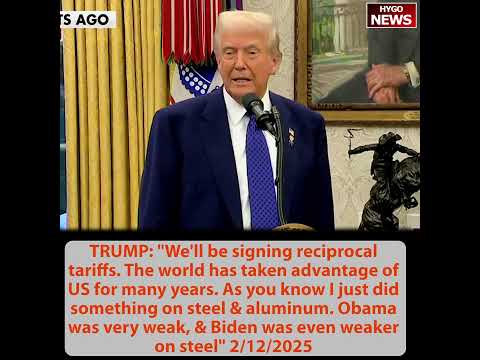
“We’ll be signing reciprocal tariffs,” Trump said. “The world has taken advantage of the United States for many years. They’ve charged us massive tariffs that we haven’t charged them.”
He cited his recent steel and aluminum tariffs as a first step. “And as you know, I just did something on steel and aluminum, 25%,” Trump said. “That’ll go up at some point, but 25%, which will level the playing field quite a bit. I did it previously, 50%.”
Trump then delivered a sharp critique of his predecessors’ handling of the steel industry. “Obama was very weak, and Biden was even weaker on steel,” he said. “Steel was just absolutely — it really started with Obama. The world really took advantage of us, and then that morphed into Biden.”
The critique was pointed because steel tariffs had been a signature issue during Trump’s first term. He had imposed 25% tariffs on steel and 10% on aluminum in 2018, arguing that the domestic steel industry was a national security asset that could not be allowed to collapse under the weight of cheap foreign imports. The Biden administration had partially maintained those tariffs but, in Trump’s view, had not been aggressive enough in protecting American producers.
Trump then connected the trade issue to Biden’s broader governance failures. “What they did was, he was so worried about trying to attack his political opponent that he didn’t know what he was doing with respect to countries taking advantage,” Trump said. “He should have looked at the countries, both friend and foe, taking advantage of us.”
The reciprocal tariff concept was simple: “Whatever they charge, we charge. Very simply.” The principle of reciprocity — if a country charged the United States 25% on a product, the United States would charge the same rate in return — was designed to be easily understood by voters and difficult for critics to argue against on fairness grounds.
Marc Fogel: “Two Weeks. He Should Have Been Out Years Ago”
The emotional centerpiece of the appearance was the story of Marc Fogel, an American teacher who had been detained in Russia for nearly four years on drug charges. Trump’s account emphasized the speed and cost-effectiveness of the negotiation.
“Just like the young gentleman that I brought home yesterday after two weeks — we worked on it for two weeks,” Trump said. “He was a fine man, and he was in there for three and a half, almost four years. And they weren’t able to do a thing.”
Trump drew a direct contrast with the Biden administration’s approach to hostage negotiations. “And I got him out. And as you know, I didn’t pay $6 billion. I didn’t pay anything. We did a trade. And we did a good job,” he said. The $6 billion reference was to the Biden administration’s controversial deal with Iran in which frozen funds were released as part of negotiations involving detained Americans.
“We got him out in two weeks. He should have been out years ago,” Trump said. The message was unmistakable: what had taken the Biden administration years of failed effort had taken the Trump administration fourteen days.
The Butler Promise: “God Saved President Trump’s Life”
Press Secretary Karoline Leavitt then provided context that transformed the Fogel story from a diplomatic achievement into a deeply personal narrative.
“Marc Fogel, an American teacher detained by Russia, was returned to American soil and met with the president here at the White House last night,” Leavitt said. “Special Envoy Steve Witkoff and the rest of President Trump’s incredible national security team helped negotiate the exchange that secured Marc Fogel’s release.”
Leavitt then revealed the connection to the July 13, 2024, assassination attempt. “Malphine Fogel, Marc’s 95-year-old mother, was understandably very worried that she would never see her son again after his arrest in 2021,” Leavitt said. “Mrs. Fogel was actually slated to join President Trump on stage at the July 13th Butler, Pennsylvania, rally to speak out for Marc, and then the infamous assassination attempt against President Trump took place.”
The timeline was remarkable: a 95-year-old mother had traveled to a political rally to plead for her son’s release, and the event had been upended by an assassination attempt that nearly killed the president.
“But that day, before the rally, President Trump promised Marc’s mother that when he returned to the White House, he would bring her son home,” Leavitt continued. “God saved President Trump’s life on that day in Butler, Pennsylvania, and now Marc Fogel is back home safely with his family as a result. God is good.”
The narrative arc — a personal promise made on the day of an assassination attempt, fulfilled within weeks of returning to office — was the kind of story that resonated beyond policy debates. It connected Trump’s survival in Butler to a concrete human outcome and provided a tangible example of a campaign promise kept.
A Sign of Progress on Ukraine
Leavitt also framed Fogel’s release in geopolitical terms, connecting it to the broader effort to end the Ukraine war. “This event shows a good faith effort from Russia, and it’s a sign, as I just said, that we are moving in the right direction to end this brutal war,” she said.
The linkage between a hostage release and the Ukraine peace process suggested that the administration viewed diplomatic engagement with Russia as a multi-track effort. Fogel’s release was not just a standalone humanitarian victory but an indicator that Moscow was willing to engage constructively with the new administration on multiple fronts.
Key Takeaways
- Trump confirmed he expected to meet Putin “probably in Saudi Arabia the first time” to work on ending the Ukraine war, calling the conflict “a disaster.”
- He announced reciprocal tariffs were coming, calling Obama “very weak” and Biden “even weaker” on steel, and citing his 25% steel and aluminum tariffs as a first step.
- Trump celebrated bringing Marc Fogel home from Russia in two weeks without paying anything, contrasting his approach with Biden’s $6 billion Iran deal.
- Leavitt revealed that Fogel’s 95-year-old mother had been scheduled to appear at the July 13 Butler rally where Trump was shot, and that Trump had promised her that day to bring her son home.
- Leavitt called Fogel’s release “a good faith effort from Russia” and “a sign that we are moving in the right direction to end this brutal war.”