 HYGO News
 Trump on Qatar Jet: 'Why Wouldn't I Accept? We're Giving to Everybody Else'; 'Most Favored Nations' Drug Prices Cut 50-90%; American Hostage Released
Trump on Qatar Jet: “Why Wouldn’t I Accept? We’re Giving to Everybody Else”; “Most Favored Nations” Drug Prices Cut 50-90%; American Hostage Released
President Trump addressed Hannity from Saudi Arabia in May 2025, providing his answer to the Qatar jet controversy and a detailed defense of his drug pricing executive order. “Some people say, ‘Oh, you shouldn’t accept gifts for the country.’ My attitude is, why wouldn’t I accept a gift? We’re giving to everybody else,” Trump said. Hannity recapped the week: “You get a deal with China. India and Pakistan. You slashed prescription drug prices. The last American hostage has been released.” On drugs: “I instituted a Most Favored Nations provision — we’re going to pay whatever the lowest country pays in the world. The drug companies have accepted it. The Democrats fought very hard to keep drug prices high. They are to blame."
"Why Wouldn’t I Accept a Gift?”
Trump’s response to Schumer’s corruption allegations was direct.
“Some people say, ‘Oh, you shouldn’t accept gifts for the country,’” Trump said. “My attitude is, why wouldn’t I accept a gift? We’re giving to everybody else, why wouldn’t I accept a gift?”
He explained the necessity: “Because it’s going to be a couple of years, I think, before the Boeings are finished. And they’ll be wonderful when they’re finished.”
The core argument was simple: the United States had spent decades giving to Qatar — military protection, diplomatic support, security infrastructure. When Qatar offered something back — an aircraft that the Defense Department could use while waiting for Boeing to finish the new Air Force One — refusing it would be both foolish and ungrateful.
The framing reversed the Democratic narrative. Schumer had portrayed the arrangement as corruption flowing from Qatar to Trump. Trump portrayed it as reciprocity within a longstanding American-Qatari relationship in which the United States had been far more generous than Qatar. A single aircraft from a country that had received decades of American security support was, in this framing, a small acknowledgment of American contributions, not a corrupt attempt to buy American influence.
The Week in Review
Hannity recapped the administration’s recent accomplishments.
“This is an amazing week so far,” Hannity said. “You get a deal with China. India and Pakistan. You slashed prescription drug prices. The last American hostage has been released. We’re on this trip to Saudi Arabia, Qatar.”
He delivered his punchline: “There’s not much going on in your life, is there?”
Trump’s response: “Well, I’ve been busy, but I’ve enjoyed it because we’re getting things accomplished. We’re getting things done.”
He reflected on the nature of government work: “You know, you can have times when you’re working very hard and not getting things done. That happens too. But we’re getting a lot done.”
He specifically noted the India-Pakistan achievement: “I don’t think there’s ever been a little period like this with the potential nuclear war. And two countries, they have very good leaders, people I know very well. It was a very important process we got involved with India and Pakistan.”
The week’s accomplishments represented an extraordinary concentration of substantive outcomes. A trade deal with China (preventing potential decoupling). A ceasefire between India and Pakistan (preventing nuclear war). A major drug pricing reform (reducing consumer costs 50-90%). A hostage release. A state visit to Saudi Arabia with $142 billion in deals. Any one of these would have been a significant achievement for a presidency; delivering them in a single week was historically unusual.
”Most Favored Nations” Drug Prices
Trump provided the most detailed public explanation of his drug pricing executive order.
“I blame the other countries in a way more — the European Union, etc.,” Trump said. “They were very nasty and very tough to the drug companies. They would give them a very low price for drug costs in the European nations.”
He described the process: “When that price was given, that was it. They wouldn’t negotiate. They said, ‘Let America pay for the difference.’”
He assigned blame: “And this happened all over the world with other countries. We had stupid people leading us, especially over the last four years. They wouldn’t do anything about it.”
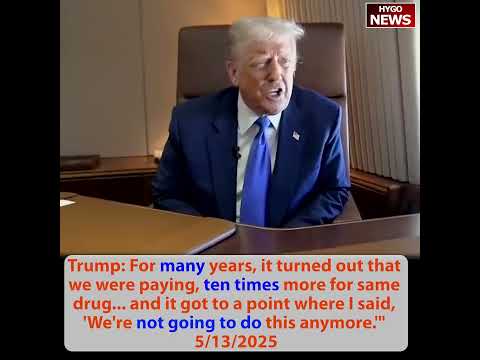
He cited the cost: “It turned out that we were paying — sometimes you saw it — 10 times more for the same drug. Same drug, same company, same plant where they make it, laboratory.”
He described his response: “It got to a point where I said, ‘We’re not going to do this anymore.’”
He described the political obstacles: “The pharmaceutical industry is very powerful — probably the most powerful, considered the most powerful lobby. The Democrats were making it impossible to lower drug prices. They knew what they were doing.”
He described the solution: “I instituted a Most Favored Nations provision or concept where we’re going to pay whatever the lowest country pays in the world. So if it’s the UK, which pays very low — any country — whatever the lowest prices, the drug companies have accepted it. Everybody accepts it.”
He placed historical blame: “The Democrats never wanted to play ball. They never wanted to do anything. It’s the Democrats’ fault that people were being ripped off for years and years.”
The Most Favored Nations drug pricing concept was straightforward. American consumers had been paying the highest drug prices in the world for decades, subsidizing research and development that benefited consumers in other countries who paid much lower prices. The MFN provision flipped the equation: American prices would be set at the lowest price paid by any other developed country for the same drug.
If the UK paid $100 for a drug that Americans paid $1,000 for, the MFN provision would require the drug company to either charge Americans $100 or charge the UK $1,000. Drug companies could not claim they couldn’t profitably sell at $100 — they were already doing so elsewhere. The choice was either lowering American prices or raising prices in every other country that benefited from American subsidization.
The 50-90% Reduction
Trump described the scale of the expected price reductions.
“We’re doing the biggest tax cuts in the history of our country, because people are going to be getting a 50 to a 90% reduction in drug prices,” Trump said.
He put the achievement in context: “Not a half a percent. I remember when I would fight so hard to get a half a point. I actually had it down a half a point for one year, and I was so proud of myself because that never happened before. It was always going up. Drugs only went in one direction — that’s up.”
He described the breakthrough: “Now after studying the industry — it’s a very complex industry, but I figured it out. And I said, ‘It’s not going to happen.’”
He reiterated the blame: “But the Democrats fought very hard to keep the prices of drugs very, very high. They really are to blame for this, because they should have done something about it.”
A 50-90% reduction in drug prices was an order of magnitude larger than any previous drug pricing achievement. The Biden administration’s Inflation Reduction Act had produced modest negotiated reductions on a small number of drugs after years of implementation. Trump’s MFN approach would apply immediately to virtually all prescription drugs, cutting American prices by half or more within months of implementation.
For American families, the financial impact would be enormous. A drug that cost $1,000 per month would drop to $100-$500. Prescription costs that consumed significant portions of household budgets would fall dramatically. Seniors on fixed incomes, families managing chronic conditions, and individuals dependent on expensive medications would all experience immediate financial relief.
The Big Beautiful Bill
Trump used the drug pricing achievement to pressure Democrats on the reconciliation bill.
“It’s going to be very hard for them not to approve the Big Beautiful Bill that we’re doing,” Trump said.
He explained: “Because people are going to be getting a 50 to a 90% reduction in drug prices.”
He projected the politics: “I think the Democrats are going to approve this bill too, because how are they going to reject a 60, 70, 80% drug cut? I don’t think they can.”
The argument was politically clever. If Democrats opposed the Big Beautiful Bill, they would be voting against massive drug price cuts that would benefit their constituents. Individual Democratic members of Congress would have to explain to voters why they had blocked legislation that would reduce their medication costs by 50-90%.
The explanation — that the bill also contained tax provisions Democrats opposed — would be politically toxic. Voters who were saving hundreds or thousands of dollars per year on prescription drugs would not care about abstract arguments about tax policy. They would remember which party delivered the drug price cuts and which party tried to block them.
Key Takeaways
- Trump on Qatar jet: “Why wouldn’t I accept a gift? We’re giving to everybody else.” It’s temporary while Boeings are finished.
- Hannity recap: China deal, India-Pakistan peace, drug price cuts, hostage released, Saudi deals — in one week.
- “Most Favored Nations” drug pricing: “Whatever the lowest country pays, we pay.” Drug companies have accepted it.
- Expected result: “50 to 90% reduction in drug prices” — orders of magnitude larger than any previous pricing action.
- “The Democrats are to blame for years of ripping off American patients. They never wanted to play ball.”