 HYGO News
 Trump: 'We Don't Have to Sign Deals -- They Have to Sign with Us'; 'Think of Us as a Super Luxury Store'; India 'Agreed to Drop Tariffs to Nothing'
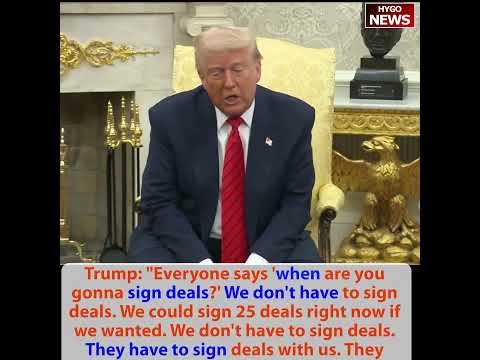
Trump: “We Don’t Have to Sign Deals — They Have to Sign with Us”; “Think of Us as a Super Luxury Store”; India “Agreed to Drop Tariffs to Nothing”
President Trump delivered the most comprehensive explanation of his trade deal philosophy in May 2025. “Everyone says ‘when are you going to sign deals?’ We don’t have to sign deals. We could sign 25 deals right now if we wanted. They have to sign deals with us. They want a piece of our market. We don’t want a piece of their market.” He described the process: “At some point over the next two weeks, I’ll sit with Howard and Scott and JD and Marco, and we’re going to put very fair numbers down. Think of us as a super luxury store — you’re going to come and pay a price.” He revealed: “India, one of the highest tariffs in the world — they’ve already agreed to drop it to nothing. They would have never done that for anybody but me.” On Canada: “I didn’t like Trudeau’s predecessor’s handling of USMCA. We have a renegotiation coming up over the next year."
"They Have to Sign with Us”
Trump reframed the trade deal question that reporters kept asking.
“Everyone says, ‘When are you going to sign deals?’” Trump said. “We don’t have to sign deals. We could sign 25 deals right now if we wanted.”
He stated the asymmetry: “We don’t have to sign deals. They have to sign deals with us. They want a piece of our market. We don’t want a piece of their market. We don’t care about their market.”
He described the process: “At some point over the next two weeks, I’ll sit with Howard and Scott and our great vice president — JD will be there, and Marco — and we’re going to put very fair numbers down.”
He explained the mechanism: “We’re going to say, ‘Here’s what we want for this country.’ Congratulations, we have a deal. And they’ll either say ‘great’ and start shopping, or ‘not good, we’re not going to do that.’ I say, ‘That’s okay, you don’t have to shop.’”
He addressed flexibility: “We may think, ‘Well, maybe we were a little bit wrong,’ so we’ll adjust it. And then you people say, ‘Oh, it’s so chaotic.’ No — we’re flexible.”
The “super luxury store” metaphor was Trump’s most vivid description of America’s economic position.
“Think of us as a super luxury store,” Trump said. “A store that has the goods. You’re going to come and you’re going to pay a price. We’re going to give you a very good price. We’re going to make very good deals.”
He stated the intent: “We’re not looking to hurt countries. We want to help countries. We want to be friendly with countries.”
He addressed the media: “You keep writing about ‘deals, deals, when are we going to sign one?’ It’s very simple. One day we’ll give you a hundred deals.”
He clarified what “deals” actually meant: “They don’t have to sign. All they have to do is say, ‘We’ll start sending our ships to pick up what we want.’ It’s very simple.”
He delivered the final formulation: “We will sign some deals. But much bigger than that is we’re going to put down the price that people are going to have to pay to shop in the United States.”
The explanation resolved the confusion that had characterized media coverage of the tariff negotiations. Reporters had been asking about formal trade agreements — signed documents between governments. Trump was describing something simpler: the United States would set tariff rates for each country, and those countries would either accept the rates and continue trading, negotiate for adjustments, or stop trading with America. Formal “deals” were optional; the tariff rates were not.
India: “Drop to Nothing”
Trump revealed a specific concession from one of the world’s most protectionist economies.
“India, as an example, is one of the highest tariffs in the world,” Trump said. “We’re not going to put up with that.”
He announced the concession: “And they’ve agreed already to drop it. They’ll drop it to nothing.”
He assessed the leverage: “They would have never done that for anybody else but me.”
India’s agreement to eliminate tariffs was one of the most significant trade developments of the tariff era. India had maintained some of the highest import duties in the world — with tariffs on American goods ranging from 40% to over 100% on certain categories. For decades, American administrations had complained about Indian protectionism but had never applied enough pressure to force change.
Trump’s tariffs had changed the calculus. Faced with American tariffs that made Indian exports uncompetitive in the U.S. market, India had agreed to reciprocal reductions — ultimately “to nothing.” The concession validated the entire tariff strategy: apply pressure, create incentives, and let economic reality drive partner countries to the negotiating table.
USMCA and Canada
Trump addressed the U.S.-Mexico-Canada Agreement with a personal aside about Trudeau’s trade representative.
“I won’t say this about Mark,” Trump said, referring to new PM Carney. “But I didn’t like his predecessor.”
He described the conflict: “We had a bad relationship having to do with the fact that we disagreed with the way they viewed the deal.”
He confirmed the future: “The USMCA is great for all countries. We do have a negotiation coming up over the next year to adjust it or terminate it.”
The USMCA renegotiation window — built into the original agreement — would give the administration leverage to address the auto sector issues Trump had raised with Carney. The agreement’s review provision meant that the entire framework of North American trade could be revisited, with the tariff leverage of the current environment providing far more pressure than had existed when the original deal was negotiated.
Key Takeaways
- Trump: “We don’t have to sign deals. They have to sign with us. They want our market — we don’t want theirs.”
- “Think of us as a super luxury store. You come, you pay a price. We’ll set the price.”
- India “agreed to drop tariffs to nothing — they would never have done that for anybody else but me.”
- Process: “In two weeks, I’ll sit with Howard, Scott, JD, Marco — put down fair numbers. Congratulations, we have a deal.”
- USMCA renegotiation confirmed “over the next year — to adjust it or terminate it.”