 HYGO News
 Trump Welcomes Italy PM Meloni: 'She's Taken Europe by Storm'; Predicts 'Very Good Deal with China' as Trade Talks Advance
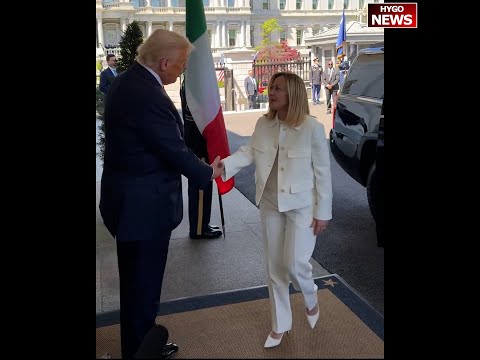
Trump Welcomes Italy PM Meloni: “She’s Taken Europe by Storm”; Predicts “Very Good Deal with China” as Trade Talks Advance
President Trump welcomed Italian Prime Minister Giorgia Meloni to the White House in April 2025, praising her as “one of the real leaders of the world” who had “taken Europe by storm.” During the joint appearance, Trump fielded questions about China trade negotiations, declaring: “I think we’re going to make a very good deal with China.” When asked whether Xi Jinping’s visits with U.S. allies should worry him, Trump dismissed the concern: “Nobody can compete with us. Nobody.” He confirmed “numerous talks at the highest level” with multiple countries and stated the core principle: “The United States was ripped off and taken advantage of by every country in the world, practically. That’s not going to happen anymore, but we’re going to make fair deals."
"She’s Taken Europe by Storm”
Trump’s praise for Meloni was among the most generous he had offered any foreign leader.
“It’s an honor to have the Prime Minister of Italy with us, Prime Minister Meloni, who’s doing a fantastic job,” Trump said.
He elevated his characterization: “I would say that she has taken Europe by storm and highly respected. Everybody loves her and respects her, and I can’t say that about many people.”
He added the personal dimension: “She’s become a friend, and we really have a great relationship between Italy and ourselves. We talked about trade, we talked about many, many things during our luncheon.”
Trump recounted the history: “I do like her very much. I think she’s a great Prime Minister. I think she’s doing a fantastic job in Italy. We’re very proud of her. I knew her right from the beginning. I knew her as a very early Prime Minister, and I knew she had great talent.”
He delivered the highest compliment: “She’s one of the real leaders of the world, and I’m very proud to be with her.”
Meloni responded with humor to Trump’s effusive praise, prompting Trump to say: “We should end the press conference” — a joke acknowledging that the praise had set such a high note that anything following would be anticlimactic.
The Trump-Meloni relationship was one of the most significant diplomatic alignments in the Western world. Meloni had risen to power in Italy on a platform strikingly parallel to Trump’s — national sovereignty, border security, cultural conservatism, and skepticism of the multinational institutions that had eroded national interests in the name of globalism. She was the first female Prime Minister of Italy and had proven herself as a formidable leader who combined conservative values with pragmatic governance.
”Nobody Can Compete with Us”
When a reporter asked whether Trump should be concerned about Chinese President Xi Jinping visiting with U.S. allies, Trump’s response was characteristically dismissive.
“No. Nobody can compete with us. Nobody,” Trump said.
The three-word declaration — “Nobody can compete with us” — was Trump’s standard framing of America’s economic position. It was not bravado; it reflected the fundamental reality that the United States had the world’s largest consumer market, the dominant reserve currency, the most productive workforce, and the deepest capital markets. Any country that wanted to access American consumers needed America more than America needed them. This asymmetry was the leverage behind the entire tariff strategy.
The reporter’s question had been designed to suggest that China was building alternative alliances to circumvent American pressure — that Xi’s diplomatic outreach to U.S. allies represented a strategic countermove. Trump’s response rejected the premise entirely. China’s economy was dependent on exports to America and to countries that were themselves dependent on the American market. No amount of diplomatic visits could change the underlying economic reality.
”Very Good Deal with China”
Trump offered his most optimistic assessment of China trade negotiations.
“I think we’re going to make a very good deal with China,” he said. “I think that you will see we’ll make a very good deal with China.”
He provided context: “As you know, we’ve had numerous talks at the highest level, frankly, with other countries. We’re doing very well and we’re moving along on trade very well.”
He stated the grievance: “The United States was ripped off and taken advantage of by every country in the world, practically. I mean, they have to say practically, but just about everyone.”
He stated the resolution: “That’s not going to happen anymore, but we’re going to make fair deals.”
The “very good deal with China” prediction came at a critical moment in the tariff standoff. Liberation Day tariffs had been implemented two weeks earlier. Markets were volatile. Media coverage focused almost exclusively on the potential economic disruption. Trump’s public confidence that a deal was imminent — combined with the confirmation of “numerous talks at the highest level” — was designed to signal that the tariffs were working exactly as intended: creating pressure that would lead to negotiated agreements more favorable to the United States.
The emphasis on “fair deals” rather than “free trade” was the philosophical core of Trump’s trade policy. The previous consensus — that free trade was inherently good and that any barriers were inherently bad — had been replaced by a recognition that trade was only beneficial when it was reciprocal. Countries that charged high tariffs on American goods while enjoying low tariffs on their exports to America were not engaging in free trade; they were engaging in exploitation.
The Meloni Alliance
The Meloni visit occurred against the backdrop of ongoing tariff negotiations with the European Union. Italy, as the EU’s third-largest economy, was a critical player in those negotiations. Meloni’s presence at the White House signaled several things simultaneously.
First, it demonstrated that Trump was willing to engage bilaterally with individual EU member states, not just with Brussels. This approach gave leaders like Meloni the ability to negotiate directly for their country’s interests rather than being subsumed into the EU’s collective bargaining position.
Second, Meloni’s visit showed that the populist-conservative alliance that stretched from Trump to Meloni to Argentina’s Milei to El Salvador’s Bukele was an active diplomatic network, not merely an ideological affinity. These leaders shared policy platforms and supported each other’s agendas in ways that created genuine geopolitical leverage.
Third, the warmth of the personal relationship — “she’s become a friend” — indicated that Italy was likely to receive favorable treatment in tariff negotiations. Trump consistently rewarded allies who treated the United States with respect and who aligned with his broader vision. Meloni’s Italy was positioned to be one of those favored partners.
Trade Negotiations Across the Board
Trump’s reference to “numerous talks at the highest level” with multiple countries confirmed that the post-Liberation Day period was one of intense diplomatic activity. The tariffs had created a global scramble to negotiate — exactly the dynamic Trump had intended.
Countries that had for decades enjoyed one-sided trade advantages with the United States were now motivated to come to the table. The tariffs had transformed the negotiating landscape: instead of America begging countries to open their markets, countries were now requesting meetings to discuss how to lower the tariffs they faced.
The “moving along on trade very well” assessment suggested that multiple negotiations were producing results. Whether with the EU, Japan, South Korea, India, or other trading partners, the tariff pressure was generating the kind of engagement that decades of diplomatic pleading had failed to achieve.
The Broader Significance
The Meloni visit encapsulated the Trump administration’s approach to international relations: personal relationships with aligned leaders, direct bilateral engagement, and the use of economic leverage to restructure trade relationships that had disadvantaged the United States.
Meloni’s presence at the White House also represented a validation of the conservative populist movement that had swept elections across the Western world. The fact that the leaders of the world’s two most influential democracies — Trump and Meloni — shared a common philosophy about national sovereignty, immigration, and cultural values was a geopolitical fact that the legacy media struggled to acknowledge.
Trump’s comment that “everybody loves her and respects her, and I can’t say that about many people” was notable for its exclusivity. Trump did not distribute praise widely among foreign leaders. That Meloni received such unqualified endorsement placed her in a category reserved for a very small number of world leaders whom Trump considered genuine partners.
Key Takeaways
- Trump praised Meloni as “one of the real leaders of the world” who had “taken Europe by storm” — among his strongest endorsements of any foreign leader.
- On China: “I think we’re going to make a very good deal. Nobody can compete with us. Nobody.”
- Trump confirmed “numerous talks at the highest level” with multiple countries and said trade negotiations were “moving along very well.”
- Core principle: “The United States was ripped off by every country in the world, practically. That’s not going to happen anymore — we’re going to make fair deals.”
- The bilateral visit signaled Italy’s favored position in tariff negotiations and the strength of the Trump-Meloni conservative alliance.