 HYGO News
 Trump: very respectful Putin, Zelensky I disagree; 88% Ukrainians want peace deal; Dems gerrymander
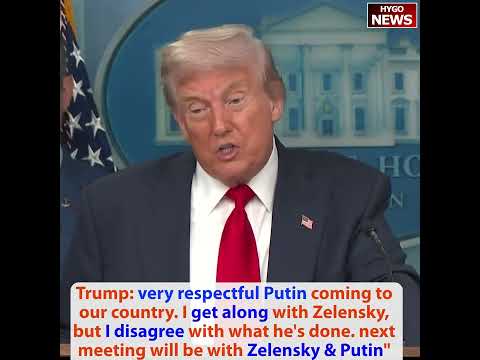
Trump: very respectful Putin, Zelensky I disagree; 88% Ukrainians want peace deal; Dems gerrymander
Trump delivered a composite briefing covering the Russia-Ukraine diplomatic schedule, the redistricting arms race between Texas and California, and the ongoing assault wave against ICE agents. On Putin’s upcoming visit to the United States: “I thought it was very respectful that the president of Russia is coming to our country as opposed to us going to his country or even a third party place.” On Zelensky: “I get along with Zelensky, but you know, I disagree with what he’s done. Very, very severely disagree. This is a war that should have never happened, wouldn’t have happened.” On the Ukrainian public’s mood: “I’ve seen a poll coming out of Ukraine. 88% of the people would like to see a deal made.” On Democratic redistricting threats: “If California tries to gerrymander five more districts, listen, Texas has the ability to eliminate 10 Democrats in our state. We can play that game more than they can.” And on ICE agents facing a reported 1000% increase in assaults: “People do not want to continue to watch people fund this kind of extraction. This is kind of violence."
"Very Respectful That the President of Russia Is Coming”
Trump’s opening framing for the Putin visit. “I thought it was very respectful that the president of Russia is coming to our country as opposed to us going to his country or even a third party place.”
“Very respectful.” That is specific diplomatic vocabulary. Russia’s president traveling to the United States — rather than the U.S. president traveling to Moscow or a neutral location like Geneva or Helsinki — is, per Trump’s framing, an indication of respect. The host country has the home-field advantage. The visiting country accepts that asymmetry.
Historical context matters. Past Russia-U.S. summits have frequently been held at neutral locations (Reykjavik, Helsinki, Geneva) to avoid the optics of either side traveling to the other’s capital. Putin traveling to the United States specifically — not Alaska, not a neutral third country — is a departure from recent diplomatic practice.
“I think we’ll have constructive conversations.” That is Trump’s expectation. Not confrontational. Not adversarial. “Constructive” — aimed at producing specific outcomes rather than merely expressing positions.
The European Call Schedule
“Then after that meeting immediately, maybe as I’m flying out, maybe as I’m leaving the room, I’ll be calling the European leaders, so I get along with very well. You know, I have a great relationship, I think with all of them.”
That is Trump’s coordination choreography. Meet Putin. Exit the meeting. Call European leaders immediately — potentially while still physically leaving the meeting room or during the return flight.
The sequence is important. Putin gets Trump’s direct face-to-face attention. Europeans get briefed by Trump immediately afterward. Zelensky gets briefed and then included in a follow-up meeting. The order communicates the hierarchy of the negotiation.
“I have a great relationship, I think with all of them.” European leaders. The collective personal relationship has survived the various policy disagreements (tariffs, NATO spending, Ukraine aid posture differences).
”I Get Along with Zelensky, But I Disagree”
The Zelensky framing. “And I get along with Zelensky, but you know, I disagree with what he’s done. Very, very severely disagree. This is a war that should have never happened, wouldn’t have happened.”
“I get along with Zelensky” is the diplomatic courtesy. Personal-level cordiality is maintained. But the policy disagreement is “very, very severely” — the doubled intensifier is Trump’s specific grammatical choice to signal the depth of the substantive rupture.
“This is a war that should have never happened, wouldn’t have happened.” That is Trump’s foundational position. Under his administration, the war would not have occurred — in his framing, because his posture toward Putin was more clearly balanced between deterrence and engagement, producing stability rather than the invasion.
Whether that counterfactual is true is historically contested. What matters for the current negotiation is that Trump holds that view and negotiates from it. The war was not inevitable. It was a failure of diplomacy. Ending it is not merely possible but required.
”The Next Meeting Will Be with Zelensky and Putin”
“But I’ll be speaking to Zelensky. The next meeting will be with Zelensky and Putin, or Zelensky and Putin and me. I’ll be there if they need.”
That is the specific diplomatic architecture. The Putin-Trump meeting is first. The Zelensky-Putin direct meeting is second. Trump may or may not be present at that second meeting — depending on whether the two leaders need him as mediator.
“Or Zelensky and Putin and me.” The three-way format. Trump as convener and mediator. Zelensky and Putin as the direct principals. That is the structure that would produce an actual peace agreement — direct engagement between the two heads of state of the warring countries, with U.S. mediation as the catalyst.
“I’ll be there if they need.” That caveat matters. Trump is willing to step back and let Zelensky and Putin negotiate directly if that is what produces an agreement. He is not demanding control of the negotiation. He is offering facilitation.
“I want to have a meeting set up between the two leaders.” That is the specific goal. Direct Zelensky-Putin contact. That has not occurred since the war began. Getting the two leaders in the same room — with or without Trump present — is the precondition for any actual peace agreement.
”Lots of Luck, Keep Fighting” or “Make a Deal”
“May say, lots of luck, keep fighting. Or I may say, we can make a deal.”
That is Trump’s decision tree. After his Putin meeting and before the Zelensky-Putin meeting, Trump will assess whether a deal is possible. If yes — “we can make a deal.” If no — “lots of luck, keep fighting” (meaning the U.S. steps back from mediation, the warring parties continue their conflict).
The binary is clear. Trump is not committing to endless mediation if the parties are not ready. He is offering a specific window. Within that window, a deal is possible. Outside that window, the United States returns to a less-engaged posture.
”88% of the People Would Like to See a Deal”
The Ukrainian opinion data. “I will tell you this, I’ve seen a poll coming out of Ukraine. 88% of the people would like to see a deal made.”
88%. That is a supermajority of the Ukrainian public supporting a negotiated settlement. The specific poll Trump is referencing is not cited — it could be one of the Ukrainian polling firms (Rating Group, KIIS) or a Western poll of Ukrainian residents. The 88% figure is consistent with some recent polls showing growing Ukrainian fatigue with the war’s human cost.
“And if you go back three years, everybody was gung-ho for war.” That comparison matters. Ukrainian public opinion has shifted. In 2022 — after the February invasion — support for continuing the war was much higher. Three years of casualties, displacement, economic damage, and infrastructure destruction have produced a different public mood.
“You know, everybody’s gung-ho for war until you have it. It’s an amazing thing.” That is Trump’s general observation about war enthusiasm. Initial war support is typically high. Sustained combat over multiple years erodes that support as the costs accumulate.
Trump’s First-Term Analogy
“I had it with a couple of countries where I couldn’t get a deal done with one particular country. I just couldn’t. A guy’s great, he’s a friend of mine, great. Could lead a tough as hell. I couldn’t get the deal done. And then he went into war for a short period of time. You know where I’m talking about. First term, and it was nasty. He went through one week of war and I was able to get the deal done. He said, this is nasty.”
That is Trump’s anecdotal parallel. An unnamed leader he could not get to agree to a deal. The leader started a war. One week into actual combat, the leader asked for the deal. “This is nasty” — the reality of war changed the leader’s calculus.
The unnamed country is likely not specified publicly. The pattern is the message: wars often require direct experience of combat’s costs before the parties accept deals that were available beforehand. Ukraine is now three years into that experience.
Zelensky Not Invited to Friday Meeting
“Just to follow up on what you were saying there. First of all, Flora Mirzelinski is not invited on Friday?”
“Flora Mirzelinski” is Whisper’s rendering of the question about Zelensky. The reporter is asking whether Zelensky is excluded from the Friday Putin-Trump meeting.
“He wasn’t a part of it. I would say he could go, but he’s gone to a lot of meetings. You know, he’s been there for three and a half years, nothing happened.”
That is Trump’s explanation. Zelensky was not invited because the Friday meeting is specifically Trump-Putin bilateral. Zelensky “could go” but that is not the format. And Trump notes that Zelensky “has been there for three and a half years, nothing happened” — the implicit critique is that Zelensky’s approach to date has not produced results.
The California-Texas Redistricting Arms Race
The reporter pivoted. “We have Democrats in California and New York and other states saying, well, if Governor Abbott does this in Texas, we’re going to add five Democratic seats. Are you not worried at all about a redistricting gerrymandering arms race going on? And theoretically, is it not just better for voters to be picking their politicians instead of politicians to be picking their voters through gerrymandering?”
That is a legitimate reporter question. Gerrymandering distorts representation. Voters should pick politicians, not the reverse. The reporter is applying that principle to both sides — Texas Republicans and California Democrats.
Trump’s response. “Well, to be clear, listen, all those big blue states, they’ve already gerrymandered. Look at the map of Illinois. Look at the map of California, New York and Massachusetts and so many other blue states. They gerrymandered a long time ago. They got nothing left with regard to what they can do.”
That is the counter-argument. Blue states have already gerrymandered to the maximum extent possible. California, Illinois, New York, Massachusetts — their congressional maps are already drawn to favor Democrats. Further Democratic gerrymandering in those states has limited incremental effect because the maps are already saturated.
“They gerrymandered a long time ago. They got nothing left with regard to what they can do.” That is the specific claim. Democrats have no remaining gerrymandering capacity in their core blue states.
”Texas Has the Ability to Eliminate 10 Democrats”
“And notice if California tries to gerrymander five more districts, listen, Texas has the ability to eliminate 10 Democrats in our state. We can play that game more than they can because they have fewer Republican districts in their states.”
That is the specific Texas vs. California asymmetry. If California gerrymanders five additional Democratic districts, Texas can gerrymander ten additional Republican districts.
Why? California’s existing congressional map has many Democratic districts and few Republican districts. Taking Republican seats and making them Democratic seats produces net gains of zero for Democrats (they already hold those seats) or gains of a few (converting marginal seats). The ceiling is low.
Texas has many Republican districts and a meaningful number of Democratic districts. Converting Democratic districts to Republican districts produces real net Republican gains. The ceiling is higher.
Five-vs-ten is Trump’s specific math. It may be optimistic — Texas demographics include significant Democratic-leaning populations (Houston, Austin, the Rio Grande Valley) that resist unlimited gerrymandering. But the underlying asymmetry is real. Red states typically have more gerrymandering capacity than blue states because blue states have already saturated their partisan map drawing.
Rashida Tlaib Calls ICE Agents “Thugs”
The reporter then asked about Rep. Rashida Tlaib’s recent comments. “I mean, just watching everything online now, the ice, you know, thugs and and just hearing all the stories and I can tell you just images after images.”
Tlaib, Democratic congresswoman from Michigan, had sat down with socialist podcaster Hasan Piker and called ICE agents “thugs.” ICE agents are currently experiencing a reported 1000% increase in assaults against them. The “thugs” framing from a sitting member of Congress contributes to the dehumanization of federal law enforcement officers who are enforcing immigration law.
Trump’s response. “You don’t have to be an immigrant. You don’t have to be Palestinian. You don’t have to be a Democrat or part of a political party. People do not want to continue to watch people fund this kind of extraction. This is kind of violence.”
That is Trump’s universalizing frame. The assault on ICE agents is not a partisan issue. It is not an immigrant issue. It is not a Palestinian issue. It is an American issue — federal law enforcement officers being subjected to dehumanizing rhetoric and physical violence.
“People do not want to continue to watch people fund this kind of extraction” is slightly garbled in the transcript, but the meaning is clear. Americans do not want to tolerate the current pattern of violence against ICE agents. The rhetorical incitement from figures like Tlaib contributes to the actual assault wave.
“Yeah, it’s violence.” That is the specific acknowledgment. Calling ICE agents “thugs” is not neutral commentary. It is rhetorical violence that produces actual violence when listeners internalize the dehumanization.
Three Threads Converging
The Russia-Ukraine diplomatic architecture (Putin visit, Zelensky meeting, 88% peace support). The California-Texas redistricting arms race (Democratic threats met with Texas’s greater gerrymandering capacity). The ICE assault wave and Tlaib’s “thugs” characterization (rhetorical violence producing physical violence).
Each thread represents a distinct administration priority. Foreign policy (ending the Russia-Ukraine war through direct diplomacy). Domestic political strategy (preserving and potentially expanding the House Republican majority through legitimate and aggressive redistricting responses). Domestic law enforcement (protecting ICE agents from assault and prosecuting those who incite violence against them).
The cumulative posture is consistent. Direct engagement. Reciprocal escalation when challenged. Protection of federal personnel. Each item reinforces the broader administration narrative of active, assertive leadership across multiple domains simultaneously.
Key Takeaways
- Trump on Putin’s U.S. visit: “I thought it was very respectful that the president of Russia is coming to our country as opposed to us going to his country or even a third party place.”
- On Zelensky: “I get along with Zelensky, but you know, I disagree with what he’s done. Very, very severely disagree. This is a war that should have never happened, wouldn’t have happened.”
- Trump citing Ukrainian public opinion: “I’ve seen a poll coming out of Ukraine. 88% of the people would like to see a deal made” — compared with three years ago when “everybody was gung-ho for war.”
- On California gerrymandering threat: “If California tries to gerrymander five more districts, listen, Texas has the ability to eliminate 10 Democrats in our state. We can play that game more than they can.”
- On ICE agents being called “thugs” by Rep. Rashida Tlaib amid a reported 1000% increase in assaults: “You don’t have to be an immigrant … People do not want to continue to watch … this kind of violence.”