 HYGO News
 Trump Welcomes Carney: 'Very Friendly but We Don't Want Canada's Cars or Steel'; Trudeau Told Me '25% Tariff Means End of Canada'
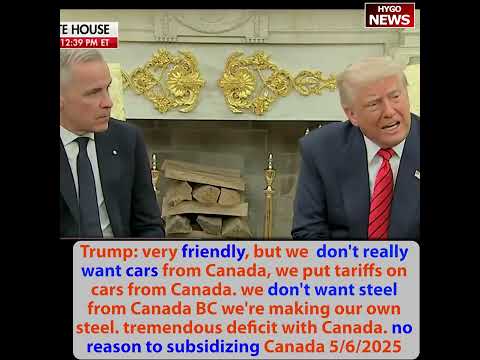
Trump Welcomes Carney: “Very Friendly but We Don’t Want Canada’s Cars or Steel”; Trudeau Told Me “25% Tariff Means End of Canada”
President Trump welcomed Canadian PM Mark Carney to the White House in May 2025 for what he called “a very friendly conversation” that nonetheless contained hard truths: “We want to make our own cars. We don’t really want cars from Canada. We don’t want steel from Canada because we’re making our own steel. We have a tremendous deficit with Canada. There’s no reason for us to be subsidizing Canada.” He recalled Trudeau’s own warning: “I said, if we put a 25% tariff on your cars, what would that mean? He said, ‘That would mean the end of Canada.’ He actually said that to me.” Carney countered that “50% of a car that comes from Canada is American.” Trump concluded warmly: “Regardless of anything, we’re going to be friends with Canada. I have a lot of respect for the Canadians. Wayne Gretzky — the great one.”
Carney’s Opening
Canadian PM Carney made his case for the bilateral relationship.
“We are the largest client of the United States in the totality of all goods,” Carney said. “So we are the largest client of the United States.”
He highlighted the auto sector: “We have a tremendous auto sector between the two of us. 50% of a car that comes from Canada is American. That’s not like anywhere else in the world.”
He framed the visit: “Is there one thing? No, this is a bigger discussion. There are much bigger forces involved. This will take some time and some discussions. That’s why we’re here.”
Carney’s “50% of a car is American” argument was the Canadian auto industry’s strongest card. The integrated North American auto supply chain — where parts crossed the border multiple times during assembly — meant that tariffs on Canadian cars would effectively tax American components. It was the most legitimate argument against blanket auto tariffs on Canada.
”We Don’t Want Your Cars”
Trump’s response was blunt but not hostile.
“The conflict is — and this is very friendly, this is not going to be like we had another blow-up — this is a very friendly conversation,” Trump said.
He stated the position: “But we want to make our own cars. We don’t really want cars from Canada. We put tariffs on cars from Canada. At a certain point, it won’t make economic sense for Canada to build those cars.”
He expanded: “We don’t want steel from Canada because we’re making our own steel. We’re having massive steel plants being built right now as we speak.”
He listed the products: “We really don’t want Canadian steel and we don’t want Canadian aluminum and various other things because we want to be able to do it ourselves.”
He stated the fiscal case: “Because of past thinking of people, we have a tremendous deficit with Canada. In other words, they have a surplus with us. And there’s no reason for us to be subsidizing Canada.”
He set the expectation: “Canada is a place that will have to be able to take care of itself economically. I assume they can.”
Trump’s argument was not that Canada was an enemy but that the economic relationship was one-sided. America was subsidizing Canadian industry through trade deficits while Canada’s military was subsidized by American defense spending. The combination meant American taxpayers were paying twice — once through trade and once through defense — to support a country that could and should support itself.
”The End of Canada”
Trump recalled a conversation with former PM Trudeau that crystallized the asymmetry.
“I used to call him Governor Trudeau,” Trump said. “I think that probably didn’t help his election.”
He recounted the exchange: “I said, so why are we taking your cars? I said, if we put a tariff on your cars of 25%, what would that mean to you?”
He delivered Trudeau’s answer: “He said, ‘That would mean the end of Canada.’ He actually said that to me.”
Trump drew the conclusion: “It’s hard to justify subsidizing Canada to the tune of maybe $200 billion a year.”
The “end of Canada” quote — attributed directly to Trudeau — was the most devastating argument for the trade imbalance’s severity. If the sitting prime minister of Canada believed that a 25% tariff on cars would destroy his country’s economy, it meant Canada was entirely dependent on preferential access to the American market. That dependency was the subsidy Trump was identifying — America was choosing to accept disadvantageous trade terms because the alternative would devastate its neighbor.
”We’ll Always Be Friends”
Trump balanced the hard economics with personal warmth.
“We’re gonna be friends with Canada,” Trump said. “Regardless of anything, we’re gonna be friends with Canada.”
He personalized: “Canada is a very special place to me. I know so many people that live in Canada. My parents had relatives that lived in Canada, my mother in particular.”
He expressed genuine affection: “I love Canada. I have a lot of respect for the Canadians.”
He added the cultural reference: “Wayne Gretzky — I mean, how good. The great one.”
He assured: “We protect Canada militarily and we always will. We’re not gonna — that’s not a money thing. But we always will.”
The Wayne Gretzky reference was vintage Trump — connecting geopolitics to cultural touchstones that humanized the relationship. Canada was not merely a trade partner with a surplus problem; it was the country that produced the greatest hockey player of all time, the country where Trump’s mother had relatives, the country Americans loved even as they demanded fair treatment.
The military assurance was equally important. By confirming that American defense of Canada was unconditional — “not a money thing” — Trump separated the security relationship from the trade relationship. Canada’s military subsidization was a separate issue from trade deficits. America would protect Canada regardless; but America would no longer accept unfair trade as part of the package.
Key Takeaways
- Trump to Carney: “We don’t want Canada’s cars, steel, or aluminum. We’re making our own. There’s no reason to subsidize Canada $200 billion a year.”
- Trudeau told Trump: “A 25% car tariff would mean the end of Canada.” Trump: “He actually said that to me.”
- Carney argued: “50% of a car from Canada is American. That’s not like anywhere else in the world.”
- Trump: “Regardless of anything, we’ll be friends with Canada. I love Canada. Wayne Gretzky — the great one.”
- On military: “We protect Canada and always will. That’s not a money thing.”