 HYGO News
 Trump & Vance meeting with Senators; Trump & First Lady Melania pay respects to Jimmy Carter
Trump & Vance meeting with Senators; Trump & First Lady Melania pay respects to Jimmy Carter
On January 8, 2025, President-elect Donald Trump and Vice President-elect JD Vance arrived at the U.S. Capitol for a day of significant events. They met with Republican senators to discuss the legislative agenda ahead of the inauguration, paid respects to former President Jimmy Carter who was lying in state in the Capitol Rotunda, and Trump briefly addressed reporters on topics ranging from the reconciliation bill strategy to the California wildfires. The visit underscored the dual nature of the transition period: the solemn observance of a former president’s death alongside the urgent work of preparing to govern.
Thunderous Applause as Trump and Vance Enter Senate Meeting
The tone of the day was set early when President-elect Trump and VP-elect JD Vance entered the meeting room with Republican senators at the Capitol. Their arrival was met with thunderous applause from the gathered lawmakers, a display of enthusiasm and unity that signaled the party’s eagerness for the incoming administration.
The meeting was focused on the critical question of how to advance Trump’s legislative agenda through Congress. The central debate within the Republican conference was whether to pursue a single large reconciliation bill or split the agenda into two separate measures.
Trump addressed the question directly when he spoke briefly to reporters afterward. “We’re looking at the one bill versus two bills, and whatever it is, it doesn’t matter,” Trump said. “We’re going to get the result. And we’re going to Make America Great Again, and we’ll see you in a little while.”
The comment reflected Trump’s pragmatic stance on the procedural question. While he had previously expressed a preference for “one big beautiful bill,” he was signaling to senators that the outcome mattered more than the process. The flexibility was important given that the Republican majority in both chambers was narrow, and any legislative strategy would need to accommodate a range of views among Republican members.
Trump and First Lady Melania Pay Respects to President Carter
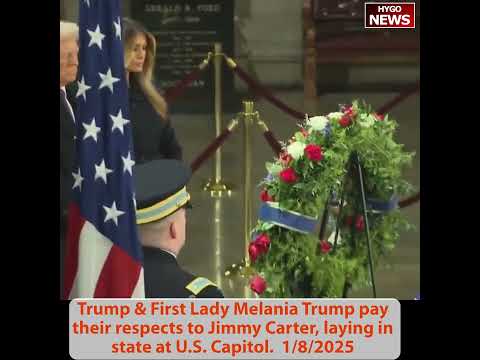
Following the Senate meeting, President-elect Trump and First Lady Melania Trump visited the Capitol Rotunda to pay their respects to former President Jimmy Carter, whose body was lying in state. The visit was a moment of bipartisan dignity during what had otherwise been a period of intense partisan activity.
Trump approached the viewing quietly, paying his respects to the 39th president in a solemn ceremony. The visit was notable for the respect shown by the incoming president to a political figure from the opposing party, continuing the tradition of former presidents honoring their predecessors regardless of party affiliation.
When reporters asked Trump for his thoughts about President Carter as he departed, Trump kept his comments brief, maintaining the somber tone appropriate to the occasion.
First Lady Melania Trump was also asked about the visit. When a reporter called out, “First Lady, are you happy to be back?” she responded simply: “Yes, of course.” The brief exchange captured both the personal dimension of the couple’s return to the Capitol and the routine of political life that would resume in full on Inauguration Day, just twelve days away.
Trump on Climate Change and California Wildfires: “No”
The most pointed exchange of the day came when a reporter attempted to connect the devastating California wildfires to the broader debate over climate change.
“Does seeing this devastation though change your opinion at all on climate change, Mr. President?” the reporter asked.
Trump’s response was immediate and unequivocal: “No.”
He then elaborated briefly but pointedly: “I have a strong opinion. I want great climate. We’re going to have that. And we’re going to have forests that are very safe, because we can’t go through this every year.”
The exchange was notable for its directness. Trump refused to concede any ground to the premise that the California wildfires were evidence of climate change, instead redirecting the conversation to his consistent argument that the fires were primarily a result of forest mismanagement and inadequate water infrastructure rather than changing climate patterns.
Flashback: Trump’s Consistent Position on California Fire Management
Trump’s January 2025 response echoed his position from years earlier. When forest fires ripped through California in 2018, Trump had stood alongside Governor Gavin Newsom and stressed the importance of proper forest management. At that time, reporters had asked similar questions attempting to link the fires to climate change, and Trump had similarly declined to shift his position.
The consistency of Trump’s messaging on California wildfires was a recurring feature of his political career. Whether in 2018, during his campaign appearances in LA County in 2024, or during his Joe Rogan interview, Trump had maintained that California’s fire problem was rooted in policy choices rather than climate dynamics.
His core argument centered on three points: first, that California’s environmental regulations prevented adequate water flow to forests and agricultural areas; second, that restrictions on forest management activities like clearing dead trees and brush created fuel for catastrophic fires; and third, that redirecting water from northern California would allow the state to maintain damper, safer forest conditions.
The Legislative Landscape Ahead of Inauguration
The Senate meeting reflected the intense behind-the-scenes work that characterized the twelve days between the Carter tribute and Trump’s inauguration on January 20. Republican senators were working to build consensus on the reconciliation approach, with the key divide between those who wanted a single comprehensive bill and those who preferred a two-bill strategy that would deliver border security measures faster.
Senate Majority Leader John Thune and other senior Republicans had different preferences, and Trump’s flexibility on the question gave the conference room to negotiate. The meeting at the Capitol was one of several strategy sessions that would take place before the inauguration, as Republicans sought to have a legislative framework ready to move as soon as Trump took office.
The narrow margins in both the House and Senate meant that every Republican vote was critical. The reconciliation process, which would allow legislation to pass with a simple majority in the Senate, was the primary vehicle for advancing the Trump agenda, but it required unity within the party to succeed.
Additional Context
The January 8 Capitol visit illustrated the multiple dimensions of a presidential transition. In a single day, Trump moved between a solemn tribute to a deceased former president, a political strategy session with his party’s senators, and a media exchange about one of the most urgent news stories of the moment. The ability to navigate these different registers was a practical requirement of the transition period and a preview of the multi-track governance approach that would characterize the early days of Trump’s second term.
Carter’s lying-in-state ceremony continued to draw dignitaries and members of the public throughout the week, with a state funeral at the Washington National Cathedral scheduled for the following day. The observances represented a rare moment of national unity during an otherwise deeply polarized political environment.
Key Takeaways
- President-elect Trump and VP-elect Vance received thunderous applause from Republican senators during a legislative strategy meeting at the Capitol focused on the reconciliation bill approach.
- Trump signaled flexibility on the one-bill versus two-bill debate, saying “whatever it is, it doesn’t matter. We’re going to get the result.”
- Trump and First Lady Melania Trump paid their respects to President Jimmy Carter lying in state at the Capitol Rotunda, with Melania saying she was happy to be back.
- When asked if the California wildfire devastation changed his opinion on climate change, Trump answered “No” and reiterated his focus on making forests “very safe” through better management.
- Trump’s position on California wildfires has remained consistent since at least 2018, consistently emphasizing forest management and water infrastructure over climate change as the primary factors.