 HYGO News
 Trump: US auto/agricultural big beneficiaries of new EU biggest deal or 8/1 at 30%; Iran enrichment
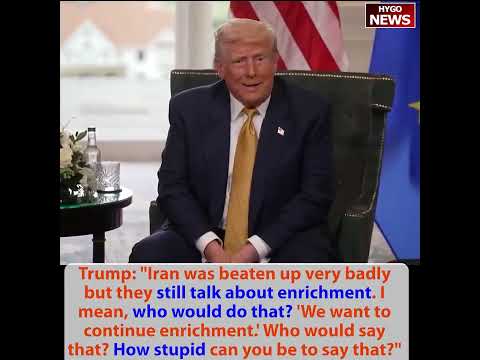
Trump: US auto/agricultural big beneficiaries of new EU biggest deal or 8/1 at 30%; Iran enrichment
Expanding on the EU deal, Trump named the American industries that would benefit most: “Maybe cars would be the one that would go the biggest, and the second would be agriculture.” He laid out the operational reality pre-deal: “We don’t sell cars into Europe. We don’t sell essentially agriculture of any great degree. They want to have their farmers do it. And they want to have their car companies do it … we have a rough situation.” Ursula von der Leyen put a sharp edge on the alternative to the deal: “We should not forget where we would have been on the first of August. We would have been at 30% … 15% is certainly a challenge for some. But we should not forget, it keeps us the access to the American market.” On Iran: “Iran was beating up very badly for good reason. We cannot have them have a nuclear weapon, but they still talk about enrichment … Who would say that? How stupid can you be to say that?"
"Cars Basically Were Not Invited”
Trump described the pre-deal American auto situation in European markets. “Cars basically were not invited, were not… I don’t know if the word is not allowed or just, you know, you just kept about somehow, right?”
“Not invited.” That is the diplomatic framing for what American auto manufacturers have experienced in Europe. Not that European consumers have rejected American cars in free markets — but that European regulatory frameworks, tariff structures, and non-tariff barriers have effectively excluded American auto products from fair competition.
European auto tariffs on U.S. imports run at 10%. American auto tariffs on European imports have been approximately 2.5%. That four-to-one asymmetry is one layer. Non-tariff barriers — vehicle type-approval requirements, emissions standards, safety certifications — have been another. For American manufacturers, the combined friction has made the European market effectively closed.
”Pickup Trucks and SUVs”
“You know, we have some cars that do terrific business and we do really well with the pickup trucks, with the SUVs.”
Pickup trucks and SUVs. That is the American auto-industry strength. Ford F-150s, Chevy Silverados, Ram trucks, Jeep SUVs, GMC Yukons — the full-size truck and SUV categories where American manufacturers dominate globally.
Those vehicles have been largely absent from European markets. European consumers, by contrast, tend to drive smaller cars due to fuel costs, urban constraints, and different consumer preferences. But there is a specific premium segment within European markets that could absorb American truck and SUV products if the market were open. That segment has been underserved precisely because of the trade friction.
“I think the people of Europe will have some diversification. I think that’ll make them happy.”
“Diversification” is the gentle framing. European consumers, under the new terms, will have access to a broader range of vehicles. American pickup trucks and SUVs become available options alongside the European compact and luxury vehicles that have dominated.
”Cars … Agriculture”
“So I think maybe cars would be the one that would go the biggest, and the second would be agriculture. The farmers will do it in very strict conjunction with the president and the European Union.”
Two categories Trump is projecting as the biggest beneficiaries: cars and agriculture.
For cars, the market opening is about reversing decades of asymmetry. American manufacturers finally getting fair access to European consumers.
For agriculture, “in very strict conjunction with the president and the European Union” suggests the implementation will be carefully managed. European agricultural regulations — GMO restrictions, hormone standards, organic certifications — have been barriers to American agricultural exports. Those regulations will not simply disappear. But under the deal, they will be reviewed and adjusted to allow American products where the underlying concerns can be addressed.
“Likewise, they’re coming into our country with a great vigor.”
European manufacturers bringing their investment to America. The $600 billion European investment commitment is part of the broader deal — European companies expanding U.S. operations, building U.S. facilities, hiring U.S. workers.
“I think they’re going to make a lot of money with this. I think everybody is. I think it, and again, it’s going to bring a lot of unity and friendship. It’s going to work out really well."
"Iran’s Been Very Nasty”
Trump pivoted to Iran. “I think Iran’s been very nasty with their words, with their mouth. I think they’ve been very nasty. They got the hell knocked out of them and they, I don’t think they know it. I actually don’t think they know it. They really do. The whole thing is a con job. We have a lot of con jobs going on.”
“Got the hell knocked out of them” refers to the U.S. strike on Iranian nuclear facilities. Trump is characterizing the strike as having produced decisive damage that Iran’s leadership has not yet acknowledged.
“The whole thing is a con job” is Trump’s assessment of Iranian public positioning. Iran’s leadership is publicly signaling continued defiance, continued enrichment plans, continued regional aggression — while, according to Trump’s characterization, their operational position has been significantly degraded.
”We Cannot Have Them Have a Nuclear Weapon”
“Iran was beating up very badly for good reason. We cannot have them have a nuclear weapon, but they still talk about enrichment. I mean, who would do that? You just come out of something that’s so bad and they talk about, we want to continue enrichment. Who would say that? How stupid can you be to say that?”
That is the baseline. The U.S. policy toward Iran’s nuclear program is categorical: Iran cannot have a nuclear weapon. The U.S. strike was predicated on that policy.
Iran’s response — continued public statements about enrichment — is what Trump is calling stupid. The strike was punitive. Iran’s continuing to talk about the activities that triggered the strike invites additional strikes. Prudent deterrence would involve publicly backing off the enrichment rhetoric, not doubling down.
“So we’re not going to allow that to happen. We’re not allowing that to happen.”
The commitment. Iran will not be allowed to develop nuclear weapons capability. The U.S. will take whatever action is necessary to prevent it. Iran’s defiant rhetoric does not change that.
”Months of Negotiation”
Trump returned to the EU deal. “This started months ago, this negotiation. So we knew pretty much what we were getting into. And we were able to make a deal that’s very satisfactory to both sides.”
“Months ago” indicates the deal was not improvised in Scotland. The negotiation track had been running throughout the first half of 2025, with detailed discussions between the U.S. Commerce Department, Trade Representative office, and the European Commission.
“So tremendously, it’s a very powerful deal. It’s a very big deal. It’s the biggest of all the deals. It will be the biggest of all the deals.”
Trump reaffirming “biggest of all the deals.” The EU deal displaces the Japan deal (previously biggest). Whether the combined Pacific deals (Japan + Indonesia + Philippines) exceed the EU deal in aggregate is a different question, but for bilateral scale, the EU deal is the largest single agreement.
“So we’re very honored to have done so. And your staff has been fantastic. And they’ve worked together very long and hard.”
Praise for von der Leyen’s negotiating team. The deal required detailed technical work across multiple agencies on both sides.
”Europe Is Very Closed”
Trump then offered his clearest statement of the pre-deal European trade posture. “Europe is very close. We don’t sell cars into Europe. We don’t sell essentially agriculture of any great degree.”
Two negatives: almost no American cars sold into Europe, almost no American agricultural products sold into Europe. Those are the two largest sectors of asymmetry.
“They want to have their farmers do it. And they want to have their car companies do it.”
European trade protectionism — specifically agricultural and auto protectionism — has been driven by the political power of European farmers and European auto industry employment. French farmers, Italian farmers, German farmers have constituted a powerful constituency defending agricultural protection. German, French, Italian auto workers have similarly defended their industry.
“I’m just, I’m not saying anything that nobody knows that we have a rough situation. If we want to sell cars in Europe, we’re not allowed to.”
That is Trump being direct about the reality that European diplomats have historically euphemized. American auto exporters have, in practice, been unable to compete in Europe due to regulatory and tariff barriers designed to protect European producers.
”Mercedes, BMW, Volkswagen”
“And as you know, they sell millions and millions of cars, Mercedes, BMW, so many different Volkswagen, so many different cars, and so many millions of cars. I would imagine number one, I didn’t look at that, but I would imagine number one by far more so than even Japan. Japan sells a lot of cars too.”
European auto imports to the U.S. — Mercedes, BMW, Volkswagen, Audi, Porsche, Fiat, Land Rover — in millions of units per year. European manufacturers have dominated the American luxury segment. Japanese manufacturers (Toyota, Honda, Nissan, Lexus, Acura, Infiniti) sell higher volumes overall, but Europeans lead in certain segments.
The asymmetry Trump is documenting: European manufacturers sold millions of cars in the U.S. American manufacturers sold virtually none in Europe. That is the commercial reality the new deal begins to reverse.
Von der Leyen on the 30% Alternative
Ursula von der Leyen delivered the key operational reality. “So I think we should not forget where we would have been on the first of August. We would have been at 30%. And it would have been much more difficult.”
August 1 was the date the expanded U.S. tariff schedule was set to take effect. Without a deal, EU goods would have faced 30% tariffs. 30% is a significant commercial penalty — at that level, many European products would have been priced out of the American market, forcing European manufacturers to either absorb substantial margin compression or accept dramatic sales losses.
“To get down now to the 15%. 15% is certainly a challenge for some. But we should not forget, it keeps us the access to the American market.”
15% is a challenge. European exporters will have to absorb or pass through 15% tariff costs. But 15% preserves market access. 30% would have been catastrophic. 15% is manageable.
That framing — “it could have been 30% without the deal” — is the political case von der Leyen is making to the European business community and European member-state governments. The deal is the best available outcome, not a surrender.
Diversification to Other Markets
“And what we are also doing intensively is diversifying to other regions of the world. And this opens up new markets, potential new markets. Indonesia, for example, is huge. It’s 250 million people.”
Von der Leyen is flagging that Europe is also pursuing other market access. Indonesia — 250 million people — is specifically cited. European exporters are building relationships beyond the U.S. to reduce dependence on any single market.
That is appropriate economic diplomacy. No single market should be so critical that its terms dominate all policy decisions. Europe is maintaining U.S. market access while building Asian market access. The U.S. is similarly pursuing multiple bilateral deals rather than depending on any single trading relationship.
Key Takeaways
- Trump on EU deal beneficiaries: “Cars would be the one that would go the biggest, and the second would be agriculture” — American pickup trucks and SUVs gaining European market access.
- Trump’s direct framing: “Europe is very closed. We don’t sell cars into Europe. We don’t sell essentially agriculture of any great degree … If we want to sell cars in Europe, we’re not allowed to.”
- Trump on Iran: “Iran was beating up very badly for good reason. We cannot have them have a nuclear weapon, but they still talk about enrichment … How stupid can you be to say that?”
- Von der Leyen: “We should not forget where we would have been on the first of August. We would have been at 30% … 15% is certainly a challenge for some. But it keeps us the access to the American market.”
- EU diversifying markets: “Indonesia, for example, is huge. It’s 250 million people.”