 HYGO News
 Trump & UK PM Starmer signed trade agreement; Russia out of G8 'was a mistake'; no nuclear in Iran
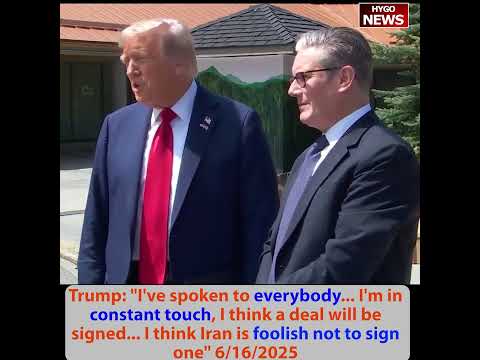
Trump & UK PM Starmer signed trade agreement; Russia out of G8 ‘was a mistake’; no nuclear in Iran
The first day of the G7 in Kananaskis produced a pair of signature outcomes that the administration will carry into the fall political calendar. President Trump and UK Prime Minister Keir Starmer formally signed the U.S.-U.K. trade agreement that had been negotiated over the preceding months — a deal the administration describes as fair to both sides and likely to produce significant employment and income gains. Trump also laid out the clearest account yet of his Iran policy in public, stating he wants “no nuclear weapon in Iran” and predicting a deal will ultimately be signed despite Iranian hesitance. In one of the more striking historical revisions of the summit, Trump argued publicly that the expulsion of Russia from the G8 back to the G7 was a “mistake” that he believes contributed directly to the outbreak of the war in Ukraine. And in a gesture that will circulate in British political circles for months, Trump told UK viewers that “The U.K. is very well protected. You know why? Because I like them. That is why.”
The Trump-Starmer Deal
The opening line of the transcript captured the deal’s core framing. “We have our trade agreement with the European Union. It’s a fair deal for both. And it produces a lot of jobs, a lot of income. We have many, many other ones coming. But you see the level of enthusiasm is very good. But the relationship that we have is fantastic.”
The reference to “European Union” appears to be Whisper transcription noise — the deal in question is with the United Kingdom, not the EU. But the substantive characterization stands. “Fair deal for both” is the language the administration has been using for all of its trade negotiations. The presumption is that previous American trade policy had been insufficiently fair to the American side — a presumption that has shaped every Trump trade negotiation of both terms.
”Car Tariffs And Aerospace”
Starmer’s own framing identified the specific sectors covered. “This now implements on car tariffs and aerospace our really important agreement. And so this is a very good day for both of our countries, a real sign of strength.”
Car tariffs and aerospace are the two sectors that have been the most contentious in U.S.-U.K. trade. The automotive sector has a long history of British exports to the United States, with Jaguar Land Rover and other manufacturers depending on predictable access to the American market. Aerospace covers both civil aviation — Rolls-Royce engines, airframe components — and defense cooperation on programs like the F-35.
Resolving the tariff posture on these sectors matters because they employ large workforces on both sides of the Atlantic and because they are part of the broader NATO defense industrial base. A deal that stabilizes access in these categories is a deal that stabilizes employment and long-term planning for manufacturers.
”A Very Good Day For Both Of Our Countries”
Starmer’s closing — “a very good day for both of our countries, a real sign of strength” — is the framing that conservative and Labour governments alike have used when signing major international agreements. The “sign of strength” formulation is particularly important because it positions the deal not as a concession made under pressure but as an affirmative statement about the two countries’ capacity to shape their own economic future.
For Starmer specifically, the deal is a political win. Labour’s trade posture has historically been more skeptical than the Conservatives’ of bilateral agreements with the United States. Starmer’s willingness to close the deal with Trump communicates both a pragmatic streak and a political calculation. The benefits to British workers in the covered sectors are concrete, and Starmer is willing to absorb any Labour base grumbling about the broader political optics of dealing with Trump.
”Regime Change In Iran?”
A reporter asked Trump directly whether he was seeking regime change. “Do you want to see regime change in Iran?”
Trump’s answer was precise. “I want to see no nuclear weapon in Iran. And we’re well on our way to making sure that happens.”
The answer is a reframing. The reporter asked about regime change. Trump answered about nuclear weapons. The implicit position: the administration’s policy objective is the removal of the nuclear weapons program, not the removal of the Iranian government. Regime change is not the goal. Denuclearization is. Whether the two can be separated in practice is a different question, but Trump is refusing to adopt the regime change frame.
”Well On Our Way”
The phrase “well on our way to making sure that happens” is worth pause. Trump is not describing the objective as aspirational. He is describing progress. The administration, in his telling, is already advancing toward the denuclearization outcome. Whether that progress is measured in Israeli strikes, diplomatic pressure, or internal Iranian regime dynamics is not specified — but the progress itself is being asserted.
”Russia Out Of The G8 Was A Mistake”
Trump then offered one of the more striking historical revisions of the summit. “The G7 used to be the G8. Barack Obama and a person named Trudeau didn’t want to have Russia in. And I would say that that was a mistake, because I think you wouldn’t have a war right now if you had Russia in. And you wouldn’t have a war right now if Trump were president four years ago. But it didn’t work out that way.”
The claim is two-part. First, that Russia’s expulsion from the G8 after the 2014 annexation of Crimea was a strategic error. Second, that American deterrence during the Biden administration was insufficient to prevent Russia’s 2022 escalation into Ukraine.
Why The G8 Argument Matters
Trump’s argument about the G8 is philosophically interesting. The G7 and G8 were forums for the major advanced economies to coordinate on economic and security matters. Russia’s inclusion in 1997 was controversial at the time — Russia’s GDP did not match the other members’ — but the inclusion was justified on strategic grounds. Bringing Russia into the leading Western forum was meant to encourage integration, liberalization, and cooperative behavior.
The expulsion in 2014 was meant to send the opposite signal. Russia had violated the norms of the post-Cold War order by annexing Crimea. The G7 members determined that Russia’s presence at their table was no longer compatible with its actions on the ground.
Trump’s argument — that expulsion was counterproductive — implies a different theory of diplomatic engagement. In his view, keeping Russia inside the tent created ongoing channels of communication and economic integration that made extreme action less likely. Pushing Russia out isolated it, and isolation encouraged escalation.
”Trump Were President Four Years Ago”
The second half of Trump’s claim — that Russia would not have invaded Ukraine had he been president in 2021 — is a counterfactual that cannot be tested. Trump believes his personal relationship with Putin and his credibility as a deterrent would have made the invasion unthinkable. Critics argue that Trump’s cooperative posture toward Putin would have emboldened further Russian expansion, not deterred it.
”It Makes Life More Complicated”
Trump’s closing observation on the G8 issue was substantive. “So it makes life more complicated. But you wouldn’t have had the war. Other than that, I think we’re going to accomplish a lot. Our primary focus will be trade and trade with Canada. And I’m sure we can work something out.”
“Life more complicated” is Trump’s informal term for the operational cost of not having a key player at the table. Russia is not in the G7. But Russia’s decisions — on energy supply, on Ukraine, on its diplomatic relationships with the rest of the world — affect everyone at the G7. Having to coordinate about Russia without Russia is harder than coordinating with Russia. That is Trump’s argument.
”Because I Like Them”
The moment that will circulate most widely in British political circles is Trump’s gesture to UK viewers. “The UK is very well protected. You know why? Because I like them. That’s why. That’s their ultimate protection.”
The statement is half joke and half serious. The underlying idea is that the U.S.-U.K. relationship, whatever formal alliance structures exist, ultimately depends on the personal affinity between the leaders who manage it. Trump likes Britain, likes Starmer, likes the cultural and linguistic connection. That like, in his telling, translates into a protective posture that no treaty alone could guarantee.
For British audiences, the line is a compliment wrapped around a slight. The compliment: Britain occupies a special place. The slight: the relationship depends on presidential favor rather than institutional commitment. British diplomats, navigating the administration’s transactional posture, will note the slight carefully.
”Done What Other People Have Been Talking About For Six Years”
Trump complimented Starmer specifically. “The prime minister’s done a great job. I want to just tell that to the people of the United Kingdom. He’s done a very, very good job. You know, he’s done what other people, they’ve been talking about this deal for six years. And he’s done what they have been able to do.”
The “six years” reference is to the period following Britain’s Brexit vote in 2016, during which successive UK prime ministers have attempted to negotiate a comprehensive trade deal with the United States. Boris Johnson, Liz Truss, Rishi Sunak — each attempted. None completed. Starmer, in Trump’s telling, finished the job.
Whether Starmer will get political credit at home for that accomplishment depends on whether British voters see the deal as favorable. If the tariff reductions produce visible benefits in British industries, Starmer will own the win. If the deal is seen as a concession to Trump that sacrifices British interests in other areas, Labour will face backlash.
”Iran Is Foolish Not To Sign One”
Trump returned to Iran with specific framing. “Have you spoken to Prime Minister Netanyahu? When might you speak? I’ve spoken to everybody. What will you say? Israel is doing very well, as you probably noticed. I gave Iran 60 days. And they said, no. And the 61st, you saw what happened. Day 61. So I’m in constant touch. And as I’ve been saying, I think a deal will be signed or something will happen, but a deal will be signed. And I think Iran is foolish not to sign one.”
“I think Iran is foolish not to sign one” is as blunt a public assessment as an American president has offered about Iranian strategic decision-making. Trump is saying that the rational calculation, from Iran’s perspective, should lead to agreement. The alternative, he is suggesting, is worse outcomes — outcomes the administration is willing to impose or to enable Israel to impose.
”Sometimes They Have To Fight It Out”
Trump’s more realistic aside was that negotiated outcomes are not always immediate. “Well, I hope there’s going to be a deal. I think it’s time for a deal and we’ll see what happens. But sometimes they have to fight it out, but we’re going to see what happens. I think there’s a good chance there’ll be a deal.”
The acknowledgment that conflicts sometimes require further fighting before a deal can be reached is the realist’s note. Trump is not saying war should continue. He is saying that the dynamics sometimes require each side to test the other’s limits before genuine negotiation becomes possible. The administration is preparing for either outcome.
”A Few New Trade Deals”
Trump’s closing referenced the broader trade pipeline. “Look, we have our trade deals. All we have to do is send a letter. This is what you’re going to have to pay. But I think we’ll have a few new trade deals.”
The “send a letter. This is what you’re going to have to pay” framing is the administration’s most compressed description of its trade strategy. The deal is not negotiated line by line. It is declared. Countries that disagree face consequences. Countries that agree get certainty. The G7 is a forum where the “few new trade deals” could be announced — countries attending the summit that want to stabilize their economic relationship with the United States can use the side meetings to reach alignment.
Key Takeaways
- Trump and Starmer signed the U.S.-U.K. trade agreement covering “car tariffs and aerospace” — what Starmer called “a real sign of strength.”
- Trump on Iran: “I want to see no nuclear weapon in Iran. And we’re well on our way to making sure that happens” — declining the regime change framing.
- Trump’s G8 revision: Russia’s expulsion “was a mistake…you wouldn’t have a war right now if you had Russia in” — a counterfactual argument about deterrence through inclusion.
- Trump on UK-US relationship: “The UK is very well protected. You know why? Because I like them. That is why. That is their ultimate protection!”
- Trump on Iran prospects: “I think Iran is foolish not to sign one…sometimes they have to fight it out, but we’re going to see what happens. I think there’s a good chance there’ll be a deal.”