 HYGO News
 Trump: Tucker Carlson Called to Apologize; Sec Duffy: BBB $12.5B telecom upgrade; Dr Oz: Medicaid
Trump: Tucker Carlson Called to Apologize; Sec Duffy: BBB $12.5B telecom upgrade; Dr Oz: Medicaid
The video compresses three distinct threads of administration news into a single cycle. Trump revealed, unprompted by a reporter’s question about a Tucker Carlson interview with Ted Cruz, that Carlson had personally called him to apologize for his Iran comments — a significant development in the intra-coalition dispute that has been running for days. Transportation Secretary Sean Duffy detailed the $12.5 billion in the One Big Beautiful Bill that will fund air traffic control modernization, including the transition from copper-era technology to modern fiber and radar. Dr. Mehmet Oz, now head of CMS, described the stability problems in Medicaid and the Affordable Care Act exchanges and made the case for work requirements on able-bodied adults. And Representative Maxwell Frost, in a separate clip, explicitly called for “amnesty for ALL illegal aliens” — saying the Democratic quiet part out loud in a way that the administration is happy to have on the record.
The Tucker Carlson Apology
The reporter’s question teed up Trump’s revelation. “Have you seen the Tucker Carlson and Senator Ted Cruz interview? It seems like this issue on whether or not the United States should strike is kind of dividing a lot of your supporters.”
Trump’s response: “No, my supporters are for me. My supporters are America first. They make America great again. My supporters don’t want to see Iran having a nuclear weapon.”
Then came the reveal. “Tucker’s a nice guy. He called and apologized the other day because he thought he said things that were a little bit too strong. And I appreciated that.”
Why The Apology Matters
Tucker Carlson is one of the most influential voices in the conservative media ecosystem, and his position on Iran — essentially that America should not be drawn into another Middle East war — had represented a significant rhetorical threat to Trump’s Iran posture. The revelation that Carlson called Trump to apologize is, in political terms, a climbdown. Carlson has pulled back from the sharpest framing of his Iran critique, at least in private communication with the president.
Trump’s framing is generous. “Tucker’s a nice guy.” “I appreciated that.” He is not rubbing the apology in. He is acknowledging it gracefully, which is the move that keeps the relationship available for future engagement.
”Ted Cruz Is A Nice Guy”
Trump also made a warm reference to Cruz. “And Ted Cruz is a nice guy. I mean, he’s been with me for a long time. I’d say once the race was over, he’s been with me ever since, right?”
The Cruz framing is biographically accurate. Ted Cruz and Trump were bitter rivals during the 2016 primary, to the point that Trump publicly speculated about Cruz’s father’s possible involvement in the Kennedy assassination. After the nomination was settled, Cruz swung hard to Trump’s side and has remained there throughout both terms. Trump’s “once the race was over, he’s been with me ever since” is an acknowledgment of that loyalty.
”If They Think It’s Okay For Iran To Have A Nuclear Weapon”
Trump then articulated the political bottom line on the Iran question. “Very simple. If they think that it’s okay for Iran to have a nuclear weapon, then they should oppose me, but nobody thinks it’s okay. I don’t want to fight either. I’m not looking to fight. But if it’s a choice between fighting and them having a nuclear weapon, you have to do what you have to do.”
The formulation collapses the political question into a binary. Either one accepts Iranian nuclear weapons, or one opposes them. If one opposes them, then one must support the administration’s actions — because the administration’s actions are aimed at preventing them. Anyone who does not accept Iranian nuclear weapons but opposes the administration’s Iran posture is, in this framing, caught in an inconsistent position.
”I Don’t Want To Fight Either”
The line “I don’t want to fight either” is Trump’s concession to his coalition’s concerns. He understands why some supporters are worried about another Middle East war. He shares the worry. He does not want to fight. But the alternative — Iranian nuclearization — is worse than fighting.
The Ronaldo Jersey
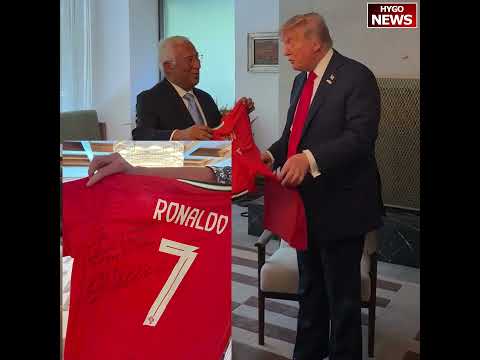
The video also captures a lighter diplomatic moment — Trump receiving a signed Cristiano Ronaldo jersey from the President of the European Council. The gift is the kind of diplomatic gesture that builds relationships quietly. Ronaldo is one of the most recognizable athletes in the world. A signed jersey from him, presented by a European leader, is the kind of detail that shows up in presidential memoirs years later.
The $12.5 Billion ATC Upgrade
Secretary Duffy’s segment detailed the specific provisions in the One Big Beautiful Bill for air traffic control modernization. “In the big, beautiful bill, there’s $12.5 billion going to be deployed for an upgrade of telecom. What does that mean? It means we’re going to move from copper wires to fiber, which, by the way, the FAA is one of the last organizations in the world that still uses copper.”
The copper-to-fiber transition is the kind of infrastructure upgrade that most Americans would assume had already happened. Fiber optic cable replaced copper wire for telecommunications in most commercial applications decades ago. The FAA’s continued reliance on copper is one of the quirks of the agency’s slow modernization pace.
”New Radios And New Voice Switches”
Duffy continued with specifics. “We’re going to get new radios and we’re going to get new voice switches as part of that money.”
Air traffic controllers communicate with pilots through voice radio. The radios and voice switches — the equipment that connects controllers to aircraft — are foundational to ATC operations. When those systems fail or degrade, flights are delayed, rerouted, or in worst cases put at risk. The modernization of this equipment is the kind of investment that produces operational improvements that passengers do not see directly but that improve safety margins.
”1970s Radar”
Duffy then cited the age of the current radar infrastructure. “We’re using 1970s radar. In that money, we get new radar as well.”
1970s radar technology is a generation behind modern solid-state radar systems. Modern radars are more accurate, more reliable, and more capable of integrating with other systems. The ATC system’s reliance on 1970s-era radars is the kind of legacy constraint that imposes operational costs on the civil aviation system. Replacing the radars is expensive but produces direct safety and efficiency benefits.
”Money To Upgrade Some Of The Towers”
The bill also provides “money to upgrade some of the towers, not all of them, and have a new in-route facility that’s going to be funded.”
The caveat — “some of the towers, not all of them” — is the realistic acknowledgment that $12.5 billion, while substantial, will not modernize every piece of the ATC infrastructure in one round. The allocation will prioritize the most-needed upgrades. Subsequent appropriations cycles will have to fund the remainder.
”The Big Beautiful Bill Is The One Pathway”
Duffy’s framing of the legislative stakes was direct. “So the big, beautiful bill is the one pathway we have right now that’s going to start the funding, start the process, start the building, start the fixing of this old antiquated system.”
The political argument: ATC modernization has been needed for decades. It has been stuck in legislative limbo. The One Big Beautiful Bill is the vehicle that finally includes the funding. If the bill fails, the modernization waits another year — or longer.
Dr. Oz On Medicaid Stability
Dr. Mehmet Oz, now administrator of the Centers for Medicare and Medicaid Services, made the affirmative case for Medicaid reform. “We took this job, did you just that, protect our most vulnerable. And yet the plans that I’ve been asked to preside over, Medicaid and the Affordable Care Act exchanges in particular, are not stable programs.”
The framing of CMS’s mission — “protect our most vulnerable” — is the principle that Democrats invoke when objecting to Medicaid reforms. Oz is claiming the same principle. He is arguing that the reforms he supports are necessary to preserve Medicaid for the vulnerable populations it was designed to serve.
”Medicaid Spending Has Increased 50%”
Oz cited the cost trajectory. “Medicaid spending has increased 50% in the last five years. And a major driver of that are the able-bodied individuals who joined the program, half of which these individuals don’t work, and many of them could work.”
A 50% increase in Medicaid spending over five years is an unsustainable trajectory. If that rate of increase continued, the program would consume ever-larger shares of federal and state budgets. Oz’s diagnosis identifies the driver: enrollment growth among able-bodied adults, many of whom could work but do not.
”I Actually Think Work Is A Good Thing”
Oz then laid out the philosophical argument. “I actually think work is a good thing in general. Economy needs more people to work. We’ve got twice as many jobs as our people seeking them, but in particular for Medicaid, the problem we run into is if we allow able-bodied individuals on Medicaid to get a 90% match from the federal government, states gain the system.”
The “90% match” reference is the Medicaid expansion funding structure under the Affordable Care Act. For the expansion population — able-bodied adults above the traditional Medicaid eligibility levels — the federal government covers 90% of costs. This creates a fiscal incentive for states to enroll as many eligible individuals as possible, because the state only pays 10 cents on each dollar. The structure, in Oz’s framing, incentivizes enrollment in ways that the traditional Medicaid program did not.
The Disenrollment Data
Oz cited the Biden-era disenrollment data. “Under the Biden administration, 15 million people were disenrolled from Medicaid. 15 million, the uninsured rate went up about 10%, went up 1.5 million people. So if you give people a chance to work or volunteer, participate in your community, go get an education, or lose your insurance, they take the job.”
The data point is significant. During the Biden administration’s redetermination process — which removed people from Medicaid rolls who no longer qualified — 15 million individuals were disenrolled. But the uninsured rate only went up by 1.5 million people. The math suggests that 13.5 million of the disenrolled individuals found insurance through other means: employer coverage, marketplace plans, or other pathways.
The implication Oz draws is that work requirements, rather than producing massive increases in uninsurance, actually produce transitions into employment that comes with employer-provided insurance. “They take the job” is the behavioral response Oz expects when work requirements are enforced.
Maxwell Frost On Amnesty
The video closed with Representative Maxwell Frost’s blunt statement. “To my Republican colleagues who say, I don’t want any undocumented people in this country, I actually agree with you. So let’s document every single one of them with those speedy path to citizenship.”
The line is the one the administration will quote back to Democrats for months. Frost is arguing that the way to resolve the undocumented population is to document them — to grant them citizenship — rather than to remove them. The “speedy path to citizenship” is the specific mechanism.
Why The Frost Line Matters
The administration’s framing is that Frost is saying “the quiet part out loud” — that the Democratic solution to illegal immigration is not enforcement but legalization. That framing matters because most of the Democratic messaging on immigration avoids explicit amnesty proposals. Democrats typically argue for “comprehensive immigration reform” that is defined in ways that can accommodate multiple policy preferences.
Frost’s explicit “amnesty for all” positioning strips away the comfortable ambiguity. If Democrats want amnesty for all 21 million undocumented individuals, they should say so. If they do not want amnesty for all, they should explain who is excluded and why. Frost’s directness forces the question.
Key Takeaways
- Trump reveals Tucker Carlson called him to apologize: “He called and apologized the other day because he thought he said things that were a little bit too strong.”
- Trump’s political bottom line: “If they think that it’s okay for Iran to have a nuclear weapon, then they should oppose me, but nobody thinks it’s okay.”
- Duffy details $12.5B ATC upgrade: copper-to-fiber transition, new radios, new voice switches, replacement of “1970s radar.”
- Dr. Oz on Medicaid: “Medicaid spending has increased 50% in the last five years…Under the Biden administration, 15 million people were disenrolled…the uninsured rate went up by 1.5 million people” — suggesting work requirements produce employment transitions, not mass uninsurance.
- Rep. Maxwell Frost’s amnesty call: “Let’s document every single one of them with [a] speedy path to citizenship.”