 HYGO News
 Trump: 'I'm Setting the Deal -- It's Up to Me, Not Them'; Blasts WSJ as 'China-Oriented'; Defends Waltz Move to UN
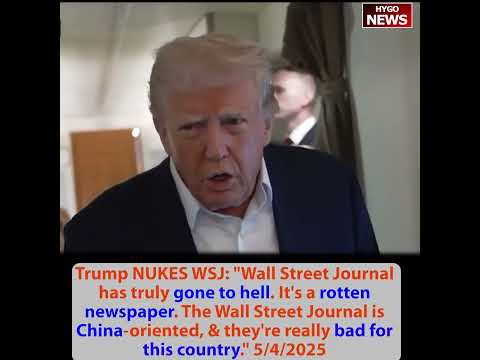
Trump: “I’m Setting the Deal — It’s Up to Me, Not Them”; Blasts WSJ as “China-Oriented”; Defends Waltz Move to UN
President Trump delivered an impromptu press gaggle in May 2025, previewing imminent trade deals and asserting total control over the negotiation process. “We’re in conversation with many countries, but at the end, I’ll set my own deals because I set the deal,” Trump said. “They don’t set the deal. I set the deal.” He confirmed deals “could very well be” coming within weeks: “At some point in the next two or three weeks, I’m going to be setting the deal.” He attacked the Wall Street Journal: “Truly gone to hell. It’s a rotten newspaper. The Wall Street Journal is China-oriented and really bad for this country.” On Mike Waltz’s move from NSA to UN Ambassador: “He didn’t resign. I just moved him. You people are so bad. That’s why nobody watches you anymore."
"I Set the Deal”
Trump reframed the entire trade negotiation dynamic with characteristic directness.
“We’re in a conversation with many countries,” Trump said. “But at the end of this, I’ll set my own deals because I set the deal. They don’t set the deal. I set the deal.”
He explained the leverage: “Every country, almost without fail, has been ripping us off for years. So we’re meeting with almost all of them, including China. But at the end, I’m setting the deal.”
He dismissed the conventional negotiation framework: “They keep saying, ‘this is not like a big deal that’s going to be signed.’ In some cases, we’ll sign. We don’t have to have them sign. I’m going to be setting the deal.”
He grew impatient with repeated questions: “You keep asking the same question. ‘When will you agree?’ It’s up to me. It’s not up to them. It’s up to me.”
He described the China situation: “They don’t have to deal with us, which is okay, because under Biden we were losing $5 billion a day. Think of it — $5 billion a day. Now we’re not dealing with China at all because the tariffs are so high that they basically can’t deal. And because of that, we’re saving billions of dollars.”
He set the timeline: “At some point in the next two weeks or three weeks, I’m going to be setting the deal. I’m going to say that such and such a country has had a tremendous trade surplus with us. They’ve taken advantage of us. And we fully understand what they were doing.”
He stated his confidence: “We were being led by people that were not very smart. They were able to be taken advantage of. But I can’t be taken advantage of.”
The “I set the deal” formulation was the most assertive statement of American trade leverage Trump had made. He was not describing bilateral negotiations between equal parties. He was describing a process in which the United States — as the world’s dominant consumer market — would determine the terms of trade and present them to partners on a take-it-or-leave-it basis.
The approach reflected the fundamental asymmetry that the tariff strategy had created. Countries that needed access to the American market had to accept American terms. Countries that refused would face tariff rates that effectively excluded them. The United States didn’t need any individual country’s goods more than that country needed American consumers.
Wall Street Journal: “Gone to Hell”
Trump launched his most aggressive attack on the Journal.
“The Wall Street Journal has truly gone to hell,” Trump said. “It’s a rotten newspaper.”
He stated the specific charge: “The Wall Street Journal is China-oriented, and they’re really bad for this country.”
He refused engagement: “I wouldn’t talk to the Wall Street Journal because it would be wasted time.”
The “China-oriented” accusation was the most specific media critique Trump had offered. He was not merely saying the Journal was biased against his tariff policy; he was accusing it of serving Chinese interests. The charge reflected the Journal’s editorial page, which had consistently criticized tariffs on China and advocated for free trade policies that, in the administration’s view, benefited Chinese exporters at the expense of American manufacturers.
The Journal’s editorial board — historically the most influential voice in conservative economic thought — had broken with Trump on trade more sharply than on any other issue. For decades, the Journal had been the intellectual home of free-trade orthodoxy. Trump’s tariff revolution represented a direct challenge to that orthodoxy, and the Journal’s resistance was correspondingly fierce.
Waltz to the UN
Reporters pressed Trump on National Security Adviser Mike Waltz’s reassignment to UN Ambassador.
“He didn’t resign,” Trump said firmly. “I just moved him.”
When reporters persisted: “You people are so bad. You’re trying to make a big deal out of something that’s not.”
He concluded: “You are so bad. That’s why nobody watches you anymore.”
The Waltz reassignment had been framed by media as a firing or forced resignation — a narrative that implied dysfunction or loss of confidence. Trump’s characterization was simpler: he had moved a trusted official from one important position to another. The UN ambassadorship was a cabinet-level role that required the same diplomatic skills and national security knowledge that Waltz had demonstrated as NSA.
Trump’s question to reporters — “I didn’t lose confidence. Why would you say I lost confidence?” — rejected the premise entirely. Moving someone from one senior role to another was not a demotion; it was a redeployment. The media’s insistence on framing every personnel change as a crisis was, in Trump’s view, another example of the “negative slant” he had identified throughout the interview.
The Trade Deal Timeline
Trump’s confirmation that deals were imminent — “two or three weeks” — was the most specific timeline he had offered. Combined with Bessent’s earlier confirmation of 18 formal proposals and 34 countries in active negotiations, the picture was one of a trade policy moving rapidly toward resolution.
The “setting the deal” approach meant that the timeline was entirely within American control. Trump did not need to wait for counterparties to agree. He could unilaterally announce tariff rates for each country based on his assessment of what was fair. Countries could then accept those rates or negotiate for adjustments — but the baseline would be set by the United States.
This approach eliminated the traditional negotiation bottleneck where both parties had veto power. In Trump’s framework, America held the pen. The deals would be written in Washington and presented to the world.
Key Takeaways
- Trump on trade: “I set the deal. It’s up to me, not them. At some point in 2-3 weeks, I’m setting the deal for each country.”
- On China: “Tariffs so high they basically can’t deal. We’re saving billions. Under Biden, losing $5 billion a day.”
- Attacked WSJ: “Truly gone to hell. China-oriented. A rotten newspaper. Really bad for this country.”
- On Waltz: “He didn’t resign. I just moved him to the UN. You people are so bad — that’s why nobody watches you.”
- Trade framework: “Every country has ripped us off. We were led by people that weren’t smart. I can’t be taken advantage of.”