 HYGO News
 Trump in Riyadh: 'Too Many Presidents Used U.S. Policy to Dispense Justice for Sins'; Offers Iran 'New Path' But 'Time Is Right Now'
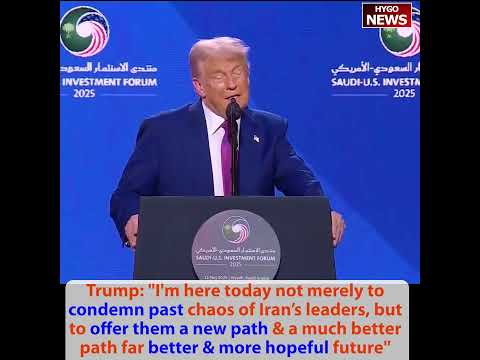
Trump in Riyadh: “Too Many Presidents Used U.S. Policy to Dispense Justice for Sins”; Offers Iran “New Path” But “Time Is Right Now”
President Trump delivered one of the most philosophically significant foreign policy speeches of his presidency at the Saudi-U.S. Investment Forum in Riyadh in May 2025. “Far too many American presidents have been afflicted with the notion that it’s our job to look into the souls of foreign leaders and use U.S. policy to dispense justice for their sins,” Trump said. “It is God’s job to sit in judgment. My job is to defend America and to promote the fundamental interests of stability, prosperity, and peace.” On Iran: “I’m here today not merely to condemn the past chaos of Iran’s leaders, but to offer them a new path and a much better path. The time is right now for them to choose.” He announced a $1 trillion military budget and stated the vision: “A new generation of leaders is transcending ancient conflicts, forging a future where the Middle East is defined by commerce, not chaos."
"God’s Job to Sit in Judgment”
Trump delivered a repudiation of two decades of American foreign policy orthodoxy.
“In recent years, far too many American presidents have been afflicted with the notion that it’s our job to look into the souls of foreign leaders and use U.S. policy to dispense justice for their sins,” Trump said.
He described the pattern: “They loved using our very powerful military.”
He stated the theological principle: “I believe it is God’s job to sit in judgment. My job to defend America and to promote the fundamental interest of stability, prosperity, and peace. That’s what I really want to do.”
The “dispense justice for sins” framing captured the central pathology of post-Cold War American foreign policy. Presidents from both parties had treated military intervention as a tool for moral correction — reshaping regimes that offended American sensibilities, building democracies where none had existed, punishing leaders whose behavior violated American values. Iraq, Libya, Syria, Afghanistan: each intervention had been justified in part by the moral inadequacy of the targeted regime.
The results had been catastrophic. Millions of deaths across the affected countries. Trillions of American dollars wasted. Failed states that became breeding grounds for terrorism. Waves of refugees that destabilized Europe. And in each case, the supposed moral improvements — democracy, human rights, women’s rights — either failed to materialize or collapsed within years of American withdrawal.
Trump’s rejection of this framework was philosophically grounded. The role of a president was to defend his own country, not to morally perfect other countries. Foreign leaders would answer to God and history for their sins; the American president’s responsibility was to American citizens. This was not isolationism; it was a return to the realist tradition of American foreign policy that had been dominant before the post-Cold War era of moral interventionism.
The $1 Trillion Military
Trump described the American military position.
“Now it’s really the most powerful it’s ever been,” Trump said. “We’re just getting a budget approved — $1 trillion, highest budget we’ve ever had in history for military. $1 trillion. Getting the greatest missiles, the greatest weapons.”
He stated the philosophy: “And you know, I hate to do it, but you have to do it because we believe in peace through strength. You have to have the strength, otherwise bad things could happen.”
He expressed the preference: “But hopefully we’ll never have to use any of those weapons. Seems to be an awfully big waste of money. You’re never going to use them, but hopefully we’ll never have to use them because the destructive power of some of those weapons are like nobody’s seen before.”
The “peace through strength” doctrine was Reagan-era orthodoxy adapted for the 2020s. The goal was not to use military force but to possess such overwhelming military capability that no rival would risk conflict. Weapons never used were weapons that had succeeded in their purpose — they had deterred attacks, prevented wars, and preserved peace through their mere existence.
The $1 trillion figure was historic. Previous peak military budgets had hovered around $800-900 billion. A trillion-dollar budget meant sustained investment in the next generation of weapons systems — hypersonic missiles, artificial intelligence applications, quantum computing, space-based capabilities, and other technologies that would define military superiority in the coming decades.
Iran: “The Time Is Right Now”
Trump delivered his most important statement on Iran.
“Iran can have a much brighter future, but will never allow America and its allies to be threatened with terrorism or nuclear attack,” Trump said. “The choice is theirs to make.”
He stated his genuine hope: “We really want them to be a successful country. We want them to be a wonderful, safe, great country. But they cannot have a nuclear weapon.”
He stated the deadline: “This is an offer that will not last forever. The time is right now for them to choose. Right now we don’t have a lot of time to wait.”
He described his broader approach: “I’m here today not merely to condemn the past chaos of Iran’s leaders, but to offer them a new path and a much better path toward a far better and more hopeful future.”
He revealed his worldview: “As I’ve shown repeatedly, I am willing to end past conflicts and forge new partnerships for a better and more stable world — even if our differences may be very profound, which obviously they are in the case of Iran.”
He stated the personal principle: “I have never believed in having permanent enemies. I am different than a lot of people think. I don’t like permanent enemies.”
He acknowledged the necessity: “But sometimes you need enemies to do the job, and you have to do it right. Enemies get you motivated.”
He cited historical precedent: “In fact, some of the closest friends of the United States of America are nations we fought wars against in generations past. Now they are our friends and our allies.”
The “no permanent enemies” philosophy was a significant revelation. Trump was offering Iran the possibility of transformation — from regime-change target to regional partner — if the Iranian leadership made the right choices about nuclear weapons. The historical precedent was real: Japan and Germany had been American enemies in World War II and were now among America’s closest allies. Vietnam had been an enemy in the 1960s-70s and was now a strategic partner. Iran could theoretically follow the same path if its leaders made the necessary choices.
But the offer was time-limited. “Right now we don’t have a lot of time to wait” meant that the diplomatic window was narrowing. Every month that passed brought Iran closer to nuclear weapons capability. If Iran crossed that threshold, the offer Trump was extending would be withdrawn — and the alternative would be far less pleasant.
”Commerce, Not Chaos”
Trump articulated the vision driving the administration’s Middle East policy.
“Before our eyes, a new generation of leaders is transcending the ancient conflicts and tired divisions of the past, and forging a future where the Middle East is defined by commerce, not chaos,” Trump said.
He elaborated: “We’re about exports, technology, not terrorism. And we’re people of different nations, religions, and creeds, building cities together, not bombing each other out of existence. We don’t want that.”
The “commerce, not chaos” framework was the Trump administration’s positive vision for the Middle East. Rather than the Bush-era democratization project or the Obama-era retreat, Trump was offering economic transformation. The Gulf states were building futuristic cities, developing world-class infrastructure, and creating economies diversified beyond oil. American partnership in these projects offered better outcomes for all parties than the wars, interventions, and nation-building exercises that had characterized the previous 25 years.
The “new generation of leaders” reference was to figures like Crown Prince Mohammed bin Salman of Saudi Arabia, UAE leadership, and other younger Middle Eastern figures who were transforming their societies through economic modernization rather than political upheaval. These leaders were not democratic reformers in the Western mold, but they were producing tangible improvements in their citizens’ lives — and doing so through partnership with American business, technology, and capital rather than through conflict with American military power.
Key Takeaways
- Trump repudiates the “soul-searching” foreign policy: “Too many presidents dispense justice for foreign leaders’ sins. It’s God’s job to judge. My job is to defend America.”
- Iran offer: “A new path and a much better path. But this offer will not last forever. The time is right now for them to choose.”
- $1 trillion military budget — “highest in history.” Peace through strength.
- “I have never believed in permanent enemies. Some of our closest friends are nations we fought wars against in generations past.”
- Vision: “Middle East defined by commerce, not chaos. Technology, not terrorism. People of different creeds building cities together, not bombing each other out of existence.”