 HYGO News
 Trump: Zelensky Coming Tomorrow to Sign 'Historic' Minerals Deal; 'American Taxpayers Will Be Reimbursed'
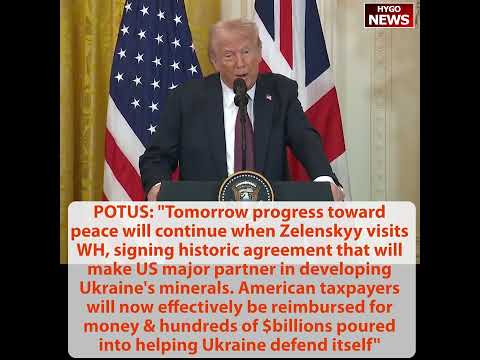
Trump: Zelensky Coming Tomorrow to Sign “Historic” Minerals Deal; “American Taxpayers Will Be Reimbursed”
President Trump confirmed on February 27, 2025, that Ukrainian President Zelensky would visit the White House the following day to sign what Trump called “a historic agreement that will make the United States a major partner in developing Ukraine’s minerals and rare earths and oil and gases.” Trump said “American taxpayers will now effectively be reimbursed for the money and hundreds of billions of dollars poured into helping Ukraine defend itself,” contrasting the deal with Biden’s approach of sending “$300 to $350 billion” with “never any knowledge of ever seeing it back.” He also announced progress on a US-UK trade agreement and asked Starmer to convey America’s acceptance of King Charles’s invitation for a second state visit.
”Signing a Historic Agreement”
Trump provided the most detailed preview yet of the minerals deal that had been weeks in the making.
“Tomorrow the progress toward peace will continue when President Zelensky visits the White House,” Trump said. “He’ll be here tomorrow in the early part of the day, and we’ll be signing a historic agreement that will make the United States a major partner in developing Ukraine’s minerals and rare earths and oil and gases. And we have a great understanding.”
He expressed confidence in the deal’s mutual benefit. “I think it’s going to be great for Ukraine,” Trump said.
With characteristic color, Trump described the operational phase ahead: “We’re going to be at the site and we’ll be digging. We’ll be dig, dig, digging. Dig we must.” He referenced a famous sign from a New York utility company: “A big utility in New York, Con Ed, they used to have a sign — ‘Dig We Must’ — and we will be digging.”
The “dig we must” metaphor was quintessentially Trump — taking a reference from his New York construction background and applying it to international resource extraction. The phrase conveyed urgency and physical action in a way that abstract diplomatic language could not. The United States was not merely signing a piece of paper; it was going to dig into Ukrainian soil and extract the minerals that would repay the American investment.
Biden’s $300-350 Billion: “Never Any Knowledge of Seeing It Back”
Trump drew the sharpest contrast yet between his approach and Biden’s handling of Ukraine aid.
“Much of the European aid to Ukraine has been sent in the form of loans, for which they expect to be paid back,” Trump noted. “And we didn’t have that honor under the Biden administration.”
He described Biden’s approach in blunt terms: “He sent money, or just sent it. Money after money after money. And never had any knowledge of ever seeing it back. Maybe $300 to $350 billion.”
The distinction was fundamental. European nations had structured their Ukraine assistance as loans — recoverable investments that would eventually be repaid. The United States under Biden had sent grants — outright gifts of money and military equipment for which no repayment was expected or sought. Trump was saying that his administration had corrected this imbalance by negotiating a minerals deal that would transform the American expenditure from an unrecoverable grant into a secured investment.
”American Taxpayers Will Be Reimbursed”
Trump then delivered the line that framed the entire minerals agreement as a victory for ordinary Americans.
“Under the breakthrough agreement — very unusual, which everyone said was difficult to get, but it’s really very good for Ukraine and very good for us — the American taxpayers will now effectively be reimbursed for the money and hundreds of billions of dollars poured into helping Ukraine defend itself,” Trump said.
He acknowledged the worthiness of the cause: “Which by and of itself is a very worthy thing to do.”
Trump noted the scale of American contribution: “We’ve paid far more than any other country. And with most of our support, it’s been paid in military — the finest weapons anywhere in the world.”
He then identified a consequence that required attention: “This includes vast amounts of military hardware, ammunition, and various other things that we now have to start rebuilding our own stockpiles.”
The stockpile depletion point was substantively important. The United States had transferred enormous quantities of artillery shells, missiles, air defense systems, and other military equipment to Ukraine. Those transfers had drawn down American military reserves, creating a readiness gap that would require time and money to fill. The minerals deal partially offset this cost by providing economic returns that could fund the rebuilding of depleted inventories.
A “Sustainable Future Relationship”
Trump described the minerals agreement in terms that went beyond simple financial recovery.
“Additionally, the minerals agreement will provide the basis for a more sustainable future relationship between the United States and Ukraine and will stimulate the long-term prosperity that will help the Ukrainians rebuild their country,” Trump said. “It’s been demolished.”
The word “demolished” captured the physical reality of Ukraine after three years of war. Cities had been destroyed, infrastructure shattered, and the economic base severely damaged. The minerals deal was framed not merely as repayment for past aid but as the foundation for Ukraine’s economic reconstruction — a partnership that would generate revenue for both countries while rebuilding what the war had destroyed.
“Working together, I believe that we’ll once again demonstrate the power of our country’s unique friendship,” Trump said. “This is indeed a unique friendship. It’s been many years, and I think it’s only gotten stronger. And we will make sure that it stays that way.”
The “unique friendship” characterization was notable given the tensions between Trump and Zelensky over the previous weeks. By describing the relationship in warm terms immediately before the signing ceremony, Trump was signaling that the diplomatic friction had been resolved and that the minerals deal represented a new chapter built on mutual interest rather than one-sided aid.
US-UK Trade Deal in Progress
Trump also announced that a trade agreement with the United Kingdom was being actively negotiated.
“We’re going to have a great trade agreement. One way or the other, we’re going to end up with a very good trade agreement for both countries, and we’re working on that as we speak,” Trump said.
He described the team working on it: “JD is working on it — Vice President — and Scott,” referring to VP Vance and Treasury Secretary Bessent. “I’m just looking at this all. Mike, you’re going to work on it. Everyone’s going to work on it.”
Trump projected speed: “We’ll see if we can do something pretty quickly. But we’re going to make some great trade agreements with the UK and with the Prime Minister, and it’ll happen very quickly.”
A post-Brexit UK trade deal with the United States had been a longstanding objective for Britain and a potential prize that helped justify leaving the EU’s customs union. Under Biden, negotiations had stalled. Trump’s commitment to moving “very quickly” on a bilateral deal offered Britain the kind of economic partnership that made Brexit’s trade implications more favorable.
Accepting the King’s Invitation
Trump closed with a formal diplomatic gesture, asking Starmer to relay his acceptance of King Charles’s state visit invitation.
“I just want to thank you again, and please thank King Charles for the invite,” Trump said. “And I look forward to you giving our acceptance on behalf of the United States of America.”
“Thank you very much, sir. Thank you,” Starmer responded.
The formal acceptance — “on behalf of the United States of America” rather than merely on his own behalf — elevated the state visit from a personal honor to a national commitment. Trump was accepting not as an individual but as the representative of the American people, giving the visit the full weight of a bilateral state event.
Key Takeaways
- Trump confirmed Zelensky would sign “a historic agreement” at the White House the following day, making the U.S. “a major partner in developing Ukraine’s minerals and rare earths and oil and gases.”
- He said “American taxpayers will now effectively be reimbursed for the hundreds of billions of dollars poured into helping Ukraine,” contrasting this with Biden who sent “$300-350 billion” with “never any knowledge of seeing it back.”
- Trump noted the agreement would “provide the basis for a more sustainable future relationship” and help Ukrainians “rebuild their country” which “has been demolished.”
- He announced a US-UK trade agreement was being negotiated with VP Vance and Treasury Secretary Bessent, promising it would “happen very quickly.”
- Trump formally accepted King Charles III’s state visit invitation “on behalf of the United States of America.”