 HYGO News
 Trump to Liberian President Boakai: such good English; Newsom floods 'humbled' Trump; Crockett MOCKS
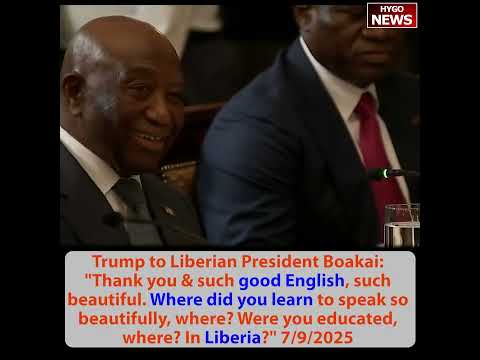
Trump to Liberian President Boakai: such good English; Newsom floods “humbled” Trump; Crockett MOCKS
A wide-ranging day captured several distinct political moments. Trump hosted Liberian President Joseph Boakai at the White House and complimented his English — prompting laughs from the room and Trump observing that “I have people at this table who can’t speak nearly as well.” California Governor Gavin Newsom attempted to score political points from the Texas flooding deaths, suggesting the tragedy may have “humbled” Trump. Rep. Jasmine Crockett mocked the fentanyl border crisis. Rep. Jimmy Gomez claimed ICE targeted “anyone who is brown, that looks like me.” And Chicago Mayor Brandon Johnson characterized ICE as “terrorizing our communities” — rhetoric that the administration ties to what is now a 700% increase in assaults on ICE agents.
Trump And Boakai
The Liberian delegation opened with warm diplomatic language. “We want to work with the United States in peace and security within the region because we are committed to that. And we just want to thank you so much for this opportunity.”
Liberian President Joseph Boakai’s visit was a formal diplomatic engagement. Liberia, a country founded by freed American slaves in 1847, has specific historical ties to the United States. The current Liberian government seeks continued American partnership on regional security and economic development.
”Such Good English”
Trump’s response captured a memorable moment. “Well thank you. It’s such good English. Such beautiful. Where did you learn to speak so beautifully? Were you educated? Where? Yes, sir. In Liberia? Yes, sir.”
Liberia’s official language is English — the country’s founding population consisted of American English-speakers who brought the language to West Africa. Liberian English has its own distinctive features, but standard English is the language of government, education, and commerce.
Trump’s question — where the Liberian president learned to speak English so well — reflects his characteristic informality in formal settings. The answer — “In Liberia” — captures the specific fact that Liberia is an English-speaking country whose educated citizens routinely use English as their primary language.
”I Have People At This Table Who Can’t Speak Nearly As Well”
Trump added the aside. “I have people at this table who can’t speak nearly as well.”
The comment captures Trump’s willingness to observe the specific verbal capability of his own cabinet and staff in public. Americans at the White House table — who presumably include cabinet officers, senior staff, and others — are in Trump’s judgment not as eloquent as the visiting Liberian president.
The observation is characteristic Trump humor. It disarms the formality of the diplomatic moment. It produces laughter. It also communicates specific respect for Boakai’s verbal capability.
Critics will characterize the comment as condescending or as reflecting ignorance that Liberia’s English-speaking tradition. Supporters will characterize it as genuine surprise and warm diplomatic engagement. Both interpretations are available. The specific effect is the memorable moment that will be clipped and shared.
Newsom’s Political Attack
The video pivoted to the Texas floods and the Democratic response. “Disgraced Gavin Newsom says the deadly Texas floods may have ‘humbled’ President Trump.”
Newsom’s framing — that the natural disaster may have “humbled” Trump — is an attempt to characterize Trump as changed by the tragedy. The implication is that Trump’s prior political posture had been insufficiently humble and that catastrophic events have now produced appropriate humility.
Newsom’s specific framing quoted in the video. “After all, the natural disaster that occurred and continues to occur and unfold in Texas may have humbled them. I don’t know. I don’t know.”
“I don’t know” twice captures Newsom’s calculated uncertainty. He is not asserting that Trump has been humbled — that assertion would be falsifiable. He is suggesting it without committing, allowing the suggestion to land without requiring specific evidence.
Why Newsom’s Framing Draws Criticism
The specific framing was widely criticized for attempting to score political points from the deaths of Texas flood victims. More than 100 people died in the flooding. Many of those deaths were children. Families are grieving. Using that tragedy for political positioning strikes many observers as inappropriate.
“It’s despicable that Democrats are using the deaths of children during an unspeakable natural disaster to score cheap political points” captures the administration’s response. The Texas deaths are real human tragedies. Converting them into material for political messaging against Trump trivializes the human losses.
Whether Newsom actually intended his “humbled” comment as a political attack or as a more ambiguous observation is debatable. The effect — the comment being quoted and criticized — is unambiguous.
The Child Victims
The reference to specific child victims captures what is politically damaging about the Newsom framing. “I don’t know if you woke up like I woke up. God is my witness. The first image I saw this morning turned on MSNBC and it was a photograph of that beautiful 13-year-old girl and her 11-year-old sister that were found clutching. Each other’s hands lost down the river, down dead.”
The image referenced — two sisters, 13 and 11 years old, found clutching each other’s hands after the flood — captures the specific human tragedy. Children who died together, holding each other, represent the specific human cost that macro political positioning obscures.
Americans seeing such images respond emotionally regardless of their political orientation. Politicians who are perceived as using such images for political purposes face specific reputational cost.
Crockett Mocks Fentanyl
The video then pivoted to Rep. Jasmine Crockett. “A lot of my bills around fentanyl. I’ve done that with a number of Republicans that have been like, oh no, the border crisis, it’s all the fentanyl. And I’m like, okay, whatever.”
Crockett’s “okay, whatever” dismissal captures a specific political style. Fentanyl — which has killed hundreds of thousands of Americans over the past several years — is the specific crisis many border-enforcement advocates cite as justifying stricter immigration policies. Fentanyl deaths are a real and documented public health emergency.
Crockett’s “okay, whatever” treats that serious concern as a tedious Republican talking point rather than as a genuine policy issue. The framing communicates that she does not take the fentanyl crisis seriously as a policy priority — that she views it as Republican political positioning rather than as the deaths of specific Americans from specific drugs.
Why The Crockett Dismissal Matters
Crockett’s dismissal matters because fentanyl deaths cross partisan lines. Republicans, Democrats, Independents — all face specific fentanyl risks. Americans across political orientations know someone whose life has been affected by opioid addiction or overdose death.
Treating fentanyl as a political distraction rather than as a genuine crisis puts Crockett outside the mainstream of American political engagement with the issue. Most voters, including most Democratic voters, take fentanyl seriously. Crockett’s dismissal positions her on the fringe rather than in the center.
Gomez On “Anyone Brown”
The video captured Rep. Jimmy Gomez’s framing. “Here’s the thing. They are not going after criminals. They’re going after anybody that is brown, that looks like me, that can’t pass as what they say as a typical American.”
Gomez’s framing — that ICE targets “anyone brown” — is the specific racialization of immigration enforcement. The claim is that ICE operations are not based on immigration status but on ethnic appearance.
The administration’s counter is that ICE operations target specific individuals based on specific immigration statuses. The vast majority of Americans and legal residents — of any ethnic background — are not subject to ICE enforcement. Individuals subject to ICE enforcement are those who are in the country illegally and subject to specific orders of removal.
Why The “Anyone Brown” Framing Is Dangerous
The “anyone brown” framing is specifically dangerous operationally. It encourages specific beliefs among Americans and among foreign nationals that ICE operations are racially motivated. Those beliefs produce specific responses — increased resistance, increased hostility toward officers, increased risk of physical confrontation.
The administration has tracked a 700% increase in assaults on ICE agents. Gomez’s framing, and similar framings from other elected officials, contribute to the climate in which those assaults occur. Officers who are characterized as targeting Americans based on ethnicity face more hostile interactions than officers who are understood as enforcing specific statutes.
The Texas NWS Framing
The video then pivoted to the National Weather Service framing. “The fact that they slashed the National Weather Service, whether or not that was the direct proximate cause of those deaths, the fact that we’re having that conversation is the issue. The fact that we aren’t sure is the problem.”
The speaker is linking Texas flood deaths to NWS staffing. The framing is careful. “Whether or not that was the direct proximate cause” acknowledges the empirical uncertainty. But “the fact that we aren’t sure is the problem” attempts to place the administration on the defensive regardless of the actual causation.
The administration’s counter is that NWS staffing was in fact adequate. The San Angelo and San Antonio offices were fully staffed. The specific warnings were issued at appropriate times. The flood was a catastrophic natural event that no level of staffing could have prevented.
Swalwell’s Framing
The video captured Rep. Swalwell’s framing. “But it’s not surprising that if you fire senior leadership who run the National Weather Service, you’re not going to get the best weather predictions.”
Swalwell’s framing presumes that senior NWS leadership was fired in ways that affected prediction quality. The NWS issues detailed pre-event warnings. Those warnings, in the Texas case, were adequate. Whether “senior leadership” changes affected specific predictions for Texas is debatable, but the specific warnings were produced and were accurate.
The administration’s response characterizes Swalwell’s framing as debunked lies. The specific NWS warning timeline — which the administration has provided in detail — contradicts the framing that inadequate forecasting contributed to the casualties.
”ICE Will Have Larger Budget Than 15 Militaries”
The video captured the Democratic fiscal framing. “The other things and all the other cuts pay for a massive increase in the masked secret police that are terrorizing our communities, ICE. ICE will now have a larger budget than all but 15 of the world’s militaries. It’s a four year total. It’s four year total is more than every military except for the United States and China.”
The characterization is striking. ICE is described as “masked secret police” — a deliberate Gestapo-reminiscent framing. ICE funding is compared to national military budgets — placing a civilian law enforcement agency in the category of sovereign armed forces.
The specific fiscal claim — that ICE’s four-year budget exceeds all but 15 of the world’s militaries — captures the scale of the administration’s immigration enforcement investment. Whether the comparison to military budgets is appropriate is debatable. ICE performs domestic law enforcement, not military functions. But the fiscal scale is substantial.
”Direct Assault On Civil Liberties”
The Democratic framing continues. “This is a direct assault on the civil liberties of all Americans and will fundamentally undermine our rights.”
The framing is expansive. The ICE funding, in this characterization, threatens not just undocumented individuals but all Americans. Civil liberties generally are at stake.
The specific mechanism for how funding ICE threatens American civil liberties is not explicit. ICE has jurisdiction over immigration enforcement. Individuals who are American citizens are not subject to immigration enforcement. How increased funding for that specific agency threatens citizens’ civil liberties requires specific causal claims that the Democratic framing does not make explicit.
The Chicago Mayor
The video closed with Chicago Mayor Brandon Johnson’s framing. “Chicago Mayor Brandon Johnson says ICE agents are ‘terrorizing our communities.’”
“Terrorizing our communities” is the specific characterization of ICE operations by the Chicago mayor. The administration’s counter is that ICE officers are conducting specific enforcement activities against specific individuals based on specific legal status.
Applying the word “terrorizing” to ICE activities places those activities in the category of terrorism — criminal violence intended to cause fear among broader populations. That framing is specifically aggressive. It characterizes federal law enforcement as criminal violence rather than as legitimate enforcement.
The 700% Assault Increase
“This type of unhinged rhetoric has led to a 700% increase in assaults on ICE agents.”
The 700% figure is up from the 500% figure the administration had been citing earlier. Either the specific figure has increased (meaning assaults are continuing to accelerate) or the reporting has been updated (meaning the specific measurement period has changed).
Either way, the specific pattern is clear. Rhetoric characterizing ICE as Gestapo, as secret police, as terrorists, as masked thugs — each specific escalation of rhetorical framing produces specific increases in physical attacks on officers. The causal connection is not linear, but the correlation over time is substantial.
The Cumulative Political Pattern
The video’s multiple threads — Newsom’s “humbled” framing, Crockett’s fentanyl dismissal, Gomez’s “anyone brown” framing, the NWS staffing narrative, Swalwell’s predictions framing, the “secret police” framing, Johnson’s “terrorizing” framing — all fit together as a specific Democratic political approach.
Each specific framing attempts to characterize the administration’s activities as illegitimate, racist, or dangerous. Each specific framing places Democratic political actors in opposition to the administration’s specific policy priorities. Each specific framing, the administration argues, contributes to the operational environment that produces assaults on federal officers.
The administration’s counter-framings — that NWS was adequately staffed, that ICE enforces law not ethnicity, that the deaths are being politicized — each address specific Democratic framings. The ongoing contest between the two sets of framings defines the current political environment.
Key Takeaways
- Trump to Liberian President Boakai: “Such good English. Where did you learn to speak so beautifully? I have people at this table who can’t speak nearly as well.”
- Newsom’s political attack: “The natural disaster that occurred and continues to occur and unfold in Texas may have humbled them. I don’t know. I don’t know.”
- Rep. Crockett on fentanyl: “I’ve done that with a number of Republicans that have been like, oh no, the border crisis, it’s all the fentanyl. And I’m like, okay, whatever.”
- Rep. Gomez on ICE targeting: “They’re going after anybody that is brown, that looks like me, that can’t pass as what they say as a typical American.”
- Chicago Mayor Johnson on ICE: “Terrorizing our communities” — rhetoric the administration ties to “a 700% increase in assaults on ICE agents.”