 HYGO News
 Trump: 'El Salvador Has One Hell of a President'; Bukele: 'We Liberated Millions -- To Liberate 350 Million, You Have to Prison Some'
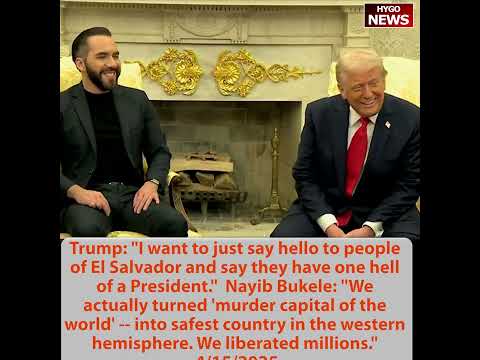
Trump: “El Salvador Has One Hell of a President”; Bukele: “We Liberated Millions — To Liberate 350 Million, You Have to Prison Some”
President Trump and El Salvador President Nayib Bukele concluded their April 2025 joint press conference with a mutual exchange of praise that produced Bukele’s most quoted line of the visit. Trump told the cameras: “I want to just say hello to the people of El Salvador and say they have one hell of a president.” Bukele responded by recounting El Salvador’s transformation from “the murder capital of the world to the safest country in the Western Hemisphere” and then offered Trump his philosophy: “To liberate 350 million Americans, you have to prison some. You cannot free the criminals and think crime is going to go down magically.” Trump also addressed tariff flexibility, saying “I don’t want to hurt anybody — but the end result is we’re going to get to the position of greatness."
"One Hell of a President”
Trump praised Bukele with the directness that characterized their relationship.
“You’re going incredibly for your country,” Trump said. “And we appreciate working with you because you want to stop crime and so do we. And it’s very, very effective.”
He addressed the Salvadoran people: “I want to just say hello to the people of El Salvador and say they have one hell of a president.”
He added the personal touch: “And I mean that. And I know him as a very young man, Marco, even younger than you. You started pretty young.”
Rubio interjected: “I’ll always be younger. Young at heart.”
Trump concluded: “I want to thank you for the great job you’re doing.”
Bukele: “Murder Capital to Safest Country”
Bukele provided the transformation narrative that had made him one of the most discussed leaders in the Western Hemisphere.
“It’s an honor to be here,” Bukele said. “We’re very happy. And we’re very eager to help. We know that you have a crime problem, a terrorism problem that you need help with. And we’re a small country, but if we can help, we can do it.”
He described the achievement: “We actually turned the murder capital of the world — that was the journalists’ call, the murder capital of the world — to the safest country in the Western Hemisphere.”
Bukele reframed the narrative from punishment to liberation: “And, you know, they sometimes say that we imprisoned thousands. I like to say that we actually liberated millions.”
Trump reacted: “Who gave him that? Do you think I can use that?”
The “liberated millions” formulation was the most philosophically powerful argument for aggressive law enforcement that any world leader had offered. The conventional media narrative about Bukele’s crime crackdown focused on the tens of thousands imprisoned in CECOT and other facilities. Bukele’s reframe asked: what about the millions of ordinary Salvadorans who had lived in terror, who couldn’t walk their streets at night, who paid extortion to gangs, whose children were recruited into violence? Those millions had been liberated by the imprisonment of the criminals who terrorized them.
”To Liberate 350 Million, You Have to Prison Some”
Bukele then applied his philosophy directly to Trump’s situation.
“Mr. President, you have 350 million people to liberate,” he said. “But to liberate 350 million people, you have to prison some.”
He stated the principle: “That’s the way it works. You cannot just free the criminals and think crime is going to go down magically. You have to imprison them so you can liberate 350 million Americans that are asking for the end of crime and the end of terrorism.”
Bukele expressed confidence: “And you can be done. You’re doing it already. And I’m sure that people have seen the change in the streets.”
He acknowledged the timeline: “A long way to go because you’re just initiating your second term. But it’s clear that, you know, with the numbers at the border — even Democratic-run cities are getting help from the federal government here.”
He concluded: “I’m really happy to be here, honored, and eager to help.”
The “to liberate millions, you have to prison some” formulation was the moral argument that the Trump administration’s critics refused to engage with. The debate about mass incarceration, deportation, and aggressive enforcement was always framed in terms of the people being imprisoned or deported. Bukele was asking about the people who benefited — the victims of crime, the communities terrorized by gangs, the ordinary citizens whose daily lives improved when violent criminals were removed from their neighborhoods.
Tariff Flexibility: “I Don’t Change My Mind, But I’m Flexible”
Trump addressed reporters’ questions about tariff exemptions with characteristic candor.
When asked about specific product exemptions, Trump said: “I’m looking at something to help some of the car companies with it. They’re switching to parts that were made in Canada, Mexico, and other places. And they need a little bit of time because they’re going to make them here. But they need a little bit of time.”
On Apple and electronics: “Look, I’m a very flexible person. I don’t change my mind, but I’m flexible. And you have to be.”
He used a metaphor: “You just can’t have a wall and only go, ‘No.’ Sometimes you have to go around it, under it, or above it.”
He cited his relationship with Apple: “I speak to Tim Cook. I helped Tim Cook recently in that whole business.”
Trump stated the principle guiding his decisions: “I don’t want to hurt anybody. But the end result is we’re going to get to the position of greatness for our country.”
He added the stakes: “With the greatest economic power in the world — if we’re smart. If we’re not smart, we’re going to hurt our country very badly.”
The “I don’t change my mind, but I’m flexible” formulation captured Trump’s approach to tariffs. The goal — bringing manufacturing back to America, reducing trade deficits, generating tariff revenue — was fixed. The methods — exemptions, pauses, escalations, negotiations — were adaptable. Companies that needed time to relocate production would get time. Products that required temporary exemptions would receive them. But the destination was non-negotiable.
”Let’s Not Start with CNN”
The press conference opened with Trump’s now-routine dismissal of CNN.
“Do you have any questions, please?” Trump said. “Let’s not start with CNN because they’re so — they’re just so wrong.”
The CNN exclusion had become a standard feature of Trump press conferences, reflecting the president’s view that the network’s coverage was consistently hostile and inaccurate. Whether one agreed with the characterization, the practical effect was that other outlets — including podcasters and non-traditional media — received more of the limited question opportunities.
Key Takeaways
- Trump praised Bukele: “The people of El Salvador have one hell of a president.”
- Bukele described transforming “the murder capital of the world to the safest country in the Western Hemisphere” and said “we liberated millions.”
- Bukele’s advice to Trump: “To liberate 350 million Americans, you have to prison some. You can’t free criminals and think crime goes down magically.”
- Trump on tariff flexibility: “I don’t change my mind, but I’m flexible. I don’t want to hurt anybody — but the end result is greatness.”
- He confirmed temporary exemptions for auto parts companies transitioning to domestic production: “They need a little bit of time.”