 HYGO News
 Trump in Doha: 'Media Has Been Very Fair -- Hard Time Saying Bad'; '$3.5-$4T Record Tour, 4M Jobs'; Iran 'Sort of Agreed to Terms -- No Nuclear Dust'
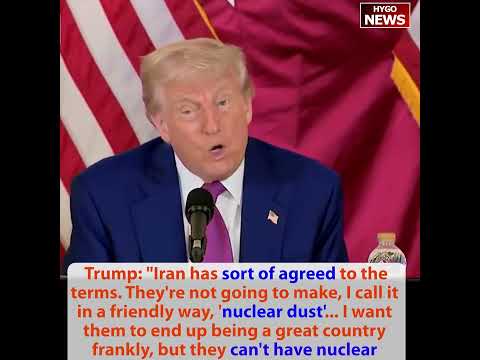
Trump in Doha: “Media Has Been Very Fair — Hard Time Saying Bad”; “$3.5-$4T Record Tour, 4M Jobs”; Iran “Sort of Agreed to Terms — No Nuclear Dust”
President Trump delivered one of his most substantive addresses from Doha in May 2025, documenting the results of his Middle East trip. “The media, I have to say, has been very fair. They’re having a hard time saying bad because this is a record tour. It could be a total of $3.5-$4 trillion in just four or five days,” Trump said. He credited Qatar: “The Emir put up a lot — investment could amount to 2, 3, maybe even 4 million jobs in the United States. AI is a big subject.” On Iran: “Iran has sort of agreed to the terms. They’re not going to make, I call it in a friendly way, ‘nuclear dust.’ I think we’re getting close to a deal without having to do this. There’s a very nice step, and there’s a violent step. I hope we’re not going to have to do the violent step.” He summarized: “In two months, we’re going to have over $10 trillion in investment. No country has ever come close to that."
"Media Has Been Very Fair”
Trump opened with an acknowledgment that surprised observers.
“I just want to thank everybody for being here,” Trump said. “I want to thank the media. The media, I have to say, has been very fair. They’ve been very fair. They’ve been terrific, actually.”
He explained the dynamic: “I was watching some of our normally — they would not say good things. But they’re having a hard time saying bad, because this is a record tour.”
He quantified the achievement: “There’s never been a tour that will raise — it could be a total of $3.5, $4 trillion. Just in this four or five days. It’s from great people.”
The “media has been fair” acknowledgment was remarkable coming from a president who had built his political brand on attacking the press. What Trump was recognizing was that the trip had been so unambiguously successful that even hostile outlets couldn’t spin it negatively.
The facts simply overwhelmed the narrative. $142 billion Saudi military deal. 160 Boeing aircraft order — largest widebody order in history. Syrian sanctions lifted with regional support. Iran “sort of agreed” to nuclear terms. Qatar commitment of trillions in investment. Multi-billion-dollar contracts for Amazon, Oracle, AMD, Uber, Qualcomm, Johnson & Johnson. When the achievements were that substantial, the media had two choices: report them accurately (ceding the positive narrative to Trump) or not report them at all (leaving the story entirely to conservative media and social media).
Most outlets had chosen the first option, which Trump was acknowledging with rare public generosity toward his usual adversaries.
The Saudi and Qatari Relationships
Trump described the bilateral relationships in personal terms.
“Our relationship now is very strong with Saudi Arabia,” Trump said. “Nobody’s going to be bothering that relationship. Nobody would be able to break that relationship because of my relationship with the Crown Prince and the family.”
He pivoted to Qatar: “And when you talk about Qatar, the relationship is equal. It’s just like nobody’s going to break that relationship. We have never had a relationship with Qatar as strong as it is now.”
He addressed the Qatari leadership: “You know that better than anybody. They’re very happy, and we’re going to protect you. We’re going to protect you. This is the one thing you need, maybe, but I don’t think you’re going to need too much of that.”
He recalled the previous evening’s event: “I said last night, it was a great meeting, great everything. They brought in Lee Greenwood to sing. It was a beautiful evening, and I appreciate it.”
The Lee Greenwood detail was significant. Greenwood — whose “God Bless the USA” had been an anthem at Trump rallies for years — represented the patriotic Americana that characterized Trump’s cultural identity. Bringing Greenwood to sing at a Qatari state dinner was the kind of cultural fusion that epitomized Trump’s diplomacy: American identity celebrated in a foreign capital while building genuine relationships with foreign partners.
4 Million Jobs
Trump credited the Emir of Qatar for substantial commitments.
“I want to thank the Emir because he put up a lot, in terms of investment,” Trump said. “It could amount to 2 million, 3 million, maybe even 4 million jobs in the United States.”
He described the substance: “And more importantly, it’s really important stuff. It’s tremendous refining capabilities. It’s capabilities for very high end.”
He identified the critical technology: “AI is a big subject, and it’s a big subject over here too.”
He noted the investment pattern: “I always say, what are you investing in? It seems one thing everybody seems to have in common is AI. So I don’t know if that’s a good thing, or maybe you shouldn’t do it because too many people are doing it, or maybe you should follow the crowd, fellas.”
The 2-4 million jobs projection was enormous. Even the low end of that range — 2 million American jobs — represented more total employment than entire industries. For comparison, the entire U.S. auto manufacturing sector employed approximately 1 million Americans. A 2-4 million job boost from Qatari investment alone would be transformative for American employment patterns.
The AI focus was the critical technology lens. Qatar, like Saudi Arabia and the UAE, was pursuing sovereign AI capabilities — massive data centers, advanced chip acquisitions, and partnerships with American AI companies. American companies that supplied this infrastructure — NVIDIA, AMD, Oracle, Microsoft — would generate decades of revenue from Middle Eastern AI buildouts. Those revenues would flow back to America as profits, investments, and wages.
”Nuclear Dust”
Trump offered a vivid characterization of the Iranian situation.
“You probably read today the story about Iran has sort of agreed to the terms,” Trump said.
He used memorable language: “They’re not going to make, I call it in a friendly way, ‘nuclear dust.’ We’re not going to be making any nuclear dust in Iran.”
He described his approach: “We’ve been strong. I want them to succeed. I want them to end up being a great country, frankly. But they can’t have a nuclear weapon.”
He stated the simplicity: “That’s the only thing. It’s very simple. It’s not like I have to give you 30 pages worth of details. There’s only one sentence: they can’t have a nuclear weapon.”
He described the progress: “I think we’re getting close to maybe doing a deal without having to do this.”
He laid out the alternatives: “There’s two steps. There’s a very, very nice step, and there’s a violent step. The violence like people haven’t seen before.”
He stated his preference: “I hope we’re not going to have to do this. I don’t want to do the second step. Some people do. Many people do. I don’t want to do that step.”
He summarized the status: “So we’ll see what happens. But we’re in very serious negotiations with Iran for long-term peace. And if we do that, it’ll be fantastic.”
The “nuclear dust” coinage was classic Trump rhetoric. The phrase combined the technical reality (nuclear weapons produced radioactive dust when detonated) with a casual, dismissive tone that made the prospect of Iran acquiring nuclear weapons sound small rather than existential. Calling something “dust” minimized it — transforming a world-altering weapons program into something trivial.
The two-step framework was more significant than the phrasing. Trump was publicly acknowledging that military action against Iran’s nuclear program — the “violent step” — remained a real possibility. The “violence like people haven’t seen before” language suggested a massive military operation that would go far beyond the limited strikes Israel and the United States had conducted previously.
But Trump was equally explicit that he preferred the “nice step” — a negotiated agreement that would eliminate Iran’s nuclear capability without military action. This was consistent with his stated philosophy that strength enabled diplomacy. By maintaining credible threat of devastating military response, Trump was creating the pressure that could drive Iran toward the negotiated outcome both sides would prefer.
”$10 Trillion in Two Months”
Trump closed with the headline economic number.
“I think we’ve raised trillions of dollars in investments. There’s never been anything like it,” Trump said.
He provided the specific figure: “We have a country that now has, I think — Howard, we can say that — at least $10 trillion of investment and potential investment.”
He contrasted with Biden: “If the past administration did a half a trillion dollars, it was a lot. But we did it in two months.”
He clarified the math: “Because it’s actually a little more than three months. But I always say the first month, I had to get a little bit acclimated. So I didn’t really do this the first. But when we started — so we’ve really been doing it, Susie, right, for two months.”
He delivered the superlative: “So in two months, we’re going to have over $10 trillion. Nobody’s ever come to — no country’s ever come close to that.”
The $10 trillion figure was extraordinary. Total U.S. GDP was approximately $29 trillion. Generating $10 trillion in new investment commitments across sectors — manufacturing, technology, energy, infrastructure — in two months meant investment flowing into the American economy at an unprecedented pace.
For context, total foreign direct investment into the United States averaged approximately $250-300 billion per year during the pre-Trump era. Trump was claiming to have generated over 30 years’ worth of typical FDI in two months. Even allowing for some overstatement in the headline number, the actual flows were clearly historic.
Key Takeaways
- Trump: “Media has been very fair — terrific, actually. They’re having a hard time saying bad because this is a record tour.”
- “$3.5-$4 trillion in four or five days. From great people.”
- Qatar investment: “2, 3, maybe even 4 million jobs in the United States. AI is a big subject.”
- Iran: “Sort of agreed to the terms — no ‘nuclear dust.’ Two steps: a very nice step, or a violent step like people haven’t seen before.”
- “$10 trillion of investment in two months. Past admin did $500 billion. No country has ever come close.”