 HYGO News
 Trump: terrible Mayor of London nasty person; welcomes UK PM & Lady to Trump Turnberry; Cambodia
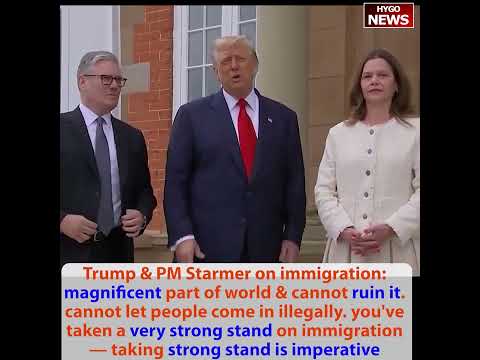
Trump: terrible Mayor of London nasty person; welcomes UK PM & Lady to Trump Turnberry; Cambodia
Asked if he would visit London during his upcoming state visit, Trump delivered a blunt assessment of the city’s mayor Sadiq Khan: “I’m not a fan of your mayor … I think he’s done a terrible job. The mayor of London. The nasty person.” Trump and UK Prime Minister Keir Starmer then connected at Trump Turnberry in Scotland, with the president offering strong praise for Starmer’s immigration posture: “I’ve heard that you’ve taken a much stronger stance on immigration … if you’re stopping immigration and stopping the wrong people, I give my hats are off to you.” Starmer reported that the UK has “returned 35,000” people “who shouldn’t be in this country.” And Trump memorialized the Cambodia-Thailand ceasefire: “It’s peace. That was going to be a very bad war … that could’ve gone on for years. Millions of people could’ve been killed. We ended the war, and we’re very happy about it."
"Not a Fan of Your Mayor”
The reporter’s question. “Will you visit London during the same business?”
Trump’s response. “I will. I’m not a fan of your mayor. Why not? I think he’s done a terrible job. The mayor of London. The nasty person.”
Sadiq Khan, the Labour Mayor of London since 2016, has been one of the most persistent European critics of Trump during both Trump terms. Khan called for Trump’s 2018 UK state visit to be canceled, has compared Trump’s rhetoric to fascism, and has been a consistent voice on the international left against Trump-era policies.
“Nasty person” is Trump’s reciprocal characterization. The mutual animosity has been visible across multiple news cycles. Khan attacks Trump publicly. Trump responds in kind.
“I think he’s done it. I think he’s… He’s a friend of mine, Russian. No, I think he’s done a terrible job.”
That is Trump’s wandering rhetoric. The “friend of mine, Russian” is probably a reference to someone else in the conversation — perhaps Rupert Murdoch or another figure. Trump corrects course and reiterates the “terrible job” framing.
”I Would Certainly Visit London”
“But I would certainly visit London, you know.”
Despite the mayor’s hostility, Trump confirms he will visit London. The state visit is on. The president-mayor conflict does not override the head-of-state protocol of the visit.
“I think he’s done it. That’s the hardest part. I don’t know how to be happy. I think… We go to the same number of teachers out there.”
That is Trump’s characteristic wandering at the start of a thought that gets interrupted. The “same number of teachers” is probably a reference to London’s staffing challenges — crime, policing, public services.
”Immigration Is a Big Factor”
“Well, immigration is a big factor. I think, frankly, if they’re coming from other countries, and you don’t know who they are, are they coming from prisons? We have them where they came in from prisons. We were moving them all out.”
That is Trump’s diagnosis of what has gone wrong in London. Uncontrolled immigration, potentially including people released from foreign prisons, has contributed to the crime and social dysfunction that has affected London.
“We have them where they came in from prisons” is a reference to Trump’s earlier claims that some illegal immigrants entering the U.S. under Biden were released from foreign prisons before arrival. Castro-era Cuba’s Mariel boatlift is the historical precedent Trump has invoked repeatedly.
“We had a border last June, just recent, you know, last month. We had zero people come into the country. Zero. Other than coming through legal means.”
The U.S. border data. Zero illegal entries. That is the contrast Trump is drawing with the UK situation.
Praise for Starmer on Immigration
“If you’re stopping immigration and stopping the wrong people, I give my hats are off to you. You’re doing a… Not a good thing. You’re doing a fantastic thing.”
Trump correcting himself. Not “a good thing” — a “fantastic thing.” Praise for Starmer’s immigration posture.
Starmer, the Labour Prime Minister, has taken a tougher stance on immigration than his party’s traditional posture would suggest. The Labour government has emphasized border enforcement, deportation of those without legal status, and reform of the asylum system. That posture aligns with what Trump has been pushing European leaders to adopt.
“So I know nothing about the votes. But if the votes are loaded up with bad people, and they usually are, because, you know, other countries don’t send their best. They send people that they don’t want.”
“Other countries don’t send their best. They send people that they don’t want.” That is a direct echo of Trump’s 2015 campaign launch statement. The underlying argument: migration flows are not a random sample of the sending-country population. They are disproportionately drawn from categories the sending country has reason to be rid of — criminals, fiscal dependents, political problems.
Starmer’s 35,000 Removals
Starmer’s operational data. “I’ve heard that you’ve taken a much stronger stance on immigration. Yeah, we’ve done a lot of work stopping them coming. We just signed an agreement to return them. We’ve returned 35,000, in fact, and the first year of the slave government, the people who shouldn’t be in this country.”
35,000 people returned. “The first year of the Labour government” (Whisper’s “slave government” is obviously a transcription error for “Labour government”). That is a specific deportation number.
For a UK Labour government — historically more reluctant on deportation than Conservative governments — 35,000 returns in the first year is significant. It represents a policy inheritance Starmer accepted rather than reversed, and extension of deportation operations rather than restraint.
“So we’re very pleased that we’re getting on with returning people who’ve got no right to be here."
"My Mother Was Born in Scotland”
“As somebody that loves this… I love this country. My mother was born in… As you know, my mother was born in Scotland. It’s an incredible place, a beautiful place.”
Trump’s personal connection to Scotland. Mary Anne MacLeod Trump was born on the Isle of Lewis in the Outer Hebrides. She emigrated to the U.S. in 1930 at age 18. That Scottish heritage is part of why Trump has invested in Scottish properties and why his Scotland visits carry personal significance.
“And if that be the case, I congratulate you. That’s exactly because I’m a very, very, very proud of you. I’m very proud of you, exactly.”
That is Trump complimenting Starmer on the immigration posture, while layering it with personal affection for Scotland.
”You’re Not Going to Have Europe Anymore”
“Because, you know, Europe is a much different place than it was just five years ago, ten years ago. They’ve got to get their act together. If they don’t, you’re not going to have Europe anymore, as you know it. You can’t do that. This is a magnificent part of the world, and you cannot ruin it.”
The warning. European immigration policy has produced a Europe that is different from 5-10 years ago — different cultures, different neighborhoods, different public-safety profiles, different demographic compositions. Trump is arguing the transformation has been for the worse and that leaders who do not reverse it will leave Europe unrecognizable.
“This is a magnificent part of the world, and you cannot ruin it.” That is the conservation framing. Europe has irreplaceable cultural, architectural, historical, and aesthetic inheritances. Those inheritances are being damaged by current immigration policies. Protecting Europe is, in Trump’s framing, a civilizational responsibility.
“You’ve taken a very strong stand on immigration, and taking a strong stand on immigration is imperative.”
Starmer praised again. The British public has been visibly concerned about immigration volumes under both Conservative and Labour governments. Starmer reading those concerns and acting on them, rather than defaulting to the Labour Party’s traditional posture, is what Trump is endorsing.
The UK Trade Deal
“Well, we’re in great shape. The trade deal was made with UK. The Prime Minister did a great job. You know, they’ve been trying to make that deal for 12 years, and he got it done.”
That UK trade deal — completed earlier in the second term — had been in negotiation since the Brexit referendum of 2016. Twelve years of discussion, multiple UK governments, never closed. Starmer closed it.
“So everybody respects it. There’s going to be a lot of jobs for here, and great for America. And, you know, in terms of even the relationship, our relationship is unparalleled, but it keeps it even closer.”
“Relationship is unparalleled” — the U.S.-UK “special relationship” framing. The trade deal reinforces that underlying alliance. Commercial relationships and diplomatic relationships strengthen each other.
“You know, when you’re able to have a good trade deal, it keeps it even closer.”
Cambodia-Thailand Ceasefire
The segment closed with Trump memorializing the Cambodia-Thailand ceasefire. Both countries had been locked in a border dispute that escalated into military exchanges earlier in the summer. Trump brokered a ceasefire.
“It’s peace. That was going to be a very bad war … that could’ve gone on for years. Millions of people could’ve been killed. We ended the war — and we’re very happy about it.”
“Millions of people could’ve been killed” is a stark counterfactual. Cambodia-Thailand conflicts have historical depth, and Southeast Asian wars have in past decades produced extraordinary casualty counts. The counterfactual is speculative but not implausible given regional history.
“We ended the war, and we’re very happy about it.” That is the operational claim. U.S.-brokered ceasefire, producing peace between two Southeast Asian countries with a history of conflict.
The Six-War Count
Combined with the earlier segment’s count of six wars stopped — India-Pakistan, Rwanda-DRC, Cambodia-Thailand, plus earlier ceasefires — the administration is building an unusual peace-deal record. Six ceasefires in six months is a pace of conflict resolution that, if it continues, will define the administration’s foreign policy legacy.
Whether all the ceasefires hold in the medium term is the future question. But the current-period demonstration — that the U.S. can broker peace between adversaries across multiple regions — is a data point that will be cited in ongoing discussions of American foreign policy effectiveness.
Trump’s Scotland Trip Wrap
The Turnberry meetings with Starmer, the EU deal with von der Leyen earlier in the visit, the conversations with Melania, and the various bilateral discussions all happening on Trump’s Scottish property represent a specific style of diplomatic engagement. Not formal state dinners. Not UN-style multilateral settings. Direct bilateral conversations at relaxed venues, often tied to Trump’s personal ownership of the settings.
Whether that style works long-term depends on whether it produces durable outcomes. The Scotland visit produced the EU trade deal, the UK cooperation on Gaza airdrops, the Cambodia-Thailand ceasefire confirmation, and the UK deportation data exchange. By short-term results, the trip produced substantial outputs.
Key Takeaways
- Asked about visiting London, Trump: “I’m not a fan of your mayor … I think he’s done a terrible job. The mayor of London. The nasty person” — confirming he would visit anyway.
- Trump welcomed UK PM Keir Starmer and Lady Starmer to Trump Turnberry in Scotland, praising Starmer’s immigration posture: “I’ve heard that you’ve taken a much stronger stance on immigration … you’re doing a fantastic thing.”
- Starmer reported that the UK has “returned 35,000” people “who shouldn’t be in this country” in the first year of Labour government.
- Trump’s warning to Europe: “You’re not going to have Europe anymore, as you know it … This is a magnificent part of the world, and you cannot ruin it.”
- On Cambodia-Thailand: “It’s peace. That was going to be a very bad war … that could’ve gone on for years. Millions of people could’ve been killed. We ended the war.”