 HYGO News
 Trump: terminate CA EV mandate ONCE FOR ALL; Bessent: TDS=Tariff Derangement Syndrome; Sec Def: Cats
Trump: terminate CA EV mandate ONCE FOR ALL; Bessent: TDS=Tariff Derangement Syndrome; Sec Def: Cats
Three different rooms. Three different stages. Three different flavors of political combat. In the Oval Office, President Trump signed what he framed as the termination of California’s electric vehicle mandate, an action he argued rescued the American auto industry from being forced to design cars for two fundamentally different regulatory regimes. In a Senate hearing room, Treasury Secretary Scott Bessent coined a term for the current Democratic posture on trade policy — “Tariff Derangement Syndrome” — and used it to skewer the idea that the best inflation numbers since 2020 could be spun as anything other than good news. In another Senate hearing room, Secretary of Defense Pete Hegseth stunned Senator Dick Durbin with a concrete example of defense research waste: taxpayer dollars going to experiments involving “marbles in the rear ends of cats.” The three moments fit together as a portrait of an administration that is moving aggressively on regulatory rollback, economic policy defense, and spending discipline in the same 24-hour cycle.
”Rescue The U.S. Auto Industry From Destruction”
Trump’s framing at the signing ceremony was unmistakable. “Here we officially rescue the U.S. auto industry from destruction by terminating the California Electric Vehicle mandate once and for all. Thank you. Thank you. Thank you.”
The word “destruction” is the hinge of the argument. Trump is not presenting the EV mandate as a policy disagreement. He is presenting it as an existential threat to an industry that employs millions of Americans directly and supports millions more in supply-chain roles. “Rescue” and “destruction” are the language of emergency response, not regulatory adjustment.
The ceremonial repetition of “thank you” — four times in the transcript — captures the atmospherics. Automaker executives and labor representatives were in the room. The signing was being framed as a deliverable for a coalition that had lobbied against the mandate for years.
”They Said It Couldn’t Be Done”
Trump’s follow-up line was a classic. “They said it couldn’t be done, but boy, it’s had us tied up in knots for years.”
The “they said it couldn’t be done” formulation is Trump’s favorite framing for policy wins. It positions the action as vindicating his judgment against a consensus of skeptics. Whether the action actually faced a consensus of skeptics or was simply politically contentious is a matter of interpretation. The framing works regardless because it invites supporters to see the signing as a triumph against odds.
The “tied up in knots for years” phrase captures the operational reality the administration is describing. The EV mandate had set different emissions and sales requirements in California than the federal baseline, and more than a dozen other states had adopted California’s standard. That meant automakers were effectively designing two product lines or treating the California rules as the national default.
”Building Cars For Two Countries”
Trump’s most analytically compelling line explained the industrial logic. “And they passed these crazy rules in California and what it would be. 17 states would go by them. The automakers didn’t know what to do because they’re really building cars for two countries. When you have 17 states, you’re building cars for two countries.”
The arithmetic is straightforward. When roughly a third of the U.S. states adopt one regulatory regime and the remaining two-thirds follow another, a national manufacturer faces a choice: build two product lines, or let the more restrictive regime become the de facto national standard. Most manufacturers, given the cost of running parallel product lines, have chosen the latter. That choice makes California’s standard the binding national standard even though California represents one state.
Trump’s framing — “building cars for two countries” — is a pithy description of that dynamic. The federal action, in his telling, restores a single national market for automobiles rather than ceding regulatory authority to a single state.
Bessent Coins “Tariff Derangement Syndrome”
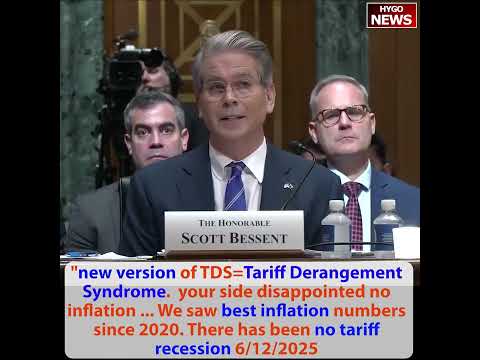
In a parallel hearing, Bessent was defending the administration’s trade policy against Democratic pushback. His diagnosis of the opposition was memorable. “There seems to be a new version of TDS, which I would call Tariff Derangement Syndrome. Many on your side seem disappointed that there is no inflation today. As a matter of fact, we saw the best inflation numbers since 2020.”
The “TDS” acronym repurposes a term — Trump Derangement Syndrome — that had been used on the political right for years to describe what its authors saw as irrational opposition to the president. Bessent’s move is to apply the same structure to tariff policy: Democrats, in his framing, are so emotionally invested in the idea that tariffs will cause inflation that they cannot process data showing tariffs have not caused inflation.
”Nothing Passed On”
Bessent’s next line was as precise as it was devastating to the Democratic framing. “So there has been nothing passed on. There has been no tariff recession.”
Pass-through is the technical term for the share of tariff costs that flows from importers to consumers. If tariffs are fully passed through, consumer prices rise by the tariff amount. If pass-through is partial, importers absorb some of the cost through reduced margins, renegotiated contracts, or source substitution. If pass-through is zero, consumers see no price effect at all.
Bessent’s argument is that the May CPI data is consistent with very low pass-through. The predicted tariff inflation has not materialized. Consumers are not paying higher prices for the affected goods. The “recession” that critics warned would result from trade war escalation has not arrived. The inflation and growth data, in Bessent’s reading, support the administration’s pre-implementation claims.
Bessent’s “Referendum” Line
The exchange with Senator Michael Bennet produced one of Bessent’s sharpest political moments. Bennet had been pressing Bessent on the Trump tax cuts. Bessent’s response was a reminder of the electoral mandate.
“Sir, we had a referendum on November 5th.” Bennet responded: “You certainly did. I agree with you.” Bessent: “Your side lost. I agree with that.”
The exchange is notable for its clean structure. Bessent asserted the election was a referendum on economic policy. Bennet agreed. Bessent said Democrats lost. Bennet agreed. The acknowledgment is meaningful because it concedes that the 2024 election validated the administration’s policy direction even for senators who oppose specific provisions of the implementation.
”A Higher Decibel Level”
The exchange continued into philosophical territory as Bennet raised his voice in subsequent questioning. “And a higher decibel level. And I’m a rare Democrat who doesn’t blame Donald Trump for winning. I’m sad he won. I don’t blame the pointy. But don’t come here.”
Bessent’s response was a gentle deflation. “Higher decibel level does not give your statements more veracity.”
The line would be at home in a law school rhetoric textbook. The observation that volume does not substitute for evidence is one of the oldest principles of debate, and Bessent’s deployment of it in response to a senator who had raised his voice is the kind of small moment that defines the tenor of a hearing.
The Defense Research Debate
The second Senate hearing, with Secretary of Defense Hegseth, produced its own viral exchange. Senator Durbin was pressing Hegseth on budget cuts to defense health research. “Your budget cuts two-thirds of that amount for defense health research. How can that be consistent with our mutual goal of making the military life a safer life for a men and women uniform?”
The question is designed to make the cabinet officer defend a specific cut against a generally popular goal. Hegseth’s response was to dispute the characterization of the cuts.
“Senator, I would take issue with your characterization that all two-thirds of that whatever was reduced is focused on the issues that you just spoke about. Because those are issues that as a secretary who’s very close to these issues and knows people close to these issues, my team knows that’s exactly the type of research that we would fund. But we did find lots of other research inside the Defense Department to the tens and millions, and in some cases hundreds of millions of dollars, that was a boondoggle for the American people."
"Give Me An Example Of A Boondoggle”
Durbin issued the challenge that produced the exchange’s signature moment. “Why? Why do you say, give me an example of a boondoggle in medical research in defense health?”
Hegseth delivered the answer. “I mean we’re talking about some stuff I shouldn’t say in public. You know, marbles in the rear ends of cats, tens of millions of dollars, things that don’t have a connection to what you’re talking about.”
The answer is immediately concrete. It is specific enough to be memorable. It names a sum — “tens of millions of dollars” — that is large enough to register as meaningful. And it describes an activity so viscerally incongruous with national defense that the audience does not need any additional context to form an opinion.
Why The Cat Marble Example Works
The reason the cat marble example went viral is not the expense per se. It is the gap between the expense and the purpose. The Department of Defense is funded because the country has made a decision that national security is worth substantial public investment. When those dollars flow to experiments involving marbles and cats, the public question becomes: how does this protect us?
Hegseth’s rhetorical move is to invite that question without having to answer it. He names the research. He names the expense. He notes that the research “doesn’t have a connection to what you’re talking about” — meaning military health and readiness. And he leaves the conclusion to the listener.
”Every Dollar We Spend Is A Dollar We Can Pour Into The Limelight”
Hegseth concluded the exchange with a statement of the administration’s broader spending philosophy. “Let me tell you, this committee and others talk about waste, fraud, and abuse all the time. We have actually gone after waste, fraud, and abuse, because every dollar that we spent is a dollar we can pour into the limelight.”
The phrase “every dollar we spend is a dollar we can pour into” something is likely meant as “every dollar we save is a dollar we can pour into the warfighter.” The transcription artifact aside, the argument is clear: the savings from eliminating research projects like the cat marble study can be redirected to core defense priorities.
Durbin’s Counter: NIH Cuts
Durbin’s closing push was to tie the defense research cuts to a broader pattern. “Eliminating two-thirds of the money for defense health research. Put that next to the decision to cut NIH medical research by 40%.”
The argument: defense health cuts do not live in isolation. They form part of a pattern that includes major cuts to the National Institutes of Health. Durbin’s rhetorical aim is to raise the concern that the administration is systematically defunding research infrastructure across government, and that the cat marble example — however memorable — is being used to mask more sweeping reductions to legitimate research.
Three Rooms, One Agenda
The three scenes together — the EV mandate termination, the inflation defense, and the cat marble exchange — are coherent. Each one involves the administration reversing a prior position of California, of congressional Democrats, or of the defense research establishment. Each one is framed as rescue, vindication, or reform. And each one produces a moment — “once and for all,” “Tariff Derangement Syndrome,” “marbles in the rear ends of cats” — that clips well and travels far.
Key Takeaways
- Trump on EV mandate: “Here we officially rescue the U.S. auto industry from destruction by terminating the California Electric Vehicle mandate once and for all…When you have 17 states, you’re building cars for two countries.”
- Bessent coins “Tariff Derangement Syndrome”: “Many on your side seem disappointed that there is no inflation today…we saw the best inflation numbers since 2020.”
- Bessent on the election: “we had a referendum on November 5th…Your side lost.” Bennet concedes: “I agree with you…I agree with that.”
- Bessent on volume: “Higher decibel level does not give your statements more veracity.”
- Hegseth’s DOD waste example: “marbles in the rear ends of cats, tens of millions of dollars, things that don’t have a connection to what you’re talking about.”