 HYGO News
 Trump: '$2 Billion a Day in Tariffs'; Japan and South Korea 'Flying Here to Make a Deal'; Ends Biden's 'War on Coal'
Trump: “$2 Billion a Day in Tariffs”; Japan and South Korea “Flying Here to Make a Deal”; Ends Biden’s “War on Coal”
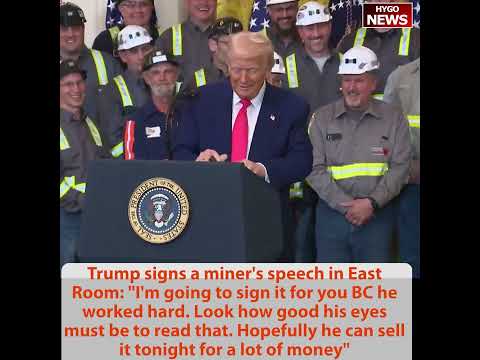
President Trump addressed a group of American miners and energy workers in the East Room in April 2025, revealing that “we’re taking in almost $2 billion a day in tariffs” and that “Japan is flying here to make a deal, South Korea is flying here to make a deal, and others are flying here.” He announced the end of “Joe Biden’s war on beautiful, clean coal” and signed executive action to reopen closed coal plants. In a lighter moment, Trump signed a miner’s printed speech: “I’m going to sign it for you because he worked hard. Hopefully he can sell it tonight for a lot of money."
"$2 Billion a Day”
Trump opened with the tariff revenue figure that reframed the fiscal conversation.
“For those of you that want to know about the tariffs you’ve been hearing about — we’re taking in almost $2 billion a day in tariffs,” he said. “$2 billion a day.”
At $2 billion per day, the annualized tariff revenue would exceed $700 billion — a sum that would fundamentally alter the federal budget. For context, the entire federal income tax on individuals generated approximately $2.5 trillion annually. Tariff revenue at $700 billion would represent nearly 30% of individual income tax collections — a massive new revenue stream that could be used to reduce the deficit, fund tax cuts, or pay down debt.
Trump described the negotiation activity the tariffs had generated: “And we’re doing very well in making — I call them tailor deals, not off the rack. These are tailored, highly tailored deals.”
He listed the countries in active negotiation: “Right now, Japan is flying here to make a deal. South Korea is flying here to make a deal. And others are flying here.”
He acknowledged the administrative challenge: “My only problem is I’m not sure I have enough people. We’re going to have to use those great law firms, I think, to help us with that. But we’re going to probably do that, actually. We’re going to use them. And we’re getting them for the right price because we need a lot of talent. We have a lot of countries coming in that want to make deals.”
The admission that the administration needed to bring in law firms to handle the volume of negotiations was both a logistical challenge and a validation of the strategy. So many countries were seeking deals that the existing trade team could not process them all. The tariffs had created a tidal wave of diplomatic activity that exceeded the government’s capacity to manage.
”Ending the War on Coal”
Trump pivoted to energy policy with an announcement directed at the miners in the room.
“Today, we’re taking historic action to help American workers, miners, families, and consumers,” he said. “We’re ending Joe Biden’s war on beautiful, clean coal once and for all.”
He broadened the historical scope: “And it wasn’t just Biden. It was Obama and it were others. But we’re doing the exact opposite.”
He described the plan: “All those plants that have been closed are going to be opened. If they’re modern enough, or they’ll be ripped down and brand new ones will be built.”
The promise to miners: “We’re going to put the miners back to work. And I said I was going to do this. I’ve said it loud and clear. And it’s time to do it. Now we need it.”
The “now we need it” phrase was significant. The administration’s simultaneous pursuit of energy dominance, manufacturing reshoring, AI data center construction, and military modernization all required massive amounts of electricity. Coal plants that had been shuttered under environmental regulations could be reopened to meet the surging demand for power — particularly in regions where renewable energy and natural gas infrastructure was insufficient.
The coal revival was not merely a cultural or political gesture to mining communities. It was a practical response to an energy demand crisis. AI data centers alone were projected to consume electricity equivalent to several major cities. The manufacturing plants being built with the $7 trillion in investment commitments would need power. And the military’s expanding operations required reliable, domestically sourced energy.
The Miner’s Speech
Trump provided the event’s most human moment when he interacted with a miner who had printed the president’s speech.
“You did a good job,” Trump said. “Let me have that speech. I want to have that.”
He examined it: “I had a couple of good lines in there. I want to keep them.”
Then the gesture: “Actually, what I want to do — I’m going to sign it for you. Because I think, I mean, he worked hard. Look at it. And look how good his eyes must be to read that.”
The joke: “I lost it once. And hopefully you can sell it tonight for a lot of money.”
The exchange captured the informal rapport between Trump and working-class supporters that had defined his political career. The miner had printed the president’s speech, studied it, and was using it to follow along. Trump noticed, appreciated the effort, and autographed it — transforming a printed sheet of paper into a personal memento that the miner could treasure or, as Trump jokingly suggested, monetize.
Electric Cooperatives: “42 Million Americans”
Tony Campbell, CEO of East Kentucky Power Cooperative, provided the institutional perspective.
“On behalf of East Kentucky Power Cooperative, the National Rural Electric Cooperative Association, and Electric Cooperatives Across America, thank you for your leadership to restore American energy dominance,” Campbell said.
He described the sector’s scope: “Electric co-ops keep the lights on for 42 million Americans across 56% of the land mass.”
He connected the cooperatives to the broader agenda: “We are owned by the communities and businesses we serve and provide electricity to growing communities, new data centers, and manufacturing plants.”
Campbell concluded: “Electric co-ops are powering America, and we are proud to partner with you and your administration to power America into the future.”
The 42-million-Americans and 56%-of-land-mass figures established that rural electric cooperatives were not a niche interest group but a fundamental component of American infrastructure. More than half the country’s land area was served by co-ops, and their ability to provide reliable, affordable electricity was essential to the rural manufacturing revival the tariff policy was designed to produce.
Key Takeaways
- Trump revealed tariff revenue of “almost $2 billion a day” — approximately $700 billion annualized.
- Japan and South Korea were “flying here to make deals”; the administration was bringing in law firms to handle the volume of negotiations.
- He announced the end of Biden’s “war on clean coal” with plans to reopen closed plants: “We’re going to put the miners back to work.”
- Trump signed a miner’s printed speech in the East Room: “Hopefully he can sell it tonight for a lot of money.”
- Electric cooperatives serve 42 million Americans across 56% of U.S. land mass, powering “new data centers and manufacturing plants.”