 HYGO News
 Trump: Zelensky Took Money 'Like Candy from a Baby'; Graham: Minerals Deal 'Not Extortion'; New ICE Leadership
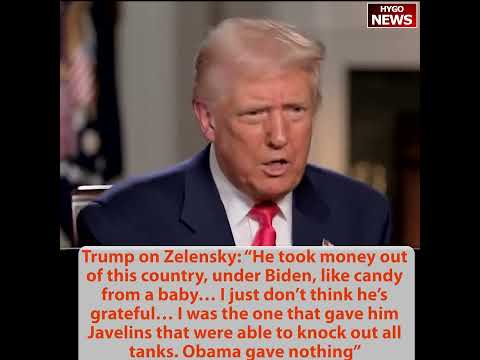
Trump: Zelensky Took Money “Like Candy from a Baby”; Graham: Minerals Deal “Not Extortion”; New ICE Leadership
A March 2025 compilation captured three threads of the Trump agenda. Trump took his “fiercest shot” at Zelensky, saying he “took money out of this country under Biden like candy from a baby” and calling him ungrateful after $350 billion in aid: “I was the one who gave him the Javelins. Obama gave nothing.” Senator Lindsey Graham made the economic case for the minerals deal, calling Ukraine “the richest country in Europe in terms of critical minerals” and asking Democrats: “What the hell did you do to deter Russia from invading?” DHS Secretary Kristi Noem announced new ICE leadership — Acting Director Todd Lyons and Deputy Director Madison Sheahan — to deliver “the American people’s mandate to target, arrest, and deport illegal aliens."
"Like Candy from a Baby”
Trump delivered his most extended critique of how Zelensky had exploited the Biden administration’s weakness.
“He was able to — it was like taking candy from a baby, what he did,” Trump said. “He’s a smart guy, and he’s a tough guy. And he took money out of this country under Biden like candy from a baby. It was so easy.”
Trump expressed the frustration that had been building since the Oval Office confrontation. “And I just don’t think he’s grateful,” he said. “We gave him, in my opinion, $350 billion. Europe has done it for $100 billion.”
He challenged Zelensky’s framing of Ukraine’s contribution. “We gave him $350 billion, and he’s talking about the fact that they have fought and they have — there’s a bravery, because somebody has to use the weapons,” Trump said. “But without those weapons, don’t forget, I was the one that gave him the Javelins that was able to knock out all the tanks. Obama gave nothing.”
The “candy from a baby” metaphor placed the blame not on Zelensky’s intelligence but on Biden’s weakness. Zelensky had played the hand he was dealt — and Biden had dealt him a hand that made extracting hundreds of billions from the American treasury trivially easy. There was no accountability, no conditions, no expectation of repayment.
Trump then catalogued the crises that Biden’s weakness had produced beyond Ukraine. “If I were president, that would have never happened,” he said. “You wouldn’t have had Russia going into Ukraine. You wouldn’t have had the whole situation with Hamas and October 7th — it would have never happened, because Iran was broke. They had no money. They weren’t giving it to Hamas or Hezbollah or anybody else.”
He added Afghanistan to the list: “You would have never had the worst evacuation anyone’s ever seen — the most embarrassing day in the history of our country.”
And inflation: “You wouldn’t have had inflation. We had record-setting inflation under Biden. It was a killer.”
The comprehensive indictment — Ukraine, October 7, Afghanistan, inflation — placed every major crisis of the Biden era into a single narrative of weakness and incompetence. Each crisis had been preventable. Each had occurred because Biden lacked the strength, judgment, or competence to prevent it.
Graham: “The Oil of the 21st Century”
Senator Lindsey Graham made the most compelling economic argument yet for the Ukraine minerals deal, reframing it from a geopolitical transaction to a strategic economic opportunity.
“We’re trying to integrate our economies. We’re trying to make sure that Ukraine has value to the American economy — a win-win situation,” Graham said. “They’re the richest country in Europe in terms of critical minerals, which is the oil of the 21st century.”
He rejected the “extortion” characterization that Democrats had applied to the deal. “Doing a deal with Ukraine is beneficial to both countries. It’s not extortion,” Graham said.
He painted the picture of what the deal could produce: “Wouldn’t it be nice to be able to do a deal with Ukraine where we can make $500 billion in the critical mineral space for our own economy, give them money, help them develop their resources so they can grow their economy and defend themselves? That’s not extortion. That’s a good business deal.”
Graham then turned the argument on the deal’s critics. “And to all these Democrats who are worried about this deal — what the hell did you do to deter Russia from invading Ukraine?” he asked. “What did you do after Russia invaded Ukraine? Pretty much nothing.”
He outlined his preferred approach: “President Trump’s going to end this war justly. We should do this critical mineral deal. We should keep arming Ukraine and providing them intelligence until ceasefire. And we should tell Russia, if you don’t engage in ceasefire discussions, we’re going to sanction you. We’ve got to put pressure on both sides to get them to the table to end this war.”
Graham concluded: “The minerals deal is a win-win.”
The “oil of the 21st century” characterization elevated critical minerals from an obscure economic category to a strategic asset class that Americans could understand. If oil had defined the geopolitics of the 20th century, critical minerals — lithium, rare earths, titanium, graphite — would define the 21st. Whoever controlled the supply of these materials would control the technologies that depended on them: electric vehicles, advanced semiconductors, military electronics, and renewable energy systems.
Noem: New ICE Leadership
DHS Secretary Kristi Noem announced personnel changes at ICE designed to accelerate the deportation mission.
“For the past four years, our brave men and women of ICE were barred from doing their jobs,” Noem said. “ICE needs a culture of accountability that it has been starved of under the Biden administration.”
She announced two appointments: “With President Trump’s support, I am appointing new ICE leadership to deliver results that President Trump and the American people rightfully demand. Todd Lyons will serve as Acting ICE Director, and Madison Sheahan as Deputy Director of ICE.”
Noem described the appointees: “Todd Lyons and Madison Sheahan are workhorses, strong executors, and accountable leaders who will lead the men and women of ICE to achieve the American people’s mandate to target, arrest, and deport illegal aliens.”
She framed the expansion in terms of partnership: “Adding more people to the team with Todd and with Madison is going to allow us to partner with local law enforcement officials to make sure that we truly are following through on enforcing the law.”
The closing message: “If you break our law, then there’s going to be consequences.”
The ICE leadership changes signaled the administration’s intent to sustain and accelerate the deportation pace that had produced record-low border crossings. Lyons’ history of working with Tom Homan provided continuity of approach, while Sheahan’s appointment expanded the leadership team to manage the growing scale of enforcement operations.
Key Takeaways
- Trump said Zelensky “took money out of this country under Biden like candy from a baby” and called him ungrateful: “We gave him $350 billion. I was the one who gave him the Javelins. Obama gave nothing.”
- He catalogued Biden’s failures: Russia-Ukraine, October 7, Afghanistan, and “record-setting inflation” — all preventable with stronger leadership.
- Sen. Graham called Ukraine “the richest country in Europe in critical minerals — the oil of the 21st century” and asked Democrats: “What the hell did you do to deter Russia?”
- Graham said the minerals deal was “not extortion” but “a good business deal” potentially worth “$500 billion in the critical mineral space.”
- DHS Sec Noem appointed Todd Lyons as Acting ICE Director and Madison Sheahan as Deputy, saying ICE needed “a culture of accountability” after being “barred from doing their jobs” for four years.