 HYGO News
 Trump: Sydney Sweeney registered Republican, her ad is fantastic! Next big move drug price; stat
Trump: Sydney Sweeney registered Republican, her ad is fantastic! Next big move drug price; stat
Five distinct items in a single gaggle. Asked about the Sydney Sweeney advertising campaign’s controversy: “You’d be surprised at how many people are Republicans … If Sydney Sweeney is a registered Republican, I think her ad is fantastic.” On drug prices: “The next big move is going to be the price of drugs, because you could buy something in London or in Germany … sometimes one tenth the price of what it costs to buy it in New York.” On Jeanine Pirro as the new DC prosecutor: “Jeanine Pirro is going to be amazing … she was a great judge and a great prosecutor.” On tariff-negotiation philosophy: “I’m not looking for leverage. I’m looking for fairness. We want reciprocal as much as possible.” And on the jobs-report revision scandal: Trump will announce “a new statistician sometime over the next three, four days” to replace the Biden-appointed official responsible for economic data he characterized as “a scam.”
Sydney Sweeney
Sydney Sweeney had become a cultural-political figure. Her recent advertising campaign for American Eagle had been criticized by progressive media as “problematic” for various reasons. It emerged that Sweeney is a registered Republican.
The reporter’s question to Trump. “She’s a registered Republican? Oh, now I love her ad. Is that right? Is Sydney Sweeney? You’d be surprised at how many people are Republicans.”
Trump’s characteristic humor. “You’d be surprised at how many people are Republicans.” That is the framing. The “silent Republican” phenomenon — people who hold conservative views but do not publicly advertise them for professional or social reasons — is real, particularly in Hollywood and related cultural industries.
“That’s what I wouldn’t have known, but I’m glad you told me that. If Sydney Sweeney is a registered Republican, I think her ad is fantastic.”
Trump is explicitly offering presidential endorsement to Sweeney. The ad itself — whatever its content — is now promoted by presidential praise. That is a specific culture-war intervention. Sweeney becomes an unlikely hero for Republican-leaning consumers who would otherwise not have had reason to celebrate her.
“Okay, thank you very much, everybody.”
Trump closing the Sweeney exchange on a positive note.
Drug Prices: The Next Big Move
Trump pivoted to pharmaceutical pricing. “The next big move is going to be the price of drugs, because you could buy something in London or in Germany, someplace in Germany, or many countries where it’s one tenth, one third, one fourth, but sometimes one tenth the price of what it costs to buy it in New York or some other place.”
That is the pricing asymmetry Trump has long cited. The same pharmaceutical products — same manufacturer, same molecule, same brand — are sold at dramatically different prices across countries. U.S. consumers pay 3-10x what European consumers pay for identical medications.
The asymmetry has existed because of pharmaceutical pricing negotiation differences. European governments, as single-payer systems or consolidated purchasing entities, negotiate aggressive pricing. The U.S. market is fragmented — thousands of insurance plans, hundreds of pharmacy benefit managers, complex middleman layers. That fragmentation prevents consolidated pricing pressure.
“And we’re not doing that anymore. We’re started many years ago when people were asleep at the wheel in this country, and they allowed that to happen, and I’m stopping it.”
Trump is signaling specific policy action on drug prices coming next. The mechanism is not specified in this clip — it may be executive order, legislative push, or negotiation leverage with pharmaceutical companies. But the policy direction is clear.
The tariff framework earlier discussed — tariffs on pharmaceutical imports with domestic reshoring incentives — is one piece. Direct price negotiation with pharmaceutical companies for federal procurement is another. Most-favored-nation pricing rules are a third. Trump’s administration is approaching drug pricing on multiple fronts.
Jeanine Pirro
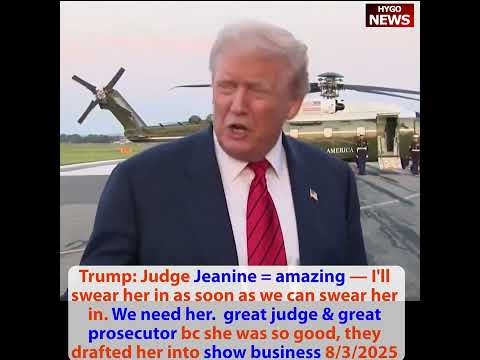
Trump then addressed Jeanine Pirro’s upcoming role. “I will happily swear in Jeanine Pirro, who’s going to be fantastic at what she does in DC over the next very short period of time. I think she’s going to be fantastic.”
Pirro — the former Westchester County DA, New York State judge, and Fox News host — is being sworn in as the interim U.S. Attorney for the District of Columbia. That is a critical position. The DC U.S. Attorney has jurisdiction over federal crimes in the nation’s capital, including congressional-related matters and potential high-profile investigations.
“Don’t forget, Jeanine Pirro was a great judge and a great prosecutor. And because she was so good, I was there. She was an amazing prosecutor and judge. Because she was so good, they drafted her into show business, and she did fantastic.”
Trump framing Pirro’s career arc. Legal career first (judge, prosecutor). Then “drafted into show business” because of demonstrated capability. Fox News success. “The Five” as #1 show.
“But her real love is exactly what she’s doing. And that’s what made her such a success in show business. So Jeanine Pirro is going to be amazing. I’ll swear in as soon as we can swear in, we need her. She’s going to be amazing.”
“We need her.” That is the operational message. Pirro’s legal background and aggressive prosecutorial style are what the administration needs in the DC U.S. Attorney role.
Reciprocity, Not Leverage
Trump addressed the broader tariff philosophy. “I’m not looking for leverage. I’m looking for fairness. We want reciprocal as much as possible.”
“Not looking for leverage. Looking for fairness.” That is the framing Trump wants for the tariff regime. Not coercion of other countries into concessions. Restoration of fair trading relationships after decades of asymmetric treatment.
“Sometimes reciprocal would be too much for them to handle because it would be a much bigger number. But we want to see some reciprocity. We want to see reciprocal wherever we can.”
Full reciprocity — matching every foreign tariff exactly — would, in some cases, produce numbers too high to absorb. A country that charges 50% on American goods would face a 50% U.S. tariff on its goods. That kind of symmetry could collapse bilateral trade entirely in some cases.
“We want to see some reciprocity.” That is the flexibility. Not full reciprocal matching. Significant movement toward reciprocity. Proportional rather than identical response.
“And all I can say is this, our country will be taking in billions of dollars. You just said it. Already we’re taking in, you know, billions and billions of dollars. And it was very unfair. The world treated us very unfair."
"Phenomenal Numbers”
“We had a very good weekend in many respects. We’re seeing phenomenal numbers in terms of the business we do with other countries, and the business we do within our own country. I mean, really phenomenal numbers.”
That is the confidence framing. The deals announced the prior week (EU deal, Japan deal, Indonesia, Philippines) are producing “phenomenal numbers” in both international trade and domestic economic indicators.
The Statistician Scandal
Trump then pivoted to the jobs-report revision. “We’ll be announcing a new statistician sometime over the next three, four days. We had no confidence. I mean, the numbers were ridiculous what she announced. But that was just one negative number. All of the numbers seem to be great. So we’ll see how that comes out.”
The context: the Bureau of Labor Statistics had recently released a major downward revision of prior months’ jobs numbers. The revision was unusually large — typical revisions are in the tens of thousands; this was hundreds of thousands. The size of the revision raised questions about the quality of the underlying statistical methodology.
Trump’s response: fire the BLS commissioner responsible (a Biden appointee) and install a new statistician. That is extraordinary. BLS commissioners are typically technical officials with long tenures. Firing one over a specific data release is a political-action framework that the administration rarely applies to career federal statisticians.
“And if you remember, just before the election, this woman came out with these phenomenal numbers on Biden’s economy, phenomenal numbers. And then right after the election, they announced that those numbers were wrong. And that’s what they did the other day.”
That is the specific pattern. Pre-election: optimistic numbers favoring the Biden administration’s economic story. Post-election: revisions revealing the optimistic numbers were wrong. Trump is framing the same pattern as recurring now — negative numbers released in ways that damage his administration.
”It’s a Scam”
“So it’s a scam, in my opinion. In my opinion, it’s just, it’s just additional scam.”
“It’s a scam.” That is the direct characterization. Not statistical methodology failure. Not honest error. Scam.
Whether the jobs-revision pattern is genuinely a scam — politically motivated data manipulation — or merely poor statistical methodology that needs correction is the critical question. If it is a scam, then the BLS’s credibility is fundamentally compromised and requires structural reform. If it is merely methodology failure, then specific process improvements would suffice.
Trump is positioning for structural reform. Replacing the BLS commissioner is the first step. Broader review of BLS methodology, data collection, and release protocols could follow.
The Political Context
The BLS revision happened in the middle of political tension around economic narratives. The administration has been citing strong economic data. Democrats have been characterizing that data as a “mirage.” The BLS revision provides Democrats with specific ammunition — “your jobs numbers are wrong, proof of mirage.”
Trump is counter-framing. The revision is not evidence of economic weakness. It is evidence of statistical corruption. Fire the statistician responsible. Fix the methodology. Continue the growth narrative.
Whether that counter-frame holds depends on the new statistician’s initial releases. If the new commissioner produces statistical output that reflects what Trump believes the true economy shows, the “scam” framing is validated. If the new commissioner produces similar revisions, the “scam” framing weakens.
Five Items, One Administration Posture
Sydney Sweeney (cultural intervention). Drug prices (economic policy). Jeanine Pirro (personnel). Tariff reciprocity (trade philosophy). BLS statistician (accountability).
Five items. Five different administration priorities being advanced in a single press engagement. That multi-front pace reflects the broader operational tempo the administration has sustained across the first six months.
Key Takeaways
- Trump on Sydney Sweeney’s registered Republican status: “You’d be surprised at how many people are Republicans … If Sydney Sweeney is a registered Republican, I think her ad is fantastic!”
- Trump previewed drug-price action: “The next big move is going to be the price of drugs … sometimes one tenth the price of what it costs to buy it in New York.”
- On Jeanine Pirro’s DC U.S. Attorney role: “Jeanine Pirro is going to be amazing … she was a great judge and a great prosecutor.”
- On tariff philosophy: “I’m not looking for leverage. I’m looking for fairness. We want reciprocal as much as possible.”
- On the BLS revision: “We’ll be announcing a new statistician sometime over the next three, four days … In my opinion, it’s just additional scam.”