 HYGO News
 Trump hosts swearing-in ceremony for Amy Coney Barrett, a newly confirmed Supreme Court Associate Justice
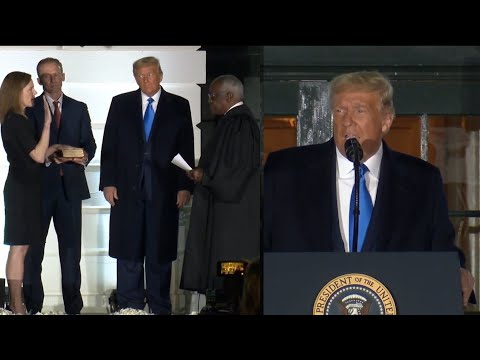
Trump Hosts Swearing-In Ceremony for Amy Coney Barrett as Supreme Court Associate Justice
On October 26, 2020, President Trump hosted a ceremony on the South Lawn of the White House where Justice Clarence Thomas administered the judicial oath to Amy Coney Barrett, making her the 115th Associate Justice of the United States Supreme Court. Barrett was confirmed by the Senate on a 52-48 vote, with all Republicans except Susan Collins of Maine voting in favor and all 45 Democrats and two independents opposing. Trump celebrated Barrett as “the very first mother of school-aged children to become a Supreme Court justice,” while Barrett used her remarks to draw a sharp distinction between the role of senators and the role of judges.
Trump’s Address: “A Momentous Day”
Trump opened the evening ceremony by framing the occasion in sweeping terms. “This is a momentous day for America, for the United States Constitution, and for the fair and impartial rule of law,” he said. “The Constitution is the ultimate defense of American liberty. The faithful application of the law is the cornerstone of our Republic.”
He praised Barrett’s credentials, calling her “one of our nation’s most brilliant legal scholars,” and highlighted her academic record: a full scholarship to Notre Dame Law School, graduating first in her class, and a clerkship with Justice Antonin Scalia. He also thanked Senate Majority Leader Mitch McConnell and Judiciary Committee Chairman Lindsey Graham, along with numerous Republican senators in attendance.
Trump noted the historical significance of Barrett’s appointment. “It is highly fitting that Justice Barrett fills the seat of a true pioneer for women: Justice Ruth Bader Ginsburg,” he said. “Tonight, Justice Barrett becomes not only the fifth woman to serve on our nation’s highest court, but the very first mother of school-aged children to become a Supreme Court justice.”
He also spoke directly to children watching. “I want every American child watching to understand that this is a very special and important ceremony,” Trump said. “Because of our Constitution and our culture of freedom, you live in a land where anything is possible and where any dream can come true.”
Barrett’s Remarks: The Duty of a Judge
Barrett’s speech centered on the fundamental distinction between legislative and judicial roles. She articulated the principle in strikingly clear terms: “It is the job of a senator to pursue her policy preferences. In fact, it would be a dereliction of duty for her to put policy goals aside. By contrast, it is the job of a judge to resist her policy preferences. It would be a dereliction of duty for her to give in to them.”
She explained the rationale for judicial independence: “Federal judges don’t stand for election. Thus, they have no basis for claiming that their preferences reflect those of the people. This separation of duty from political preference is what makes the judiciary distinct among the three branches of government.”
Barrett described the scope of judicial independence broadly: “A judge declares independence not only from Congress and the President, but also from the private beliefs that might otherwise move her. The Judicial Oath captures the essence of the judicial duty: the rule of law must always control.”
She addressed the public directly: “My fellow Americans, even though we judges don’t face elections, we still work for you. It is your Constitution that establishes the rule of law and the judicial independence that is so central to it.”
Her closing pledge was unequivocal: “The oath that I have solemnly taken tonight means, at its core, that I will do my job without any fear or favor, and that I will do so independently of both the political branches and of my own preferences. I love the Constitution and the Democratic Republic that it establishes, and I will devote myself to preserving it.”
The Confirmation Vote
The Senate confirmed Barrett with a 52-48 vote along almost entirely partisan lines. All 45 Democrats and two independents who caucus with Democrats opposed the confirmation. Only one Republican, Senator Susan Collins of Maine, broke with her party to vote against Barrett.
The Judiciary Committee had advanced the nomination on a unanimous Republican vote, with all Democrats boycotting the committee vote. Following a unanimous vote by the committee, the full Senate held its floor vote just eight days before the November 3 presidential election.
The American Bar Association had given Barrett its highest “well qualified” rating. Her former law clerks wrote in a letter that “Judge Barrett taught us that a good judge will not always like the results she reaches; a good judge goes wherever the law leads.”
A New Perspective on the Bench
Barrett’s appointment brought several firsts and distinctions to the Court. She was the first mother of school-aged children to serve as a Supreme Court justice. As the mother of a child with special needs, she brought a perspective on the issues confronting the nation’s most vulnerable people. She was also the only sitting justice with a law degree from a school other than Harvard or Yale, having graduated at the top of her class from Notre Dame.
Her colleagues at Notre Dame Law School described her as “the very model of a sympathetic yet impartial judge” and “exactly the type of person whom the American people deserve to have sitting on their Supreme Court.”
Barrett herself articulated the stakes during her confirmation hearing: “If we are to protect our institutions, and protect the freedoms, and protect the rule of law that’s the basis for the society and the freedom that we all enjoy — if we want that for our children and our children’s children — then we need to participate in that work.”
Key Takeaways
- Justice Clarence Thomas administered the oath to Amy Coney Barrett on the South Lawn of the White House following her 52-48 Senate confirmation, making her the fifth woman and first mother of school-aged children to serve on the Supreme Court.
- Barrett drew a sharp philosophical line between legislative and judicial roles, declaring that “it is the job of a judge to resist her policy preferences” and pledging to act “without any fear or favor” and independently of “both the political branches and of my own preferences.”
- The confirmation proceeded on a near-total party-line vote just eight days before the presidential election, with the ABA giving Barrett its highest rating and her former clerks testifying that “a good judge goes wherever the law leads.”