 HYGO News
 Trump vs. NBC: 'Such a Dishonest Interview -- Prices Are Down'; Won't Remove Powell; 'China's Economy Is Collapsing'; 'Tariffs Make Us Rich'
Trump vs. NBC: “Such a Dishonest Interview — Prices Are Down”; Won’t Remove Powell; “China’s Economy Is Collapsing”; “Tariffs Make Us Rich”
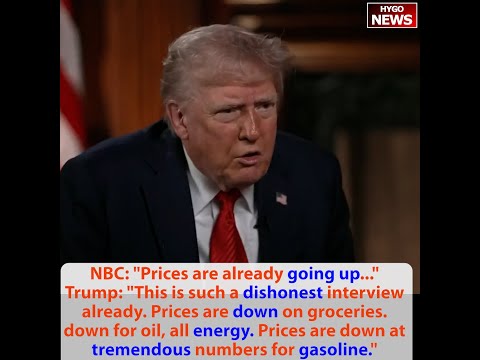
President Trump clashed with NBC in a combative May 2025 interview that covered prices, the Fed, China, and tariffs. When the interviewer claimed “prices are already going up,” Trump fired back: “This is such a dishonest interview. Prices are down on groceries, down for oil, down for all energy, down at tremendous numbers for gasoline.” On Powell: “Why would I remove him? I get to replace him in a short period of time.” On China: “At some point I’m going to lower tariffs because otherwise you can’t do business. Their economy is collapsing.” On the stock market: “Ultimately, I take responsibility for everything. The tariffs are going to make us rich.” He called out NBC for highlighting small businesses while ignoring the auto industry: “The union head said, ‘We’ve been waiting 40 years for somebody to do what Trump is doing.’"
"Such a Dishonest Interview”
The interviewer opened by citing rising prices on “popular items, tires, strollers.”
Trump responded immediately: “This is such a dishonest interview already.”
He listed the data: “Prices are down on groceries. Prices are down for oil. Prices are down for all energy. Prices are down at tremendous numbers for gasoline.”
He identified the cause of Biden-era inflation: “What he did, he spent like a stupid person, which he was. And that was bad for inflation. But what really killed us with inflation was the price of energy.”
The exchange captured the fundamental disconnect between media framing and economic reality. The interviewer cited specific consumer products whose prices had increased due to tariffs — tires and strollers being import-heavy categories. Trump countered with the categories that constituted the largest portions of household spending — groceries, energy, and gasoline — all of which were declining.
Both could be simultaneously true: some imported products were more expensive while the overall cost of living was falling. But the media’s focus on tariff-affected products while ignoring the broader price declines created a misleading picture that Trump refused to accept.
Powell: “Why Would I Do That?”
The interviewer asked about removing Fed Chairman Powell.
“Do you rule out removing the Fed chair on your own power?” the interviewer asked.
Trump responded: “You know, I get to change them very quickly anyway. It’s in a very short period of time.”
The interviewer pressed: “You don’t have plans to remove him before 2026?”
Trump was dismissive: “Why would I do that? I get to replace the person in a short period of time.”
The answer was the most definitive closure Trump had offered on the Powell question. By pointing out that Powell’s term would expire soon regardless, Trump eliminated the rationale for the dramatic step of removal. Why create a constitutional crisis over a personnel decision that would resolve itself through the normal process?
The market implications were stabilizing. Every time Trump ruled out firing Powell, investor anxiety about Fed independence decreased. The consistent message — I don’t like him, but I won’t fire him, and I’ll replace him soon anyway — provided certainty without conceding the policy argument.
”China’s Economy Is Collapsing”
Trump assessed China’s negotiating position with characteristic bluntness.
“You’re not dropping the tariffs against China to get them to the table?” the interviewer asked.
“Why would I do that?” Trump said.
“Would you lower them?”
Trump was candid: “At some point, I’m going to lower them because otherwise you could never do business with them. And they want to do business very much.”
He assessed China’s position: “Look, their economy is really doing badly. Their economy is collapsing.”
The admission that tariffs would eventually be lowered was not a concession — it was an explanation of how negotiations worked. The tariffs at their current elevated levels were pressure. Their eventual reduction would be the reward for Chinese concessions. But the reduction would come on American terms, at American timing, in exchange for American gains.
The “collapsing” characterization of China’s economy was supported by multiple data points: declining exports, rising youth unemployment, a real estate crisis, and capital flight. China needed access to the American consumer market far more than America needed Chinese goods.
”I Take Responsibility”
The interviewer tried the accountability angle.
“You acknowledge when you announced tariffs, the stock market dropped. Do you take responsibility for that?”
Trump’s answer was disarming: “Ultimately, I take responsibility for everything. But I’ve only been here for a little more than three months.”
He cited the recovery: “The stock market — look at what’s happened in the last short period of time. It’s had nine or ten or eleven days in a row where it’s gone up.”
He stated his vision: “The tariffs have just started kicking in. We’re doing really well psychologically. The tariffs are going to make us rich. We’re going to be a very rich country.”
The “I take responsibility for everything” was both a political strength and a debating tactic. By accepting responsibility broadly, Trump eliminated the gotcha — the interviewer couldn’t claim he was dodging accountability. But by immediately pivoting to the recovery, he reframed the responsibility from “I caused the drop” to “I caused the recovery.”
The Auto Union Turnaround
Trump’s strongest argument was the auto industry transformation.
When the interviewer cited small businesses hurt by tariffs, Trump challenged the framing: “Why do you always mention that? You pick out a couple of little businesses. What about the car business? They’re going to make a fortune because of the tariffs.”
He cited the UAW: “The head of the union, who was no fan of mine — Fain, Sean Fain — he didn’t endorse me. Now he’s saying, ‘Wow, what Trump’s done for the automobile — I can’t believe it’s happening. We’ve been waiting 40 years for somebody to do what Trump is doing.’”
He delivered the closing argument: “Why don’t you mention the big car industry instead of somebody doing strollers?”
He stated the fundamental principle: “There are no tariffs if you build your product here. It’s very easy. It’s very simple.”
The Sean Fain endorsement remained the administration’s most powerful political weapon on tariffs. When the head of the United Auto Workers — a Democrat who had endorsed Biden and Harris — praised Trump’s tariff policy, the argument that tariffs hurt workers collapsed.
Key Takeaways
- Trump to NBC: “Such a dishonest interview. Prices are down on groceries, oil, all energy, and gasoline at tremendous numbers.”
- On Powell: “Why would I remove him? I get to replace him in a short period of time” — ruling out pre-2026 action.
- On China: “At some point I’ll lower tariffs. Their economy is collapsing. They want to do business very much.”
- On stock market: “I take responsibility for everything. The tariffs are going to make us rich.”
- Auto union head Fain (who didn’t endorse Trump): “We’ve been waiting 40 years for somebody to do what Trump is doing.”