 HYGO News
 Trump After Liberation Day Market Drop: 'Like a Patient Getting Operated On'; '$6-7 Trillion Coming -- Markets Are Going to Boom'
Trump After Liberation Day Market Drop: “Like a Patient Getting Operated On”; “$6-7 Trillion Coming — Markets Are Going to Boom”
President Trump addressed the market selloff following the Liberation Day tariff announcement on April 3, 2025, comparing the economic adjustment to surgery: “It was an operation — like when a patient gets operated on, and it’s a big thing. I said this would exactly be the way it is.” He projected confidence about the outcome: “We have six or seven trillion dollars coming into our country, and we’ve never seen anything like it. The markets are going to boom, the stock is going to boom, the country is going to boom.” Trump acknowledged the initial market decline as expected and temporary: “The first day in here is because of the terror."
"Like a Patient Getting Operated On”
Trump’s surgical metaphor was the most revealing statement he made about his understanding of the market reaction.
“I think it’s going very well,” Trump said when asked about the day’s market performance. “It was an operation. Like when a patient gets operated on, and it’s a big thing.”
He emphasized that the reaction was predicted: “I said this would exactly be the way it is.”
The surgical analogy was carefully chosen. Surgery was painful, disruptive, and frightening — but it was also necessary and, when successful, produced an outcome far better than the pre-operative condition. The patient (the American economy) was undergoing a procedure (tariff restructuring) that would cause temporary pain (market decline) but would ultimately restore health (industrial revival and trade balance).
The “I said this would exactly be the way it is” claim was significant. Trump was not surprised by the market selloff; he had anticipated it. The acknowledgment that the initial reaction would be negative — and that he had predicted it — was designed to reassure markets that the administration was not panicking, not reconsidering, and not being caught off guard.
”$6 or $7 Trillion Coming”
Trump pivoted from the short-term market reaction to the long-term investment picture.
“We have six or seven trillion dollars coming into our country, and we’ve never seen anything like it,” he said.
The $6-7 trillion figure represented an escalation from the $4 trillion he had cited at the cabinet meeting weeks earlier. The cumulative investment commitments from companies like Apple ($500B), SoftBank/OpenAI/Oracle ($500B), Nvidia (hundreds of billions), TSMC ($100B), Hyundai ($21B), and dozens of others had grown to a scale that dwarfed anything in American economic history.
Trump contrasted the investment inflows with the market’s daily fluctuations: “The thing that people have to talk about — we’re up almost to seven trillion dollars of investment coming into our country, and you’ll see how it’s going to turn out.”
The implicit argument was that investment commitments were a more meaningful indicator of economic direction than daily stock market movements. A company that committed $500 billion to build factories in the United States was making a decision based on a multi-decade time horizon. A stock trader who sold shares on the day tariffs were announced was reacting to a single day’s news. The investors were betting on America’s future; the traders were reacting to the present.
”The First Day Is Because of the Terror”
Trump acknowledged the market decline with characteristic directness.
“Our country is going to boom,” he said. “The markets today are way down. The first day in here is because of the terror.”
The “terror” reference captured the market psychology. Tariffs at the scale Trump had announced were unprecedented in modern history, and markets — which priced in certainty and stability — reacted to the uncertainty of a new trade regime with immediate selling. Investors did not know which specific industries would be affected, how foreign governments would retaliate, or how supply chains would adjust. The unknown was the enemy, and markets sold first and asked questions later.
Trump’s framing treated the decline as a natural first-day reaction that would reverse as the actual effects of the tariffs became clear. The “terror” would subside. The investment would materialize. The factories would be built. And the markets would eventually recognize that an economy with $7 trillion in new investment, a revived manufacturing base, and massive tariff revenue was worth more, not less, than the economy that had preceded it.
”The Rest of the World Wants to Make a Deal”
Trump described the diplomatic dynamic the tariffs had created.
“The markets are going to boom, the stock is going to boom, the country is going to boom,” he said, “and the rest of the world wants to see is there any way they can make a deal.”
He cited the historical grievance: “They’ve taken advantage of us for many, many years. For many years, we’ve been at the wrong side of the ball.”
His prediction: “And I’ll tell you what, I think it’s going to be unbelievable.”
The “make a deal” framing was crucial to understanding the tariffs’ purpose. The reciprocal tariffs were not necessarily intended to be permanent. They were designed to create leverage — to force trading partners to the negotiating table where they would agree to reduce their own barriers to American products. The tariffs were the opening position in a negotiation, not the final outcome.
If countries like Japan, the EU, Australia, and Canada negotiated reductions in their own tariffs on American goods, the reciprocal tariffs would be reduced proportionally. The system created an automatic incentive for bilateral trade deals that benefited both sides. The pain of the initial tariff shock was the price of admission to a fairer trading system.
The Confidence Question
Trump’s repeated assertions of confidence — “going to boom,” “going to be unbelievable,” “you’ll see how it’s going to turn out” — served a specific economic function beyond political messaging. Presidential confidence affected market psychology. If the president had expressed doubt about the tariff policy in the face of a market selloff, the decline would have accelerated as investors concluded the administration might reverse course.
By projecting absolute certainty that the policy would succeed, Trump was providing a floor of confidence that prevented panic from feeding on itself. Markets needed to believe that the tariff policy was stable and that the administration would not abandon it at the first sign of market distress. Trump’s emphatic repetition of “boom” — markets, stocks, country — was designed to establish that stability.
The surgical metaphor reinforced this message. A surgeon does not stop an operation because the patient’s vital signs temporarily worsen during the procedure. The temporary deterioration is expected, managed, and ultimately resolved as the operation succeeds. Trump was telling the markets: the operation is proceeding as planned, the short-term pain is expected, and the long-term outcome will be extraordinary.
Departure for Florida
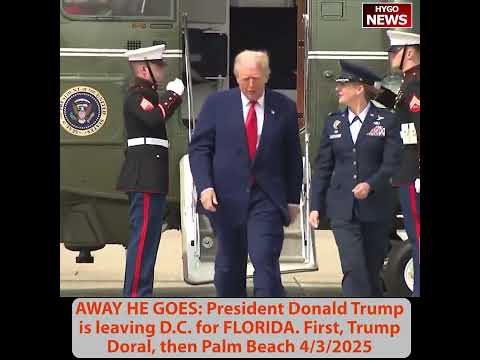
The clip concluded with Trump departing Washington for Florida — first to Trump Doral, then to Palm Beach. The departure itself was a statement of normalcy. The president was not hunkered down in the White House monitoring markets; he was proceeding with his schedule. The message was that Liberation Day was a policy action, not a crisis, and the president’s daily life would not be disrupted by market reactions to decisions he had made deliberately and with full anticipation of their short-term effects.
Key Takeaways
- Trump compared the post-tariff market selloff to surgery: “Like a patient getting operated on. I said this would exactly be the way it is.”
- He cited $6-7 trillion in investment commitments: “We’ve never seen anything like it. The markets are going to boom.”
- Trump acknowledged the market decline: “The first day in here is because of the terror” — but treated it as temporary and expected.
- He said foreign countries “want to see if there’s any way they can make a deal” — framing tariffs as leverage for negotiation, not permanent barriers.
- Trump’s repeated “boom” predictions served to stabilize market confidence: “The stock is going to boom. The country is going to boom. It’s going to be unbelievable.”