 HYGO News
 Trump on Musk: 'I Wish Him Well -- Hope He Does Well with Tesla'; Won't Revoke WH Key: 'No, I Don't Take Things Back'; On DOGE: 'It Helped Us a Lot -- Many People Remain with Us, We Saved Hundreds of Billions'; On NYT Drug Article: 'Sounded Very Unfair to Him'; 'I'm Not Thinking About Elon' -- Working on China, Russia, Iran
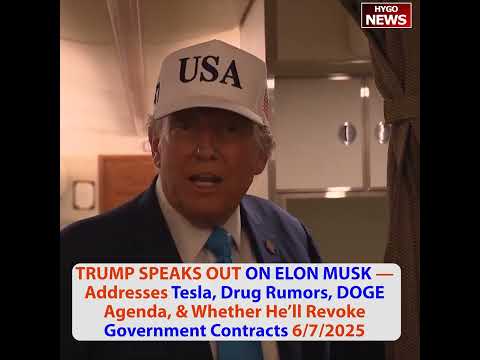
Trump on Musk: “I Wish Him Well — Hope He Does Well with Tesla”; Won’t Revoke WH Key: “No, I Don’t Take Things Back”; On DOGE: “It Helped Us a Lot — Many People Remain with Us, We Saved Hundreds of Billions”; On NYT Drug Article: “Sounded Very Unfair to Him”; “I’m Not Thinking About Elon” — Working on China, Russia, Iran
In June 2025, President Trump addressed multiple questions about Elon Musk in a single session, providing a comprehensive view of the evolving relationship. On canceling Musk’s government contracts: “Well, we’ll take a look at everything. He gets a lot of subsidy — only if it’s fair for him and for the country, but it has to be fair.” On reopening investigations: “I didn’t know that they had any. I would just let them speak for themselves. I have no idea whether or not they have investigations.” On concerns about Musk’s alleged drug use: “I don’t want to comment on that. I read an article in the NYT and, frankly, it sounded very unfair to him.” On whether he wanted to take back the White House key he’d given Musk: “No, I don’t take things back. I gave him a key because he tried very hard.” On Musk’s DOGE work: “Oh, I think it helped us a lot. It’s not finished at all. We’ve basically taken it over, and many people remain with us. We saved hundreds of billions of dollars.” On the White House Tesla: “I haven’t thought about it. I hope he does well with Tesla.” Asked if he’d heard from Musk: “Honestly, I’ve been so busy working on China, working on Russia, working on Iran. I’m not thinking about Elon. I just wish him well.” On reunification efforts: “I’ve been asked about it, but I’m not really interested in that. I’m really interested in the country and solving problems.”
Trump on Contract Review
A reporter asked about canceling Musk’s government contracts.
“And it could way to save money, be to cancel some of Musk’s contracts. How seriously are you considering that?” the reporter asked.
Trump’s response: “Well, we’ll take a look at everything. I’ll look at everything.”
He acknowledged the subsidies: “He’s got a lot of money. He gets a lot of subsidy, so we’ll take a look at that.”
He added the qualifier: “Only if it’s fair, only if it’s fair for him and for the country, I wouldn’t certainly think about it, yeah?”
He emphasized: “But it has to be fair.”
The Contract Review Framework
Trump’s approach was measured and professional.
What he didn’t do:
- Commit to canceling contracts
- Threaten revocation
- Retaliate against Musk
- Use contracts as weapon
- Act impulsively
What he did:
- Acknowledge he’d review
- Emphasize fairness criterion
- Noted bilateral interest
- Maintained flexibility
- Avoided personal animosity
Why this mattered:
- Government contracts shouldn’t be politicized
- Fair evaluation is the standard
- Business decisions not personal vendettas
- Good government practice
- Maintains institutional integrity
The practical reality:
- Some Musk contracts would continue
- Some might be reviewed
- Evaluation based on merits
- National interest primary consideration
- Not political retaliation
Reopening Investigations
Another reporter asked about company investigations.
“You consider reopening investigations into his companies?”
Trump’s response: “They know that they had any, but they had to…”
He continued: “I would just let them speak for themselves. I had no idea… excuse me, I have no idea whether or not they had the investigation.”
The Investigation Question
Trump’s response was notably cautious.
What reporter was asking:
- Tesla had faced various regulatory investigations
- SpaceX faced FAA issues
- Other companies had various proceedings
- Would Trump weaponize these?
- Was personal conflict driving policy?
Trump’s answer:
- Genuine uncertainty about status
- No interference plans
- Normal regulatory process
- No political direction
- Institutional respect
Why this was politically smart:
- Avoided appearing vindictive
- Preserved regulatory independence
- Professional distance
- Unlike Biden administration’s SpaceX investigations
- Contrast with opponents’ behavior
”I’m Not Thinking About Elon”
A reporter pushed further on Musk.
“And what’s your view on Elon Musk as of today? I mean, have you heard from him at all?” the reporter asked.
Trump’s characteristic response: “Honestly, I’ve been so busy working on China, working on Russia, working on Iran, working on so many…”
He delivered the key line: “I’m not thinking about Elon. You know, I just wish him well, you know.”
The “Not Thinking About Him” Framing
This was strategic political positioning.
What Trump achieved:
- Minimized Musk’s political significance
- Emphasized his own priorities
- Denied emotional investment
- Left door open for relationship
- Professional detachment
The foreign policy priorities:
- China: trade, Taiwan, security
- Russia: Ukraine peace, sanctions
- Iran: nuclear, regional security
- Major geopolitical work
- Genuine presidential priorities
The message to Musk:
- Not obsessed with his opposition
- Have bigger priorities
- Not going to war over disagreement
- Door remains open
- Time heals
The message to audience:
- Trump is focused on substance
- Not distracted by personal drama
- Presidential rather than petty
- Major work continues
- Coalition-building approach
The Survival Question
A reporter asked a substantive question.
“So, Elon, Mr Musk’s contracts, do you feel like the U.S. can survive without them? Obviously, you can trip too long when it comes to defense and space, and that relationship has been important for quite some time.”
Trump’s answer: “Yeah, I think so. The U.S. can survive without almost anybody.”
He paused, then added the zinger: “Except me."
"Except Me”
The “except me” line was classic Trump.
What it captured:
- Self-confidence
- Recognition of his unique role
- Humor in serious context
- Reality of executive power
- Political leadership
The underlying truth:
- Trump was unique political phenomenon
- No other Republican could have won 2024
- Built the coalition
- Drove the agenda
- Irreplaceable politically
The contrast with Musk:
- Musk valuable but replaceable
- Others can contribute similar value
- Space industry has alternatives
- Defense has alternatives
- Presidential leadership doesn’t
The humor function:
- Self-deprecating but confident
- Broke serious tone
- Made audience laugh
- Defused tension
- Trump at his best
The Drug Article Question
A reporter asked a sensitive question.
“Did you have any concerns about his drug use when he was working for you?”
Trump’s response was careful: “I don’t want to comment on his drug use. I don’t know what his status is.”
He added context: “I read an article in The New York Times. I thought it was, frankly, it sounded very unfair to him.”
The NYT Drug Article
The specific NYT article had been controversial.
What the article alleged:
- Musk’s drug use
- Ketamine usage
- Various other substances
- Personal behavior
- During time working with Trump administration
Why Trump defended Musk:
- NYT had previously attacked Trump with similar tactics
- Pattern of manufactured concerns
- Selective reporting
- Political motivation clear
- Journalistic malpractice suspected
Trump’s measured response:
- Didn’t deny allegations (couldn’t know)
- Didn’t attack Musk personally
- Criticized the NYT article
- Defended Musk’s general reputation
- Showed loyalty even in conflict
Why this mattered:
- Demonstrated Trump’s character
- Even in disagreement, defended ally
- Not vindictive
- Recognized NYT pattern
- Maintained some dignity in conflict
The Misspoken “Problem”
A reporter asked about Trump’s earlier “problem” comment.
“You said earlier today that Mr Musk had a problem. What did you mean by that? And did you misjudge him by bringing him…”
Trump pivoted: “I don’t want to talk about problems.”
He delivered his preferred framing: “I think that my… I think the United States had problems. And if you look at the numbers today, the numbers were unbelievable.”
The Economic Pivot
Trump skillfully pivoted from personal topics to economic success.
“The numbers were incredible. The numbers that came up today, the stock market went way up. The country is doing really well.”
He extended: “Almost, I think, in a very short period of time, you’re going to be saying, doing better than it’s ever done before.”
He cited specific data: “We have hundreds of plants coming in, plants. A lot of jobs are being created. That’s what happened this morning. You saw them jobs.”
He noted the quality: “And the nice part, they’re not government jobs. They’re jobs of people coming in and doing other things, including the leisure hotel and leisure. Good stuff.”
The Substantive Economic Success
Trump shifted the conversation to success.
“A lot of good things are happening with our country. We’re taking in billions of dollars of tariff money. The money is pouring in.”
He emphasized the growth potential: “And it hasn’t even started yet, really, relatively. We’re going to have a very successful country very soon. And very strong bill.”
The Pivot Strategy
Trump’s pivot demonstrated political skill.
Why the pivot worked:
- Media focus on Musk distracted from accomplishments
- Economic success was the real story
- Voters cared about results
- Trump could redirect narrative
- Control of conversation
The key facts Trump cited:
- Stock market up
- Plants coming in (hundreds)
- Jobs being created
- Tariff money flowing
- Private sector growth
The political effect:
- Musk story minimized
- Success story emphasized
- Voters see positive news
- Policy achievements highlighted
- Media couldn’t sustain Musk focus
The White House Key
A reporter asked about the symbolic gift.
“Mr. President, you gave Elon Musk when he left the White House a key, symbolically, to the White House, to the administration in large. I think that’s what… Would you like him to give that back?”
Trump’s response: “No, I don’t take things that I don’t know. I gave him a key. He tried very hard with the Tesla.”
The Character Moment
Trump’s refusal to take back the key was character-revealing.
What this showed:
- Not petty
- Doesn’t reverse gestures
- Honors commitments
- Appreciates effort
- Classy handling
The contrast with critics:
- Democrats often retaliated over disagreements
- Trump critics canceled personal relationships
- Cancel culture common
- Forgiveness rare
- Trump’s approach different
The practical effect:
- Preserves future relationship potential
- Doesn’t burn bridges
- Sends signal to other potential allies
- Maintains dignity
- Political capital preserved
Why “I don’t take things back”:
- Signaled character trait
- Not specific to Musk
- Broader principle
- Reliable ally characteristic
- Presidential demeanor
DOGE Assessment
A reporter asked about DOGE’s effectiveness.
“How do you think his doge did at the end of the day with the savings?”
Trump’s enthusiastic response: “Oh, I think it helped us a lot. I think it helped our thinking.”
He extended: “And it’s not finished at all. We’re basically taking it over. We’re doing a job. Many of those people remain with us. And they’re going to remain with us. They’re very good.”
He delivered the numerical summary: “It’s terrific. We saved hundreds of billions of dollars. It’s terrific. And it’s going further.”
He offered measured perspective: “I mean, I’d give you the answer, actually, at the end of two years, because a lot of it is out into the future. But it was a big saving and a good mindset.”
The DOGE Legacy
Trump’s DOGE framing was significant.
What he acknowledged:
- Musk’s contribution was valuable
- Savings were substantial
- Work continues
- Personnel still in place
- Legacy secured
What he emphasized:
- Not finished (administration continues)
- “We’ve basically taken it over”
- Former Musk team integrated
- Results building over time
- Full accounting in 2 years
The political message:
- DOGE success independent of Musk
- Administration commitment continues
- Personnel loyal to mission
- Reform process institutionalized
- Won’t be undone by Musk departure
The specific numbers:
- “Hundreds of billions” saved
- Going “further”
- Two-year full accounting
- Continued progress
- Bigger picture emerging
The Tesla Question
A reporter asked about the White House Tesla.
“What do you do as a Tesla? Are you going to keep it or are you going to…”
Trump’s casual response: “I haven’t thought about it.”
He added: “I hope he does well with Tesla.”
The Specific Tesla Context
The “White House Tesla” referred to a specific vehicle.
The Tesla background:
- White House had acquired Tesla during Musk’s DOGE service
- Symbolic of Trump-Musk alliance
- Pro-American electric vehicle
- Visible presidential endorsement
- Specific vehicle in fleet
Why the question mattered:
- If Trump kept Tesla, normalcy maintained
- If Trump disposed of it, feud signaled
- Symbolic importance beyond practical value
- Media would analyze either way
- Statement opportunity
Trump’s “I haven’t thought about it”:
- Minimized importance
- Not obsessed with Musk details
- Vehicle not priority
- Practical rather than symbolic
- Avoided making bigger story
The Reporters and Rumors
A reporter asked about outreach efforts.
“Do you have any plans to speak with Mr. Musk? This was one of your closest advisors for months.”
Trump’s direct response: “I don’t have any plans.”
He added context: “Somebody made a mistake. A lot of reporters have been calling me. I didn’t call any reporter. A lot of reporters, they asked me the same question. No, I’m not even thinking about that.”
The Reunification Rumors
A reporter asked about specific reunification efforts.
“There apparently were these efforts. This is what I read, to bring you guys, you and Elon back together. Those efforts are… Where are they…?”
Trump’s response: “There are efforts. I mean, I’ve been asked about it, but I’m not really interested in that.”
The “Not Really Interested” Framing
Trump’s lack of interest was strategic.
What he was signaling:
- Not desperate for Musk reconciliation
- Administration successful without him
- Self-respect intact
- Musk needed to come to him
- Power dynamics clear
The negotiating leverage:
- If Trump pursued reconciliation: weakness
- If Musk pursued it: Trump can accept or decline
- Position of strength
- Let Musk reconsider
- Natural outcome
The practical reality:
- Third parties involved
- Trump not leading efforts
- Not personally engaged
- Low priority
- Business partners could facilitate
The Presidential Priorities
Trump redirected to actual priorities.
“I’m really interested in the country and solving problems, including war problems in very far away lands. A lot of people being killed.”
He pivoted to historical framing: “When I left, we had no problem. We didn’t have wars. We defeated ISIS 100%. Iran was broke. There was no Hamas problem. There was no Hezbollah problem.”
He extended: “Israel wouldn’t have happened, in other words. Russia, Ukraine wouldn’t have happened. We had no inflation.”
The Current Foreign Policy Success
Trump’s framing emphasized current success.
What he was claiming:
- October 7 wouldn’t have occurred under his leadership
- Russia wouldn’t have invaded Ukraine
- ISIS defeated during his tenure
- Iran was economically isolated
- Hamas and Hezbollah contained
The historical record:
- Trump did destroy ISIS territorial caliphate
- Iran sanctions were maximum pressure
- Abraham Accords produced stability
- No major new wars during first term
- Record generally supported claims
Why this mattered now:
- Current wars (Ukraine, Gaza) under Trump’s watch to resolve
- Iran nuclear crisis ongoing
- Russia continuing aggression
- Making progress but not complete
- Serious presidential priorities
The Inflation Point
Trump concluded with economic point.
“And by the way, we have no inflation now. And if we had a good Fed chairman, you would lower rates. And you know what? If inflation happened in a year from now, we’re two years, let them raise rates.”
The Fed Rate Debate
Trump consistently pushed Fed chair Powell on rates.
Trump’s argument:
- Inflation is low now
- Fed should cut rates
- Higher rates unnecessarily restrict economy
- Powell too cautious
- Rates could rise if needed later
Powell’s position:
- Maintain rates steady
- Wait for clearer inflation trajectory
- Err on the side of caution
- Independence from political pressure
- Data-dependent approach
The fundamental tension:
- Trump wanted growth maximization
- Powell wanted inflation control
- Different time horizons
- Different risk tolerances
- Political vs. technocratic frames
The ongoing Fed rate dispute was an important part of Trump’s economic management challenges.
Key Takeaways
- Trump on canceling Musk’s contracts: “We’ll take a look. Only if it’s fair for him and for the country.”
- Trump won’t take back WH key: “No, I don’t take things back. I gave him a key because he tried very hard.”
- On Musk’s DOGE work: “Helped us a lot. We saved hundreds of billions of dollars. Not finished, we’ve basically taken it over.”
- On NYT drug article: “Sounded very unfair to him.”
- Trump’s pivot: “I’m not thinking about Elon. I’m really interested in the country and solving problems.”